

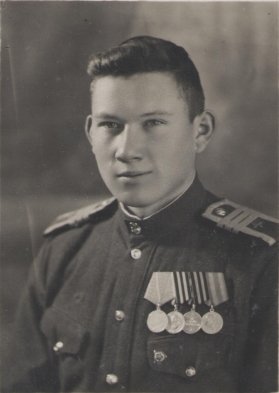


Luginin Ivan Petrovich
CITY: village Kurai Semenovskiy s / s Shabalinsky district, Kirov region. DATE OF BIRTH: 05/08/1915 DATE OF DEATH: 03/01/1980 HISTORY: Type of troops: Technical troops (Chemical Troops,Railway Troops,Radio-radar Troops, Long Waves,topographic) Ivan Petrovich Luginin, was the 3rd child in the family. He grew up without a father, since his father, Pyotr Dmitrievich Luginin, died in the 1st World War in February 1916. From early childhood he learned all the hardships of peasant labor: he plowed and sowed, prepared fodder for livestock, mastered many crafts, without which one cannot live in a village. In September 1936, he was drafted into the ranks of the Red Army by the Kotelnichesky RKK for active service, where he acquired the specialty of a driver-mechanic. He served in Siberia in a chemical platoon. In December 1938, after serving, he returned home. He immediately became involved in peasant work. Soon he began to work as a tractor driver on a wheeled tractor. On June 24, 1941, my father was mobilized to the front. He was the driver of a chemical warfare vehicle in a separate chemical battalion (OCB). On November 7, 1941, he took the oath of office at the 36th separate chemical defense battalion. From May 1942 he continued his combat path in the 14th separate chemical battalion. On May 9, 1945, the war was not over for him. Their 14th separate chemical defense battalion was deployed to the Far East. After the end of the war with Japan on October 22, 1945, he was demobilized. But he did not stay at home for long, since after chemical poisoning (his participation in the Japanese war lasted only 9 days, and then, chemical poisoning and a military hospital) on October 22, he was demobilized and sent to the Gorky hospital to continue treatment. He drove home for a few days (he did not tell his family about the departure, but reported about a short vacation),left for the city of Gorky and returned home only in February 1946, after treatment in one of the Gorky hospitals (there was a certificate from the hospital about the treatment, but at the end of the 60s it disappeared somewhere, the father said that he gave it to the district hospital when he was given a disability group .) Began to work on a collective farm. In the fall of 1946 he was elected chairman of the Kuraevsky collective farm. In this position he worked until 1951, when small collective farms began to enlarge. In different years he was both a foreman and a groom. He did carpentry, was a joiner, beat off the braids of collective farmers, mending home shoes, even learned how to roll felt boots for household members. I also sewed sheepskin coats and quilts for myself, breeches. Many asked him to sew the same for them. In the winter, he left for several weeks to harvest timber for the state. They prepared in advance for the trip to the plot: they baked bread and dried crackers, frozen milk and sour cream. In 1960, after moving to the village of Cherpaki in the Svechinsky District, he began to work as a driver in a ZIL-5 car at the Krasnaya Zarya collective farm. After the transfer of the lands of the Cherpaki village from the collective farm to the Kotelnichesky feed-lot farm (in 1965), my father began to work as a tractor driver on a DT-54 tractor. In 1968 he moved to the urban-type settlement Svecha. His health deteriorated, and he was taken to the disability group. I got a job as a watchman in the Svechinsky cattle. Overwork from childhood and service in the chemical troops affected health. In 1980, after a long illness at the age of 65, his father died of pulmonary (one lung was removed in the mid-70s) and heart failure.
0 comment



2026 © Russian Military Historical Society Developed by Jetmix