

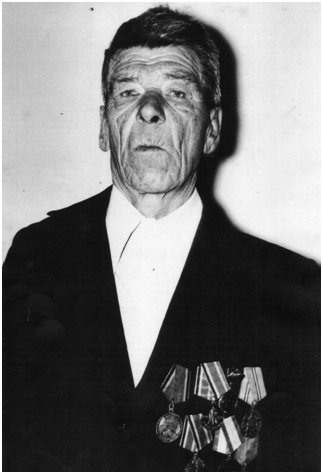




Artser Alexander Valentinovich
CITY: the former village of Seewald, Frankish canton, Saratov region, Autonomous Soviet Socialist Republic of Volga Germans; now the village of Verkhovskoye (Verkhovka), Aleshninsky village settlement, Zhirnovsky district DATE OF BIRTH: 12/28/1918 DATE OF DEATH: 01/09/1997 HISTORY: My grandfather Artser Alexander Valentinovich was born into a large German peasant family. In 1931, the entire Arzer family (the kulak family) was evicted from the Saratov region (Autonomous Soviet Socialist Republic of the Volga Germans) for a special settlement in the Dzhambul region of the Kazakh SSR as dispossessed. He began his pre-war labor activity in 1940 as a primary school teacher in a rural school. He knew 2 languages: German and Russian. In 1941, grandfather Sasha was 23 years old. Soviet ethnic Germans during the Second World War were considered unreliable, which is why my grandfather was mobilized into the labor army, in the 2nd stage, according to the Decree of the State Defense Committee of the USSR No. 1123ss dated 01/10/1942. This document obliged People’s Commissariat to mobilize for work in logging, industrial and railway construction 120 thousand German men aged 17-50 years from among those deported from the Volga region to many regions, including the Kazakh SSR. On May 17, 1942, grandfather was drafted into the labor army of the Sairam Military Commissariat and sent to the disposal of the head of Bakalstroy of the NKVD as part of a team of 17 Germans. From June 1942 to the end of November 1946, my grandfather worked as an assistant train driver, a worker in logging, in stone quarries. From the recollections of grandfather Sasha: “... it was a difficult time. The physical strength of the strongest, healthiest person and the psychological mood were exhausted,“ strangled. ”Not everyone could withstand forced labor service as part of the German workers, regardless of the object of work, the barracks position , fenced-in guarded "zones" with a military routine, illness, death, fear, humiliation, bullying, the status lowered by the authorities to the level of prisoners. Work in the labor army became both a Feat and a Tragedy. It was necessary to forge Victory over the enemy in conditions of mistrust and isolation " ... In 1946, grandfather Sasha was demobilized. He returned to the Dzhambul region of the Kazakh SSR (the surviving Germans from the labor army were allowed to return only to the places of eviction where their relatives were) and was in a special settlement until July 1954, after which he was released from the special settlement and received an unlimited passport. My grandfather immediately went to work as a handyman. In the bitter frosts, he prepared firewood, in the summer heat he worked in the field, helped grow vegetables, mowed hay. After a hard day at work, in the evenings I played the balalaika, without knowing the musical notation. He had an excellent ear for music and a beautiful voice. Perhaps one of these releases helped him forget all that past, difficult times that weakened people. He got married in 1948. Wife - Elena Konstantinovna Yatsenko, born in 1922, a native of the Sumy region, Ukrainian SSR, Ukrainian by nationality. In July 1941, she was evacuated from Kiev to the Kazakh SSR, Dzhambul region. In 1950, my daughter Valentina (my mother) was born. On July 20, 1954, the grandfather was released from the special settlement together with his wife and children. From the enormous responsibility to his family, parents, and most likely from the enormous peasant industriousness inherent in the genes, grandpa was able to be a persistent, strong and resilient person. His labor activity is large and versatile - the department of the regional trade in the position of a store manager; malaria station - booster instructor; at Machine and Tractor station - coppersmith and combine operator; Artel named after N.K. Krupskaya - foreman, upon completion - builder; Agrigate Plant, further Dzhuvalinsky rayavtodor - foreman (work experience -30 years). For his conscientious work, my grandfather Sasha received many awards and distinctions, letters of thanks: the medal "For Valiant Labor in the Great Patriotic War of 1941-1945", the medal "50 Years of Victory in the Second World War", the "Veteran of Labor" medal, the badge "Winner of the socialist competition in 1975", badge "Honorary road worker of the Kazakh SSR", etc. The memory of my grandfather Alexander, a labor army soldier is immortalized in the Form of open archival data "Open list of victims of political repression in the USSR", as well as on the pages in the book of memory of the project Gedenkbuch ", dedicated to the largest forced labor camp for labor-mobilized Germans in the USSR.
0 comment



2026 © Russian Military Historical Society Developed by Jetmix