


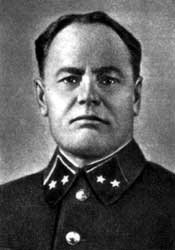
Gorodnyanskiy Avksentyi Mikhailovich
Rank: Lieutenant General Type of Troops: Ground Forces, Air Force (except naval aviation), coastal service, NKVD troops, border troops Subdivision: 129th Infantry Division (1st formation). Avksentiy Mikhailovich Gorodnyansky in the Russian army since 1915, senior non-commissioned officer. Member of the First World War on the Western and Romanian fronts, platoon commander. In the Red Army since 1918, he graduated from the Oryol infantry courses (1919), the Shooting-tactical advanced training courses for the command staff of the Red Army "Shot" them. Comintern (1924). During the Civil War A. M. Gorodnyansky fought on the Southern and Eastern fronts, the commander of a partisan detachment, company, rifle regiment. In the interwar period A. M. Gorodnyansky - company commander, assistant to the head of the school, head and political instructor of the regimental school, assistant to the regiment commander for economic and combat units, battalion, regiment commander, 101st Kamchatka Rifle Division. From October 1940 A.M. Gorodnyansky was the commander of the 129th Infantry Division of the 2nd Red Banner Army of the Far Eastern Front. With the beginning of the Great Patriotic War, the division as part of the 19th Army was in the reserve of the Supreme Command Headquarters. In early July 1941 the army was transferred to the Western Front and took part in defensive battles in the Vitebsk direction. At the end of July, the division was transferred to the 16th Army of this front and participated in the Smolensk battle. Since the end of August, A.M. Gorodnyansky, commander of the 13th Army of the Bryansk Front, in which he fought defensive battles at the mouth of the river. Gum. In the Oryol-Bryansk defensive operation, which was an integral part of the battle near Moscow, the 2nd tank group of the enemy broke through the front of the 13th army east of Shostka and, developing an offensive to the north and northeast, surrounded it and the troops of the 3rd army in area of Trubchevsk. The fascist German command to eliminate the encircled Soviet troops threw four of the five corps of this group. However, the enemy failed to complete this task. Troops of the 13th Army under the command of A.M. Gorodnyansky in an organized manner left the encirclement at night, in the direction indicated by the front command. For a breakthrough from the encirclement, A. M. Gorodnyansky created a shock group of rifle divisions and a rearguard up to one rifle division. By October 23, the troops of the 3rd and 13th armies broke through from the encirclement and withdrew to the Belev, Mtsensk, Fatezh, Lgov line. In November, the 13th Army was transferred to the Southwestern Front, fought defensive battles in the Voronezh direction and by December 5 withdrew to the line southeast of the city of Efremov, east of Yelets, Volovo. In these defensive battles, the troops of the army under the command of A.M. Gorodnyansky showed the greatest resilience and activity. With the beginning of the counteroffensive near Moscow, the army took part in the Yelets offensive operation. According to the decision of the front command, the operational group of General F. Ya. Kostenko was to deliver the main attack south of Yelets in the general direction to Livny, and the 13th Army - an auxiliary strike bypassing Yelets and north-west to Lamskoye. A.M. Gorodnyansky created a shock group consisting of one rifle and one cavalry divisions, rifle and tank brigades, which on December 6 went over to the offensive, fettered the enemy with their attacks and diverted his attention from the direction of the main attack of the front. In this operation, A. M. Gorodnyansky displayed high military skill and firmness in commanding army formations. Army troops liberated the town of Yelets and, developing the offensive, advanced 80-100 km, ensuring the success of the troops of the right wing of the front. 13 December 1941 A.M. Gorodnyansky was appointed commander of the 6th Army of the Southwestern Front, which took part in Barvenkovo-Lozovskaya offensive operation. In this operation, the army operated in the direction of the main attack of the adjacent wings of the Southwestern and Southern fronts, together with the 57th and 37th armies in the direction of the city of Zaporozhye. The operation was carried out with the aim of encircling and routing the enemy's Donbass grouping. A. M. Gorodnyansky concentrated the main forces of the army on the right flank of the operational formation. With the beginning of the operation, the army broke through the enemy's defenses and, having introduced the 1st Cavalry Corps into the battle, developed an offensive in the direction of Plesovaya. In the first four days of the operation, the army, in cooperation with the 57th Army, advanced to a depth of 30 km, ensuring the capture of the city of Barvenkovo by the troops of the Southern Front. However, the enemy stubbornly held the areas of the years. Balakleya and Slavyansk, preventing the expansion of the breakthrough to the sides of the flanks. In the course of subsequent hostilities, the army under the command of A. M. Gorodnyansky took part in the Kharkov battle (May 1942). The offensive of the troops of the Southwestern Front in this operation was carried out in order to defeat the Kharkov enemy grouping, liberate the city and create conditions for an offensive on the city of Dnepropetrovsk. The offensive of the front troops began on May 12. For 3 days the southern strike group of the front, consisting of the 6th Army and the operational group of Major General LV Bobkin, advanced 25-50 km. Favorable conditions were created for the introduction of mobile units into battle in order to develop success.However, the front command, misled by information about the concentration of a large enemy tank grouping in the area of Zmiev (Gottwald), delayed the entry of six tank corps. This played a fatal role in the heavy defeat of our troops near the city of Kharkov. At the same time, it should be noted the high military art shown by the German command, which struck with the forces of the 51st Army Corps from the north in the direction of Balakleya, Petrovsky, and the army group of General Kleist as part of the 1st Tank and 17th Armies from the south in the general direction to Petrovskoe. Both groups united south of Balakleya. The troops of the 6th and 57th armies, two tank and one cavalry corps were surrounded. Soviet troops under the command of A. M. Gorodnyansky fought heroically, trying to break out of the enemy ring. Thus, the incorrect assessment by the command of the Southwestern and Southern Fronts of the operational-strategic situation, poorly organized reconnaissance and interaction of troops, the lack of foreseeing the course of hostilities, the belated introduction of tank corps into battle led to large losses of our troops in manpower and equipment. The troops of the 6th and 57th armies and the army task force of General L.V. Bobkin were defeated, and A. M. Gorodnyansky, when leaving the encirclement, died in battle on May 27, 1942 at the Barvenkovo bridgehead. He was buried by the Germans on the khutor Orlinoyarsk, Petrovsky district, Kharkiv region, after the liberation of the Kharkiv region, reburied in Kharkov at the Pushkin cemetery.
Gorodnyanskiy Avksentyi Mikhailovich
Rank: Lieutenant General Type of Troops: Ground Forces, Air Force (except naval aviation), coastal service, NKVD troops, border troops Subdivision: 129th Infantry Division (1st formation). Avksentiy Mikhailovich Gorodnyansky in the Russian army since 1915, senior non-commissioned officer. Member of the First World War on the Western and Romanian fronts, platoon commander. In the Red Army since 1918, he graduated from the Oryol infantry courses (1919), the Shooting-tactical advanced training courses for the command staff of the Red Army "Shot" them. Comintern (1924). During the Civil War A. M. Gorodnyansky fought on the Southern and Eastern fronts, the commander of a partisan detachment, company, rifle regiment. In the interwar period A. M. Gorodnyansky - company commander, assistant to the head of the school, head and political instructor of the regimental school, assistant to the regiment commander for economic and combat units, battalion, regiment commander, 101st Kamchatka Rifle Division. From October 1940 A.M. Gorodnyansky was the commander of the 129th Infantry Division of the 2nd Red Banner Army of the Far Eastern Front. With the beginning of the Great Patriotic War, the division as part of the 19th Army was in the reserve of the Supreme Command Headquarters. In early July 1941 the army was transferred to the Western Front and took part in defensive battles in the Vitebsk direction. At the end of July, the division was transferred to the 16th Army of this front and participated in the Smolensk battle. Since the end of August, A.M. Gorodnyansky, commander of the 13th Army of the Bryansk Front, in which he fought defensive battles at the mouth of the river. Gum. In the Oryol-Bryansk defensive operation, which was an integral part of the battle near Moscow, the 2nd tank group of the enemy broke through the front of the 13th army east of Shostka and, developing an offensive to the north and northeast, surrounded it and the troops of the 3rd army in area of Trubchevsk. The fascist German command to eliminate the encircled Soviet troops threw four of the five corps of this group. However, the enemy failed to complete this task. Troops of the 13th Army under the command of A.M. Gorodnyansky in an organized manner left the encirclement at night, in the direction indicated by the front command. For a breakthrough from the encirclement, A. M. Gorodnyansky created a shock group of rifle divisions and a rearguard up to one rifle division. By October 23, the troops of the 3rd and 13th armies broke through from the encirclement and withdrew to the Belev, Mtsensk, Fatezh, Lgov line. In November, the 13th Army was transferred to the Southwestern Front, fought defensive battles in the Voronezh direction and by December 5 withdrew to the line southeast of the city of Efremov, east of Yelets, Volovo. In these defensive battles, the troops of the army under the command of A.M. Gorodnyansky showed the greatest resilience and activity. With the beginning of the counteroffensive near Moscow, the army took part in the Yelets offensive operation. According to the decision of the front command, the operational group of General F. Ya. Kostenko was to deliver the main attack south of Yelets in the general direction to Livny, and the 13th Army - an auxiliary strike bypassing Yelets and north-west to Lamskoye. A.M. Gorodnyansky created a shock group consisting of one rifle and one cavalry divisions, rifle and tank brigades, which on December 6 went over to the offensive, fettered the enemy with their attacks and diverted his attention from the direction of the main attack of the front. In this operation, A. M. Gorodnyansky displayed high military skill and firmness in commanding army formations. Army troops liberated the town of Yelets and, developing the offensive, advanced 80-100 km, ensuring the success of the troops of the right wing of the front. 13 December 1941 A.M. Gorodnyansky was appointed commander of the 6th Army of the Southwestern Front, which took part in Barvenkovo-Lozovskaya offensive operation. In this operation, the army operated in the direction of the main attack of the adjacent wings of the Southwestern and Southern fronts, together with the 57th and 37th armies in the direction of the city of Zaporozhye. The operation was carried out with the aim of encircling and routing the enemy's Donbass grouping. A. M. Gorodnyansky concentrated the main forces of the army on the right flank of the operational formation. With the beginning of the operation, the army broke through the enemy's defenses and, having introduced the 1st Cavalry Corps into the battle, developed an offensive in the direction of Plesovaya. In the first four days of the operation, the army, in cooperation with the 57th Army, advanced to a depth of 30 km, ensuring the capture of the city of Barvenkovo by the troops of the Southern Front. However, the enemy stubbornly held the areas of the years. Balakleya and Slavyansk, preventing the expansion of the breakthrough to the sides of the flanks. In the course of subsequent hostilities, the army under the command of A. M. Gorodnyansky took part in the Kharkov battle (May 1942). The offensive of the troops of the Southwestern Front in this operation was carried out in order to defeat the Kharkov enemy grouping, liberate the city and create conditions for an offensive on the city of Dnepropetrovsk. The offensive of the front troops began on May 12. For 3 days the southern strike group of the front, consisting of the 6th Army and the operational group of Major General LV Bobkin, advanced 25-50 km. Favorable conditions were created for the introduction of mobile units into battle in order to develop success.However, the front command, misled by information about the concentration of a large enemy tank grouping in the area of Zmiev (Gottwald), delayed the entry of six tank corps. This played a fatal role in the heavy defeat of our troops near the city of Kharkov. At the same time, it should be noted the high military art shown by the German command, which struck with the forces of the 51st Army Corps from the north in the direction of Balakleya, Petrovsky, and the army group of General Kleist as part of the 1st Tank and 17th Armies from the south in the general direction to Petrovskoe. Both groups united south of Balakleya. The troops of the 6th and 57th armies, two tank and one cavalry corps were surrounded. Soviet troops under the command of A. M. Gorodnyansky fought heroically, trying to break out of the enemy ring. Thus, the incorrect assessment by the command of the Southwestern and Southern Fronts of the operational-strategic situation, poorly organized reconnaissance and interaction of troops, the lack of foreseeing the course of hostilities, the belated introduction of tank corps into battle led to large losses of our troops in manpower and equipment. The troops of the 6th and 57th armies and the army task force of General L.V. Bobkin were defeated, and A. M. Gorodnyansky, when leaving the encirclement, died in battle on May 27, 1942 at the Barvenkovo bridgehead. He was buried by the Germans on the khutor Orlinoyarsk, Petrovsky district, Kharkiv region, after the liberation of the Kharkiv region, reburied in Kharkov at the Pushkin cemetery.
0 comment



2026 © Russian Military Historical Society Developed by Jetmix