

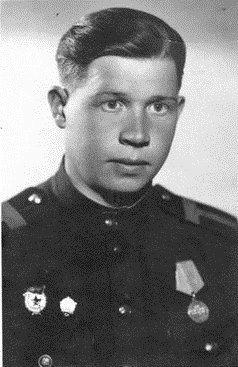


Sergeyev Mikhail Andreevich
Sergeyev Mikhail Andreevich
Mikhail Sergeev was born on the 19th of November, 1925, in Kazakh SSR, North Kazakhstan region, Bulaevsky district, Konyukhovo village. He served in the Red Army since January 1, 1943. Mikhail was only 17 years old on November 19, 1942, so he was not immediately sent to the front. First, he was sent to the 18th Separate school of excellent marksmen of sniper training-Ashgabat (Turkmen SSR). And only a year later, he found himself in the Gorokhovets camps near the city of Gorky, where units were being formed to be sent to the front. At the front from 09.01. to 09.02.1944. Corporal. Sniper. He participated in the Kalinkovichi-Mozyr operation of the Belarusian front as part of the 65th army of the 1201st Rifle Regiment of the 354th Rifle Division (later the Kalinkovichi of the order of Lenin and the Red Banner of the order of Suvorov). During an attack on German positions near the village of Gorokhovishchi (Gorokhovichi) on February 9, 1944, Mikhail Sergeev was seriously wounded by a mine fragment in the knee joint with bone damage. This is how he recalled later: "We were advancing on the German positions on a snow-covered field under heavy mortar and machine-gun fire. Our commander was immediately killed by a direct hit to the head by a mine. I only remember a tree standing alone in this field. It was next to him that I was hurt. A mine exploded somewhere behind them. The explosion sent me sprawling on my stomach, face down in the snow, my left leg bent up at the knee. I hadn't really felt the pain yet, but lay there, afraid that stray bullets might hit my leg. I couldn't bend my leg. Suddenly the leg was violently jerked, it stretched out along the body. As it turned out later, the bullet went through the muscle below the knee and threw the leg. But a fragment of a mine pierced the bone of the kneecap of the left leg. I don't remember exactly how quickly, but help arrived. They were not orderlies, but two of my classmates from our rifle platoon. The boys wrapped something around my wounds and dragged me on my back through the snow to our trenches. I didn't lose consciousness, but the pain was just terrible. The guys dragged me, and they envied me, repeating the words that I remembered for a lifetime: "You're lucky, Mishka, now you're going to the hospital, and then you're going HOME!!!" And so it happened later. Only at first I was lucky with the captain of the medical service, who saved my leg in a military field hospital. I wish I could remember his last name. The ambulance train took us to the rear for many days. As it turned out - to a hospital in the town of Orsk, Orenburg region. There I lay in a cast for six months. There was also pain, and there were lice under the cast, which made the leg itch worse than the pain in the wounds. Most of the wounded were still beardless boys. So most of all I rememberhow we were shy of the young nurses who served us in the hospital. One mature nurse who entered our ward always asked loudly:"where is the blue-eyed one?" she would go to my bed and say, " Well, how are you? How are you doing, blue eyes?" If I started complaining of pain, she would start humming to me from Utesov : "After all, you are a SAILOR, MISHKA, a sailor does not cry and does not lose his spirits ever!" That's how I waited for her arrival and somehow it became easier after that." After finishing treatment in hospital No. 3640 in the city of Orsk, Orenburg region, in August 1944, he was declared unfit for military service by the medical Commission and sent to the reserve. He came back home to the village of Kamyshlovo, where his elder brother Gennady and sister Rufina lived after being wounded. For a long time he moved on crutches, and then - with a cane. The wound periodically opened and required treatment. This continued throughout his life until his death in January 1996. Mikhail marriedRimma Nikolaevna Belousova in 1952 , a teacher of Russian language and literature, who came to work at a local school. At the Kara-Guga station, where he moved with his family, his sons Vyacheslav (1953) and Viktor (1955) were born. He graduated from an school for adult workers. Leter he worked in various organizations. He joined the CPSU (b), then worked for many years in the party and Soviet bodies.He received a correspondence higher education, having graduated from the Higher Party School in the city of Alma-ATA. Labor veteran. Holder of three orders of "Badge of Honor", various medals and certificates of honor. He went to different places of military glory of the Great Patriotic War, visited Belarus and the place of his wounds at the village of Gorokhovye. He was a member of the Council of veterans of the Second World war of the Bulaevsky district of the North Kazakhstan region and headed it. He collected a library of memoirs of Soviet military chiefs. He was buried in the Forest cemetery of Yekaterinburg. Has combat awards: Order of the Great Patriotic War I of the 1st class # of the Order 488982 Order book #062673 Medal "For military merit" 3009689 from June 15, 1948.
Sergeyev Mikhail Andreevich
Sergeyev Mikhail Andreevich
Mikhail Sergeev was born on the 19th of November, 1925, in Kazakh SSR, North Kazakhstan region, Bulaevsky district, Konyukhovo village. He served in the Red Army since January 1, 1943. Mikhail was only 17 years old on November 19, 1942, so he was not immediately sent to the front. First, he was sent to the 18th Separate school of excellent marksmen of sniper training-Ashgabat (Turkmen SSR). And only a year later, he found himself in the Gorokhovets camps near the city of Gorky, where units were being formed to be sent to the front. At the front from 09.01. to 09.02.1944. Corporal. Sniper. He participated in the Kalinkovichi-Mozyr operation of the Belarusian front as part of the 65th army of the 1201st Rifle Regiment of the 354th Rifle Division (later the Kalinkovichi of the order of Lenin and the Red Banner of the order of Suvorov). During an attack on German positions near the village of Gorokhovishchi (Gorokhovichi) on February 9, 1944, Mikhail Sergeev was seriously wounded by a mine fragment in the knee joint with bone damage. This is how he recalled later: "We were advancing on the German positions on a snow-covered field under heavy mortar and machine-gun fire. Our commander was immediately killed by a direct hit to the head by a mine. I only remember a tree standing alone in this field. It was next to him that I was hurt. A mine exploded somewhere behind them. The explosion sent me sprawling on my stomach, face down in the snow, my left leg bent up at the knee. I hadn't really felt the pain yet, but lay there, afraid that stray bullets might hit my leg. I couldn't bend my leg. Suddenly the leg was violently jerked, it stretched out along the body. As it turned out later, the bullet went through the muscle below the knee and threw the leg. But a fragment of a mine pierced the bone of the kneecap of the left leg. I don't remember exactly how quickly, but help arrived. They were not orderlies, but two of my classmates from our rifle platoon. The boys wrapped something around my wounds and dragged me on my back through the snow to our trenches. I didn't lose consciousness, but the pain was just terrible. The guys dragged me, and they envied me, repeating the words that I remembered for a lifetime: "You're lucky, Mishka, now you're going to the hospital, and then you're going HOME!!!" And so it happened later. Only at first I was lucky with the captain of the medical service, who saved my leg in a military field hospital. I wish I could remember his last name. The ambulance train took us to the rear for many days. As it turned out - to a hospital in the town of Orsk, Orenburg region. There I lay in a cast for six months. There was also pain, and there were lice under the cast, which made the leg itch worse than the pain in the wounds. Most of the wounded were still beardless boys. So most of all I rememberhow we were shy of the young nurses who served us in the hospital. One mature nurse who entered our ward always asked loudly:"where is the blue-eyed one?" she would go to my bed and say, " Well, how are you? How are you doing, blue eyes?" If I started complaining of pain, she would start humming to me from Utesov : "After all, you are a SAILOR, MISHKA, a sailor does not cry and does not lose his spirits ever!" That's how I waited for her arrival and somehow it became easier after that." After finishing treatment in hospital No. 3640 in the city of Orsk, Orenburg region, in August 1944, he was declared unfit for military service by the medical Commission and sent to the reserve. He came back home to the village of Kamyshlovo, where his elder brother Gennady and sister Rufina lived after being wounded. For a long time he moved on crutches, and then - with a cane. The wound periodically opened and required treatment. This continued throughout his life until his death in January 1996. Mikhail marriedRimma Nikolaevna Belousova in 1952 , a teacher of Russian language and literature, who came to work at a local school. At the Kara-Guga station, where he moved with his family, his sons Vyacheslav (1953) and Viktor (1955) were born. He graduated from an school for adult workers. Leter he worked in various organizations. He joined the CPSU (b), then worked for many years in the party and Soviet bodies.He received a correspondence higher education, having graduated from the Higher Party School in the city of Alma-ATA. Labor veteran. Holder of three orders of "Badge of Honor", various medals and certificates of honor. He went to different places of military glory of the Great Patriotic War, visited Belarus and the place of his wounds at the village of Gorokhovye. He was a member of the Council of veterans of the Second World war of the Bulaevsky district of the North Kazakhstan region and headed it. He collected a library of memoirs of Soviet military chiefs. He was buried in the Forest cemetery of Yekaterinburg. Has combat awards: Order of the Great Patriotic War I of the 1st class # of the Order 488982 Order book #062673 Medal "For military merit" 3009689 from June 15, 1948.
0 comment



2026 © Russian Military Historical Society Developed by Jetmix