


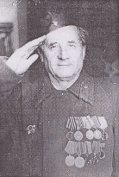


Solovykh Pyotr Ivanovich
Solovykh Pyotr Ivanovich
Born in the Oryol region, Bolhovsky district, Zaretsky village. Participant of the Great Patriotic War of 1941-1945. Rank: Sergeant. Branch of service: Artillery. Division: 94th Guards Rifle Zvenigorod-Berlin division of the Order of Suvorov. My great – GRANDFATHER — the knight of TWO ORDERS of GLORY. He lived the glorious life. My great-grandfather, Peter Ivanovich Solovykh. We owe our lives and happiness to warriors like him, true heroes. The greatest soldier's feat during the Great Patriotic War was awarded three Orders of Glory. My great-grandfather was a knight of two Orders of Glory. Unfortunately, I didn't have much contact with Pyotr Ivanovich. But I know about this heroic man from my grandfather and my parents. I am absolutely sure that my children will know this family history and will be proud of their ancestor. Pyotr Ivanovich Solovykh was born on January 19, 1918 in the village of Zaretskoye, Bolkhovsky district, Oryol region. For me, there is nothing more interesting than his memories, on the basis of which I will build my story. Before the beginning of the Great Patriotic war in 1938, my great-grandfather was drafted into the Red Army, served in the Far East in the 129th Special Rifle Division of the NKVD in the railway battalion. In the spring of 1941, the division was transferred to Belarus on the border with Poland. My great-grandfather was present at the front of the Great Patriotic war from the very first day - from June 22, 1941. He was the commander of the anti-tank rifle squadn. "I remember June 22, 1941. Our military unit was located in Lida, in Western Belarus. It was a Sunday afternoon, suddenly there was an alarm. In a hurry, they received additional ammunition and took up the defense. Most did not believe that the war had started, they thoughthtere were usual training sessions. At 3 o'clock in the afternoon, planes appeared in the air, they flew in our direction. Some soldiers said they were ours, while others said they were enemy's. But when 24 planes with swastikas on Board, having reached our location, began dropping bombs and low-level scribbling from heavy machine guns, it became clear to everyone that, indeed, the war had begun." The enemy had a great superiority, both in the number of troops, and in the level of technical and material support. The order to retreat was received. Pyotr Ivanovich and his comrades had to leave Minsk. Then my great-grandfather was sent to the city of Sverdlovsk to restore the evacuated factories, then in the spring of 1942 he was enrolled in the Kamyshlov infantry school, and in August a 24-year-old young soldier was sent to replenish a special rifle brigade. He participated in one of the greatest and most fateful battles – the battle of Stalingrad. "In September 1942, our brigade arrived at Stalingrad. We immediately entered the battle. The earth and sky seemed to burn, shuddering from the endless blows of the guns. Huge tanks with crosses on their armor were moving towards us, and the breath of death was felt everywhere. But there was an order to stand to the death, and we stood! Everyone had only one word in his head: "Not a step back – there is no land beyond the Volga! So many times the enemy attacked our defense, trying to overturn the Volga, but nothing happened. There was no limit to the patriotism of our soldiers and officers and hatred of the enemy. The wounded did not leave the battlefield, fighting to the last strength. After some time, our ranks were replenished, and we began the offensive." In the early morning of November 19, 1942, Soviet troops launched a General offensive as the part of the operation «Uranus». "The artillery thundered, «Katyushas’s shells fl»ew, tanks moved, and aircraft operated well. On February 2, 1943, the Stalingrad group of Germans capitulated. 330,000 of them surrendered, it was a joyous day. The prisoners were already marching in columns. I saw how the commander of the 6th army, field Marshal Paulus, and his staff were transported in 3 cars. I did not console myself with the hope that death would pass me by in the future. And Berlin was still 828 days away. My comrades and I still saw death in the face at Belgorod, at the Kursk bulge, at Kharkov, when crossing the Dnieper, Dniester, Vistula, Oder, and Elbe. But on February 2, 1943, in Stalingrad, we were already filled with the smell of victorious silence." My great-grandfather was awarded the medal for the defense of Stalingrad for his courage and heroism in the battle of Stalingrad. After the battle of Stalingrad, Peter Ivanovich had a chance to participate in the battles on the Orel-Kursk bulge. "Our unit was transferred from Stalingrad to Stary Oskol in the Kursk region. There we received new weapons, replenishment. I was appointed commander of a 122 mm howitzer." "I will always remember the night of the 5th of July, 1943," he remembered. "They put us on alert. The task was to close the way for the Nazis in the defense zone of the village Sevryukovo-height 206.9-the village Myasoedovo. The distance was only a few kilometers, but, as it turned out, the density of fire was almost the most dangerous part of the first days of the battle on the Fire Arc. In the evening our battery was moved to reserve positions. They had just turned around when the German tank attack began. On our battery was the Deputy commander of the regiment, major Oryabinsky. I remember, he said, "Well, Stalingrad soldiers, don't let us down". In this attack, the Germans missed 6 tanks and disappeared into woods. We lost a whole team of 7 people, a gun and a tractor. On the battlefield were left mutilated, torches burning Nazi tanks. A few days later, there were so many of them that they made it difficult to fire direct fire. On the first day of the battle of Oryol-Kursk, my gun knocked out three German tanks, for which I was awarded the Order of the Red Star and accepted into the Communist party in the dugout." The award list, signed by the commander of the guards regiment, Captain Yemelyanikov, stated that "Solovykh, during the battle in the Belgorod direction of the village of Myasoedovo from July 7 to July 14, 1943, as a part of the calculation, repulsed two tank attacks... As a result, 20 vehicles, 4 tanks and up to a company of enemy infantry were destroyed." "On the shield of my gun appeared 3 red stars, indicating the number of damaged tanks." Pyotr Ivanovich took part in the liberation of Belgorod. He remembered how on the evening of August 5, 1943, in the destroyed Belgorod, the soldiers listened to the order Of the Supreme commander-in-Chief, Marshal of the Soviet Union I. V. Stalin, congratulations and thanks for the defeat of the Germans on the Kursk bulge and the liberation of the city of Belgorod. His further front-line path lay through the Ukraine. Pyotr Ivanovich was awarded the medal "For the liberation of Kharkiv". After liberating the Eastern regions of the Ukraine, Soviet troops approached the Dnieper. Pyotr Ivanov was in a variety of situations that required the utmost mobilization of volitional and physical efforts. We also had to visit the surrounding area: "Our 94th division continued its way through the Right-Bank Ukraine. I remember that in the area of Zvenigorodka, Kiev region, the division broke through the German defense, rushed forward, without receiving the support of the neighboring division, and we were surrounded. The situation was difficult. The enemy pressed in from all sides. There was little ammunition left. The command gathered us, the asset, and proposed an exit plan. In the darkness, units began to break out of the encirclement. Under enemys’ fire, they came out of the fire bag." My great-grandfather also participated in the defeat of the Korsun-Shevchenko group. In this battle, the Germans lost tens of thousands of soldiers and officers killed and captured. According to his memoirs , "all roads were cluttered with abandoned equipment." In the spring of 1944, Peter Ivanovich, along with his comrades in the calculation of the guns, crossed the Dniester, and secured a foothold on the Right Bank. And the war was slowly but steadily rolling back to the West. In August 1944, the 199th Guards Artillery Regiment fought on the outskirts of Chisinau. By 23 hours on August 23, the fighting was already in the center of the city, and by the morning of August 24, 1944, the city was taken. "The first shot at Kishinev was fired from our cannon," my great - grandfather proudly recalled. "I remember entering Kishinev in the early morning of August. Moldovans threw flowers at us, treated us to wine and fruit, and hugged us." For the liberation of Kishenev guards senior Sergeant Solovov was awarded the Order of Glory of the 3rd class. In the award list, signed by the commander of the 199th Guards Artillery Regiment of the guards, Lieutenant Colonel Zherebtsov, it was noted: "On the 23rd of August, 1944, Solovov was the first to roll out his gun on direct fire, set it at a distance of 400 meters from the enemy infantry and opened fire on the enemy. As a result, two machine-gun points were destroyed, the fire of an artillery battery was suppressed, and 20 Hitlerites were destroyed. This made it possible for our infantry to break into the city of Kishenev." In November 1944, Peter Ivanovich and his comrades were transferred to the Vistula. Developing the offensive, the division's regiments reached the tributary of the Vistula — the Pilica. Senior Sergeant Pyotr Ivanovich was awarded the second order of Glory of the guard for his exploits committed in January 1945 in Poland. On January 14, 1945, when the enemy's heavily fortified defenses broke through at the Magnuszeski bridgehead near the village of Grabuv Pilica, " ... his gun destroyed a submachine gun and up to two enemy infantry squads. From the Eastern Bank of the Pilitsa river, direct fire supported the crossing of the river, while one enemy submachine gun was destroyed and two armored personnel carriers were suppressed as part of other guns. By his actions, Solovykh contributed to the seizure of a bridgehead on the Western Bank of the river Pilica". Pyotr Ivanovich also said that while attacking the Nazis outside the territory of the USSR, the tactics of fighting changed. "At night, the guns were pulled up to the closest distance on their hands. Each gun was assigned one or two targets, and in the morning, unexpectedly for the enemy, direct fire smashed its defenses to pieces." So Peter Ivanovich participated in the liberation of Warsaw. "In February 1945, our division approached the Oder, immediately crossed this navigable large river and secured a foothold near the city of Kustrin. Crossing the Oder was very difficult. Under heavy enemy fire, soldiers laid planks on the ice, rolled guns on their hands, and brought shells to the soldiers in bags. Across the Oder, Soviet sappers were building crossings, building bridges with the expectation of passing heavy guns and tanks-the last blow to the lair of fascism was being prepared." On February 3, 1945, the 199th Guards Artillery Regiment, in which Peter Ivanovich served, crossed the Oder. The rest of the way lay to Berlin. On April 19, 1945, in the area of the German city of Neudorf, the Nazis did everything to gain a foothold on the third line of defense of their capital, Berlin. In the afternoon, the SS broke through the location of the Soviet troops on the right flank. "We immediately occupied the first trench. The enemy unleashed a barrage of fire on us. The whole earth seemed to be boiling, but we were rushing forward. And then I was wounded." The Victory day found Pyotr Ivanovich in a hospital in the city of Lansberg, which was located near Berlin. He said often that he was very sorry that he did not enter Berlin with our troops, and met the Victory in the hospital: "That night there was indiscriminate shooting – our soldiers saluted with all types of weapons in honor of the great Victory over fascism. We thought: "The hospital was attacked by the Germans." Crawled out, as we could, to try to defendoccupy… And this war was over… The long-awaited Victory." After recovering, Pyotr Ivanovich found his military unit in Berlin. He learned that his gun with 7 red stars on the shield, destroyed the enemys’ shell, which landed right in the calculation and took the lives of four of his comrades. The Great Patriotic war of the soldier Peter Solovykh counted kilometers in the battles of Stalingrad and Kursk, lay under a hail of bullets in Ukraine, Moldova and Poland, clung to every inch of land when crossing the Oder and was shot through on the outskirts of Berlin. My great-grandfather fought like a true hero. During the war, he was awarded two Orders of the Red Star, Orders of Glory of II and III classes, the Great Patriotic War of I class, medals "For the defense of Stalingrad", "For the liberation of Warsaw", "For the capture of Berlin", "For the victory over Germany" and other awards. Peter Ivanovich was discharged in 1945. After the war, he lived in Bolkhov. Worked as a carpenter in the construction and installation Department, senior inspector of the state fire supervision in the Ministry of Internal Affairs of Russia "Bolkhovsky". Speaking at a meeting in honor of the 40th anniversary of the Victory on may 9, 1985, Pyotr Ivanovich remembered: "I walked the roads of war from the first day to the last day. As a part of the legendary 5th Army under the command of General Berzarin, I crossed the Vistula river and liberated Warsaw. With fights passed Pomerania, crossed the Oder, in heavy battles with the enemy held a bridgehead under the city of Kustrin, from where Berlin was only 60 kilometers away. At the very beginning of the assault on Berlin, I was wounded and sent to the hospital, where I found the joyful news of our Victory." I also remember my great-grandfather saying that people ask him often about the most memorable day of the war. "Which day was it? When? It's not hard for me to choose. Yes, I say, I know this day. This is the day of the great Stalingrad victory! - February 2, 1943. Stalingrad is our pride and glory!" My great-grandfather had many awards, he valued each one, but the most expensive front-line award for him was the medal "For the defense of Stalingrad". Pyotr Ivanovich died on October 4, 2012, at the age of 94. On September 11, 2013, a memorial plaque was installed on the house where P. I. solovykh lived in Bolkhov. My great-grandfather's fate is similar to that of thousands of his contemporaries, and we all owe them an irrevocable debt for the Victory won at the cost of irreparable losses. My great-grandfather's name, along with the names of other orlovtsy, is mentioned in the books of local historians dedicated to the holders of the Orders of Glory. I'm proud of my great-grandfather! If I have a son in the future, I will call him Peter. Kirill Korgin, grade 6, 12 years old Municipal budget educational institution-Lyceum No. 18, Orel
Solovykh Pyotr Ivanovich
Solovykh Pyotr Ivanovich
Born in the Oryol region, Bolhovsky district, Zaretsky village. Participant of the Great Patriotic War of 1941-1945. Rank: Sergeant. Branch of service: Artillery. Division: 94th Guards Rifle Zvenigorod-Berlin division of the Order of Suvorov. My great – GRANDFATHER — the knight of TWO ORDERS of GLORY. He lived the glorious life. My great-grandfather, Peter Ivanovich Solovykh. We owe our lives and happiness to warriors like him, true heroes. The greatest soldier's feat during the Great Patriotic War was awarded three Orders of Glory. My great-grandfather was a knight of two Orders of Glory. Unfortunately, I didn't have much contact with Pyotr Ivanovich. But I know about this heroic man from my grandfather and my parents. I am absolutely sure that my children will know this family history and will be proud of their ancestor. Pyotr Ivanovich Solovykh was born on January 19, 1918 in the village of Zaretskoye, Bolkhovsky district, Oryol region. For me, there is nothing more interesting than his memories, on the basis of which I will build my story. Before the beginning of the Great Patriotic war in 1938, my great-grandfather was drafted into the Red Army, served in the Far East in the 129th Special Rifle Division of the NKVD in the railway battalion. In the spring of 1941, the division was transferred to Belarus on the border with Poland. My great-grandfather was present at the front of the Great Patriotic war from the very first day - from June 22, 1941. He was the commander of the anti-tank rifle squadn. "I remember June 22, 1941. Our military unit was located in Lida, in Western Belarus. It was a Sunday afternoon, suddenly there was an alarm. In a hurry, they received additional ammunition and took up the defense. Most did not believe that the war had started, they thoughthtere were usual training sessions. At 3 o'clock in the afternoon, planes appeared in the air, they flew in our direction. Some soldiers said they were ours, while others said they were enemy's. But when 24 planes with swastikas on Board, having reached our location, began dropping bombs and low-level scribbling from heavy machine guns, it became clear to everyone that, indeed, the war had begun." The enemy had a great superiority, both in the number of troops, and in the level of technical and material support. The order to retreat was received. Pyotr Ivanovich and his comrades had to leave Minsk. Then my great-grandfather was sent to the city of Sverdlovsk to restore the evacuated factories, then in the spring of 1942 he was enrolled in the Kamyshlov infantry school, and in August a 24-year-old young soldier was sent to replenish a special rifle brigade. He participated in one of the greatest and most fateful battles – the battle of Stalingrad. "In September 1942, our brigade arrived at Stalingrad. We immediately entered the battle. The earth and sky seemed to burn, shuddering from the endless blows of the guns. Huge tanks with crosses on their armor were moving towards us, and the breath of death was felt everywhere. But there was an order to stand to the death, and we stood! Everyone had only one word in his head: "Not a step back – there is no land beyond the Volga! So many times the enemy attacked our defense, trying to overturn the Volga, but nothing happened. There was no limit to the patriotism of our soldiers and officers and hatred of the enemy. The wounded did not leave the battlefield, fighting to the last strength. After some time, our ranks were replenished, and we began the offensive." In the early morning of November 19, 1942, Soviet troops launched a General offensive as the part of the operation «Uranus». "The artillery thundered, «Katyushas’s shells fl»ew, tanks moved, and aircraft operated well. On February 2, 1943, the Stalingrad group of Germans capitulated. 330,000 of them surrendered, it was a joyous day. The prisoners were already marching in columns. I saw how the commander of the 6th army, field Marshal Paulus, and his staff were transported in 3 cars. I did not console myself with the hope that death would pass me by in the future. And Berlin was still 828 days away. My comrades and I still saw death in the face at Belgorod, at the Kursk bulge, at Kharkov, when crossing the Dnieper, Dniester, Vistula, Oder, and Elbe. But on February 2, 1943, in Stalingrad, we were already filled with the smell of victorious silence." My great-grandfather was awarded the medal for the defense of Stalingrad for his courage and heroism in the battle of Stalingrad. After the battle of Stalingrad, Peter Ivanovich had a chance to participate in the battles on the Orel-Kursk bulge. "Our unit was transferred from Stalingrad to Stary Oskol in the Kursk region. There we received new weapons, replenishment. I was appointed commander of a 122 mm howitzer." "I will always remember the night of the 5th of July, 1943," he remembered. "They put us on alert. The task was to close the way for the Nazis in the defense zone of the village Sevryukovo-height 206.9-the village Myasoedovo. The distance was only a few kilometers, but, as it turned out, the density of fire was almost the most dangerous part of the first days of the battle on the Fire Arc. In the evening our battery was moved to reserve positions. They had just turned around when the German tank attack began. On our battery was the Deputy commander of the regiment, major Oryabinsky. I remember, he said, "Well, Stalingrad soldiers, don't let us down". In this attack, the Germans missed 6 tanks and disappeared into woods. We lost a whole team of 7 people, a gun and a tractor. On the battlefield were left mutilated, torches burning Nazi tanks. A few days later, there were so many of them that they made it difficult to fire direct fire. On the first day of the battle of Oryol-Kursk, my gun knocked out three German tanks, for which I was awarded the Order of the Red Star and accepted into the Communist party in the dugout." The award list, signed by the commander of the guards regiment, Captain Yemelyanikov, stated that "Solovykh, during the battle in the Belgorod direction of the village of Myasoedovo from July 7 to July 14, 1943, as a part of the calculation, repulsed two tank attacks... As a result, 20 vehicles, 4 tanks and up to a company of enemy infantry were destroyed." "On the shield of my gun appeared 3 red stars, indicating the number of damaged tanks." Pyotr Ivanovich took part in the liberation of Belgorod. He remembered how on the evening of August 5, 1943, in the destroyed Belgorod, the soldiers listened to the order Of the Supreme commander-in-Chief, Marshal of the Soviet Union I. V. Stalin, congratulations and thanks for the defeat of the Germans on the Kursk bulge and the liberation of the city of Belgorod. His further front-line path lay through the Ukraine. Pyotr Ivanovich was awarded the medal "For the liberation of Kharkiv". After liberating the Eastern regions of the Ukraine, Soviet troops approached the Dnieper. Pyotr Ivanov was in a variety of situations that required the utmost mobilization of volitional and physical efforts. We also had to visit the surrounding area: "Our 94th division continued its way through the Right-Bank Ukraine. I remember that in the area of Zvenigorodka, Kiev region, the division broke through the German defense, rushed forward, without receiving the support of the neighboring division, and we were surrounded. The situation was difficult. The enemy pressed in from all sides. There was little ammunition left. The command gathered us, the asset, and proposed an exit plan. In the darkness, units began to break out of the encirclement. Under enemys’ fire, they came out of the fire bag." My great-grandfather also participated in the defeat of the Korsun-Shevchenko group. In this battle, the Germans lost tens of thousands of soldiers and officers killed and captured. According to his memoirs , "all roads were cluttered with abandoned equipment." In the spring of 1944, Peter Ivanovich, along with his comrades in the calculation of the guns, crossed the Dniester, and secured a foothold on the Right Bank. And the war was slowly but steadily rolling back to the West. In August 1944, the 199th Guards Artillery Regiment fought on the outskirts of Chisinau. By 23 hours on August 23, the fighting was already in the center of the city, and by the morning of August 24, 1944, the city was taken. "The first shot at Kishinev was fired from our cannon," my great - grandfather proudly recalled. "I remember entering Kishinev in the early morning of August. Moldovans threw flowers at us, treated us to wine and fruit, and hugged us." For the liberation of Kishenev guards senior Sergeant Solovov was awarded the Order of Glory of the 3rd class. In the award list, signed by the commander of the 199th Guards Artillery Regiment of the guards, Lieutenant Colonel Zherebtsov, it was noted: "On the 23rd of August, 1944, Solovov was the first to roll out his gun on direct fire, set it at a distance of 400 meters from the enemy infantry and opened fire on the enemy. As a result, two machine-gun points were destroyed, the fire of an artillery battery was suppressed, and 20 Hitlerites were destroyed. This made it possible for our infantry to break into the city of Kishenev." In November 1944, Peter Ivanovich and his comrades were transferred to the Vistula. Developing the offensive, the division's regiments reached the tributary of the Vistula — the Pilica. Senior Sergeant Pyotr Ivanovich was awarded the second order of Glory of the guard for his exploits committed in January 1945 in Poland. On January 14, 1945, when the enemy's heavily fortified defenses broke through at the Magnuszeski bridgehead near the village of Grabuv Pilica, " ... his gun destroyed a submachine gun and up to two enemy infantry squads. From the Eastern Bank of the Pilitsa river, direct fire supported the crossing of the river, while one enemy submachine gun was destroyed and two armored personnel carriers were suppressed as part of other guns. By his actions, Solovykh contributed to the seizure of a bridgehead on the Western Bank of the river Pilica". Pyotr Ivanovich also said that while attacking the Nazis outside the territory of the USSR, the tactics of fighting changed. "At night, the guns were pulled up to the closest distance on their hands. Each gun was assigned one or two targets, and in the morning, unexpectedly for the enemy, direct fire smashed its defenses to pieces." So Peter Ivanovich participated in the liberation of Warsaw. "In February 1945, our division approached the Oder, immediately crossed this navigable large river and secured a foothold near the city of Kustrin. Crossing the Oder was very difficult. Under heavy enemy fire, soldiers laid planks on the ice, rolled guns on their hands, and brought shells to the soldiers in bags. Across the Oder, Soviet sappers were building crossings, building bridges with the expectation of passing heavy guns and tanks-the last blow to the lair of fascism was being prepared." On February 3, 1945, the 199th Guards Artillery Regiment, in which Peter Ivanovich served, crossed the Oder. The rest of the way lay to Berlin. On April 19, 1945, in the area of the German city of Neudorf, the Nazis did everything to gain a foothold on the third line of defense of their capital, Berlin. In the afternoon, the SS broke through the location of the Soviet troops on the right flank. "We immediately occupied the first trench. The enemy unleashed a barrage of fire on us. The whole earth seemed to be boiling, but we were rushing forward. And then I was wounded." The Victory day found Pyotr Ivanovich in a hospital in the city of Lansberg, which was located near Berlin. He said often that he was very sorry that he did not enter Berlin with our troops, and met the Victory in the hospital: "That night there was indiscriminate shooting – our soldiers saluted with all types of weapons in honor of the great Victory over fascism. We thought: "The hospital was attacked by the Germans." Crawled out, as we could, to try to defendoccupy… And this war was over… The long-awaited Victory." After recovering, Pyotr Ivanovich found his military unit in Berlin. He learned that his gun with 7 red stars on the shield, destroyed the enemys’ shell, which landed right in the calculation and took the lives of four of his comrades. The Great Patriotic war of the soldier Peter Solovykh counted kilometers in the battles of Stalingrad and Kursk, lay under a hail of bullets in Ukraine, Moldova and Poland, clung to every inch of land when crossing the Oder and was shot through on the outskirts of Berlin. My great-grandfather fought like a true hero. During the war, he was awarded two Orders of the Red Star, Orders of Glory of II and III classes, the Great Patriotic War of I class, medals "For the defense of Stalingrad", "For the liberation of Warsaw", "For the capture of Berlin", "For the victory over Germany" and other awards. Peter Ivanovich was discharged in 1945. After the war, he lived in Bolkhov. Worked as a carpenter in the construction and installation Department, senior inspector of the state fire supervision in the Ministry of Internal Affairs of Russia "Bolkhovsky". Speaking at a meeting in honor of the 40th anniversary of the Victory on may 9, 1985, Pyotr Ivanovich remembered: "I walked the roads of war from the first day to the last day. As a part of the legendary 5th Army under the command of General Berzarin, I crossed the Vistula river and liberated Warsaw. With fights passed Pomerania, crossed the Oder, in heavy battles with the enemy held a bridgehead under the city of Kustrin, from where Berlin was only 60 kilometers away. At the very beginning of the assault on Berlin, I was wounded and sent to the hospital, where I found the joyful news of our Victory." I also remember my great-grandfather saying that people ask him often about the most memorable day of the war. "Which day was it? When? It's not hard for me to choose. Yes, I say, I know this day. This is the day of the great Stalingrad victory! - February 2, 1943. Stalingrad is our pride and glory!" My great-grandfather had many awards, he valued each one, but the most expensive front-line award for him was the medal "For the defense of Stalingrad". Pyotr Ivanovich died on October 4, 2012, at the age of 94. On September 11, 2013, a memorial plaque was installed on the house where P. I. solovykh lived in Bolkhov. My great-grandfather's fate is similar to that of thousands of his contemporaries, and we all owe them an irrevocable debt for the Victory won at the cost of irreparable losses. My great-grandfather's name, along with the names of other orlovtsy, is mentioned in the books of local historians dedicated to the holders of the Orders of Glory. I'm proud of my great-grandfather! If I have a son in the future, I will call him Peter. Kirill Korgin, grade 6, 12 years old Municipal budget educational institution-Lyceum No. 18, Orel
0 comment




2026 © Russian Military Historical Society Developed by Jetmix