


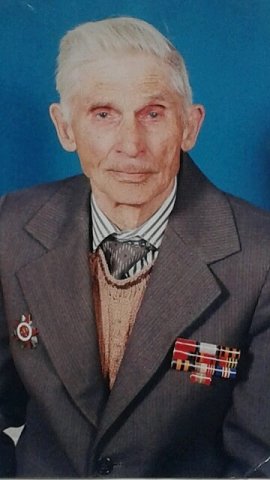


Alexander Bretman
Title: Red Army Soldier
Branch of Service: Artillery
Alexander Bretman was born in 1918 in the village of Moor (Kluchi) Krasnoarmeysky District of the Saratov Region, five kilometers from Baltser in the family of a craftsman. After graduating from the nine-year Balzer School in 1935, he continued his studies at the German Pedagogical Institute in Engels. Immediately after graduation, in 1939, A. Bretman was drafted into the army. He served first in Livni (Oryol Military District), then was sent to the Finnish war.
As a soldier of the 113th Rifle Division of the 10th Rifle Corps of the 7th Army, from January to March 1940, he took part in the breakthrough of the "Mannerheim Line". In particular, in the fighting in the district of Karhula for the station of Somme. His unit was transferred to the Odessa Military District in 1941, where he met the beginning of the war with Germany. At that time, he was the commander of the crew of a large-caliber anti-aircraft machine gun. In the battle on the Prut River, he was wounded and sent to a hospital in the city of Nikolaev. After treatment in September 1941, he did not return to the active army. He was briefly held in one of the rear units, and then sent for deportation. First, he got into one of the collective farms of the Chimkent region (this is in southern Kazakhstan), where he had to perform various purely peasant work. In early 1942, like all Soviet German men between the ages of 17 and 50, he was conscripted into the"labor army". He was in Chelyabinsk, for the construction of a metallurgical plant. It was being built by the organization, then bearing the name of Belstroi of the NKVD (later Chelyabmetallurgstroy). About 30 thousand German labor soldiers were gathered there. A. Bretman was sent to a brick factory. He worked as a digger, brick Kilner, foreman, shift supervisor. In 1946, he was "demobilized" and sent to the village of Ruzaevka, the district center of the Kokchetav Region, where his parents lived in exile. There he became a math teacher in school.
He worked for this school for 43 years, eventually becoming its Director, and received the titles of Honored Teacher of the Kazakh SSR and Excellent Worker of Education in Kazakhstan. Here he created a family and had four children: Ella, Viktor, Vladimir, and Elvira. He retired in 1985, at the age of 67. During the war, all his documents were lost, including those about his service in the army, participation in the Finnish campaign, in the battles of 1941, and about his injury. Only in 1975, the Ruzaevsky District Military Commissar at a solemn meeting at the school handed its Director a certificate of war veteran and six medals at once. Alexander Bretman was a poet. He began writing in the pre-war period, published in various German-language papers since 1961: the "Lenins Weg", "Junger Sturmer", "Rote Jugend", "Nachrichten". He also wrote memoirs about his life, a short excerpt of which was published in 1985 in the almanac "Native expanses". In 1990, he went to Germany, and there he managed to publish many of his works, including his memoirs.
Alexander Bretman
Title: Red Army Soldier
Branch of Service: Artillery
Alexander Bretman was born in 1918 in the village of Moor (Kluchi) Krasnoarmeysky District of the Saratov Region, five kilometers from Baltser in the family of a craftsman. After graduating from the nine-year Balzer School in 1935, he continued his studies at the German Pedagogical Institute in Engels. Immediately after graduation, in 1939, A. Bretman was drafted into the army. He served first in Livni (Oryol Military District), then was sent to the Finnish war.
As a soldier of the 113th Rifle Division of the 10th Rifle Corps of the 7th Army, from January to March 1940, he took part in the breakthrough of the "Mannerheim Line". In particular, in the fighting in the district of Karhula for the station of Somme. His unit was transferred to the Odessa Military District in 1941, where he met the beginning of the war with Germany. At that time, he was the commander of the crew of a large-caliber anti-aircraft machine gun. In the battle on the Prut River, he was wounded and sent to a hospital in the city of Nikolaev. After treatment in September 1941, he did not return to the active army. He was briefly held in one of the rear units, and then sent for deportation. First, he got into one of the collective farms of the Chimkent region (this is in southern Kazakhstan), where he had to perform various purely peasant work. In early 1942, like all Soviet German men between the ages of 17 and 50, he was conscripted into the"labor army". He was in Chelyabinsk, for the construction of a metallurgical plant. It was being built by the organization, then bearing the name of Belstroi of the NKVD (later Chelyabmetallurgstroy). About 30 thousand German labor soldiers were gathered there. A. Bretman was sent to a brick factory. He worked as a digger, brick Kilner, foreman, shift supervisor. In 1946, he was "demobilized" and sent to the village of Ruzaevka, the district center of the Kokchetav Region, where his parents lived in exile. There he became a math teacher in school.
He worked for this school for 43 years, eventually becoming its Director, and received the titles of Honored Teacher of the Kazakh SSR and Excellent Worker of Education in Kazakhstan. Here he created a family and had four children: Ella, Viktor, Vladimir, and Elvira. He retired in 1985, at the age of 67. During the war, all his documents were lost, including those about his service in the army, participation in the Finnish campaign, in the battles of 1941, and about his injury. Only in 1975, the Ruzaevsky District Military Commissar at a solemn meeting at the school handed its Director a certificate of war veteran and six medals at once. Alexander Bretman was a poet. He began writing in the pre-war period, published in various German-language papers since 1961: the "Lenins Weg", "Junger Sturmer", "Rote Jugend", "Nachrichten". He also wrote memoirs about his life, a short excerpt of which was published in 1985 in the almanac "Native expanses". In 1990, he went to Germany, and there he managed to publish many of his works, including his memoirs.
0 comment




2026 © Russian Military Historical Society Developed by Jetmix