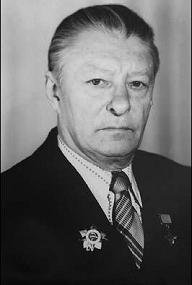

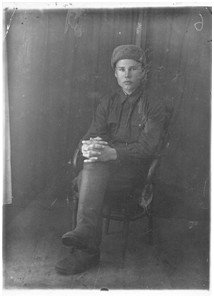
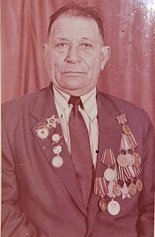


Boris Boretsky
Rank: Lieutenant
Branch of Service: Artillery
Unit: 5th Guards Stalingrad Red Banner Order of Suvorov Breakthrough Heavy Artillery Division
My father, Boris Boretsky, at the age of 19, was sent to Ferghana, where the Kharkov Artillery School was evacuated then. It was located in the old Skobelev Barracks. After graduation, the young Lieutenant was sent to a horse-drawn artillery regiment.
The Battle of Stalingrad ended and the front was disbanded. They were transferred to the North. It was a very difficult time. They broke away from the rear and there was no food for either horses or people, and the soldiers, having received the order to relocate, loaded their howitzers on sleds and tried to move. The starved horses (the usual team of three pairs of horses) were unable to move the heavy howitzers! We had to harness the baggage horses and harness ourselves to help the exhausted horses.
White snow was replaced by red clay, sleds were replaced by carts, but felt boots and fur coats were their only clothing for a long time. Hundreds of kilometers passed from Stalingrad to Yelets before they changed their uniforms. This journey cost my father his legs: as soon as the earth bloomed, his feet "bloomed" with boils. And what it was like to ride after the cure, all his legs were scarred. In the old age, this led to problems with his legs.
My father fought all over Europe, reached Berlin, and served in Germany after the war. Then he was sent Home. He wanted to return to technical institute, but they sent him to the Kharkov Academy and he became a rocket engineer. He was sent to serve in the city of Kalinin, in the research Institute, where he rose to the rank of Lieutenant Colonel, retired.
He never lost his sense of humor and told us, my older brothers, and me about the war, not much and always with humor, but when he finished another story, he would stop talking and go to his room. Later he tottaly stopped sharing his memories with us.
I was small, but I knew it was hard for him. Today I am a grandmother myself, I tell my granddaughter stories I heard from my father, I take her to veterans (they arrange concerts with their classmates), we go to memorials, and on May 9 we definitely go to our great-grandfather to honor his memory.
Boris Boretsky
Rank: Lieutenant
Branch of Service: Artillery
Unit: 5th Guards Stalingrad Red Banner Order of Suvorov Breakthrough Heavy Artillery Division
My father, Boris Boretsky, at the age of 19, was sent to Ferghana, where the Kharkov Artillery School was evacuated then. It was located in the old Skobelev Barracks. After graduation, the young Lieutenant was sent to a horse-drawn artillery regiment.
The Battle of Stalingrad ended and the front was disbanded. They were transferred to the North. It was a very difficult time. They broke away from the rear and there was no food for either horses or people, and the soldiers, having received the order to relocate, loaded their howitzers on sleds and tried to move. The starved horses (the usual team of three pairs of horses) were unable to move the heavy howitzers! We had to harness the baggage horses and harness ourselves to help the exhausted horses.
White snow was replaced by red clay, sleds were replaced by carts, but felt boots and fur coats were their only clothing for a long time. Hundreds of kilometers passed from Stalingrad to Yelets before they changed their uniforms. This journey cost my father his legs: as soon as the earth bloomed, his feet "bloomed" with boils. And what it was like to ride after the cure, all his legs were scarred. In the old age, this led to problems with his legs.
My father fought all over Europe, reached Berlin, and served in Germany after the war. Then he was sent Home. He wanted to return to technical institute, but they sent him to the Kharkov Academy and he became a rocket engineer. He was sent to serve in the city of Kalinin, in the research Institute, where he rose to the rank of Lieutenant Colonel, retired.
He never lost his sense of humor and told us, my older brothers, and me about the war, not much and always with humor, but when he finished another story, he would stop talking and go to his room. Later he tottaly stopped sharing his memories with us.
I was small, but I knew it was hard for him. Today I am a grandmother myself, I tell my granddaughter stories I heard from my father, I take her to veterans (they arrange concerts with their classmates), we go to memorials, and on May 9 we definitely go to our great-grandfather to honor his memory.
0 comment




2026 © Russian Military Historical Society Developed by Jetmix