
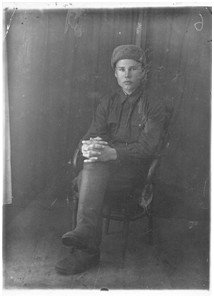
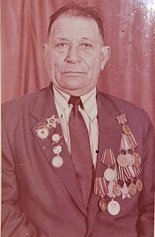


Vasily Bytkov
Rank: Lieutenant
Branch of Service: Armored and Mechanized Troops
Vasily Bytkov was born in 1911 (in some documents 1913). My grandfather (my dad’s dad) before the war lived in the village of Shestopalovo, Kursk Region, Svobodinsky District with his family - wife and one-year-old son. He worked for the Svobodinsky District Military Commissariat .
It was Sunday on June 22, 1941. The family was going for a walk in the grove in the morning, but a neighbor knocked on the wall and said that the war had begun. Grandfather hugged his wife, kissed his son, said "Well, Klava, I'm off." He took the duffel bag and left . I don't know where or in wich position he started the war. Kursk Region was occupied by the Germans very quickly. For 19 months relatives did not communicate. Letters to Shestopalovo began to arrive only in 1943, after the liberation from the Germans .
The first letters that have been preserved our family were sent from Tatishchev, Saratov Region (20.04.43). Tatishchevo station was a military rear, where military units were formed to be sent to the front. There was a testing ground nearby, a lot of farms, warehouses and military bases, I don't know what my grandfather did there. He graduated from a tank school, but which one and when? In June 1943, he was a Lieutenant, Commander of the 1 mrc (I think a motorized rifle company), 2nd MRB (something mechanized rifle battalion, or brigade) under the command of Major Bushmakin (one of the letters was written on a notebook sheet on the back of which was crossed out the part of the report from 28.06.43.) Letters written in July came from field post office #06790, the 50th Mechanised Brigade. Then a letter dated August 4, 1943 came from Kubinka, near Moscow (where the 8th Mechanized Corps of Major General Khasin was being formed at that time, the 66th (former 50th) Mechanized Brigade was part of the corps. 120 T-34 tanks of the “Soviet Uzbekistan” column were used to complete the corps, and Lieutenant Bytkov continued to serve as a company commander on one of them. Letters began to arrive with the return address of the field post office #43748. The postcard dated 8.11.1943 from the Poltava region said: "... I'm going to perform a combat mission." The last letter he wrote shortly before his death: "...where I was before I left and now I am in the South... it rains all the time... Please write more letters, because I now live in a different environment. Hello to all your family and friends. I kiss you and Valeriy. Vasiliy 14.11.1943.”
Grandfather died on November 28 in the village of Zakharovka in Ukraine, we did not know for a long time where the grave of my grandfather was. Then the pathfinders of the Zakharovskaya School, somewhere in the 1980's, sent a letter telling us about his death and the place of burial. My grandmother and father went to Zakharovka and talked to eyewitnesses of those events.
Here is what they learned about them:
During the offensive, our tank did not notice the German one hiding in the corn, it slipped through and was shot in the back, the crew of the already burning tank turned the turret and shot at the enemy, the German tank caught fire.
According to the stories of others, our tank went to the field during the offensive and ran into a German ambush in a cornfield, the crew of the already burning tank shot at the German and it caught fire also. I don't know what is more correct, I only know that for a long time (somewhere before 1948) two burnt-out tanks were facing each other on the field.
The grandfather, he was badly burned, was taken to a field hospital. A local girl helped to take care of the wounded. She said that the tankman constantly asked for a drink, but he was not allowed to drink (or he could not), and she moistened his lips with a cotton swab. Talking to him, I found out that he was from the Kursk Region, at home he left his wife Klava and son Valeriy.
When my grandfather died, he was buried alone near the hospital under a pear tree. Then reburied in a mass grave. Mass grave is located in Ukraine, Kirovograd Region, Svetlovodsky District, village of Zakharovka, village center.
Previously, very good people lived in Zakharovka. My grandmother corresponded with many people for a long time. I want to believe that even now, in our strange time, someone is taking care of the grave and at least occasionally brings flowers.
Vasily Bytkov
Rank: Lieutenant
Branch of Service: Armored and Mechanized Troops
Vasily Bytkov was born in 1911 (in some documents 1913). My grandfather (my dad’s dad) before the war lived in the village of Shestopalovo, Kursk Region, Svobodinsky District with his family - wife and one-year-old son. He worked for the Svobodinsky District Military Commissariat .
It was Sunday on June 22, 1941. The family was going for a walk in the grove in the morning, but a neighbor knocked on the wall and said that the war had begun. Grandfather hugged his wife, kissed his son, said "Well, Klava, I'm off." He took the duffel bag and left . I don't know where or in wich position he started the war. Kursk Region was occupied by the Germans very quickly. For 19 months relatives did not communicate. Letters to Shestopalovo began to arrive only in 1943, after the liberation from the Germans .
The first letters that have been preserved our family were sent from Tatishchev, Saratov Region (20.04.43). Tatishchevo station was a military rear, where military units were formed to be sent to the front. There was a testing ground nearby, a lot of farms, warehouses and military bases, I don't know what my grandfather did there. He graduated from a tank school, but which one and when? In June 1943, he was a Lieutenant, Commander of the 1 mrc (I think a motorized rifle company), 2nd MRB (something mechanized rifle battalion, or brigade) under the command of Major Bushmakin (one of the letters was written on a notebook sheet on the back of which was crossed out the part of the report from 28.06.43.) Letters written in July came from field post office #06790, the 50th Mechanised Brigade. Then a letter dated August 4, 1943 came from Kubinka, near Moscow (where the 8th Mechanized Corps of Major General Khasin was being formed at that time, the 66th (former 50th) Mechanized Brigade was part of the corps. 120 T-34 tanks of the “Soviet Uzbekistan” column were used to complete the corps, and Lieutenant Bytkov continued to serve as a company commander on one of them. Letters began to arrive with the return address of the field post office #43748. The postcard dated 8.11.1943 from the Poltava region said: "... I'm going to perform a combat mission." The last letter he wrote shortly before his death: "...where I was before I left and now I am in the South... it rains all the time... Please write more letters, because I now live in a different environment. Hello to all your family and friends. I kiss you and Valeriy. Vasiliy 14.11.1943.”
Grandfather died on November 28 in the village of Zakharovka in Ukraine, we did not know for a long time where the grave of my grandfather was. Then the pathfinders of the Zakharovskaya School, somewhere in the 1980's, sent a letter telling us about his death and the place of burial. My grandmother and father went to Zakharovka and talked to eyewitnesses of those events.
Here is what they learned about them:
During the offensive, our tank did not notice the German one hiding in the corn, it slipped through and was shot in the back, the crew of the already burning tank turned the turret and shot at the enemy, the German tank caught fire.
According to the stories of others, our tank went to the field during the offensive and ran into a German ambush in a cornfield, the crew of the already burning tank shot at the German and it caught fire also. I don't know what is more correct, I only know that for a long time (somewhere before 1948) two burnt-out tanks were facing each other on the field.
The grandfather, he was badly burned, was taken to a field hospital. A local girl helped to take care of the wounded. She said that the tankman constantly asked for a drink, but he was not allowed to drink (or he could not), and she moistened his lips with a cotton swab. Talking to him, I found out that he was from the Kursk Region, at home he left his wife Klava and son Valeriy.
When my grandfather died, he was buried alone near the hospital under a pear tree. Then reburied in a mass grave. Mass grave is located in Ukraine, Kirovograd Region, Svetlovodsky District, village of Zakharovka, village center.
Previously, very good people lived in Zakharovka. My grandmother corresponded with many people for a long time. I want to believe that even now, in our strange time, someone is taking care of the grave and at least occasionally brings flowers.
0 comment



2026 © Russian Military Historical Society Developed by Jetmix