

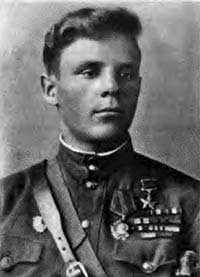




Lysykh Nikolay Afanasievich
CITY: Tambov region, Kirsanovsky district, Orlov DATE OF BIRTH: 08/01/1923 DEATH DATE: 08/01/1943 HISTORY: Title: Red Army soldier. Type of troops: Signal troops. Subdivision: 33rd Guards Rifle Sevastopol Red Banner Order of Suvorov Division. Listen, Lyudmila! They say that in the first spring after the war, the slopes of Marinovka were reddened, as in the days of battles: red poppies bloomed on the human blood spilled here. More than 150 thousand soldiers died and went missing in the battles on the Mius front, among them I, your uncle Lysykh Nikolai Afanasyevich. And again the nightingales are singing on Mius. Listen, Lyudochka, listen! Much has been forgotten, few witnesses of those battles remain. It is only remembered by the steppe, its forbs, and me, Nikolai Bald, lying in this steppe. There were craters on the site of the collapsed trenches, burying soldiers' helmets, riddled with shrapnel, cartridge cases, rusty mines and grenades, which are still found by search engines. But they won't find me in any way ... Listen, Luda, listen! I remember on August 1, 1943, when I was killed. You can feel it smells of blood ... Grasses sway above me, the warm wind sings me a lullaby, as my mother used to sing. My beloved mother, I would like to get up, touch my lips to your gnarled hands,which worked hard on the collective farm Tambov field, but I can't get up. I will forever protect the peace and tranquility of the Donbass land. Forgive me, mom ... Who would have imagined that after the liberation of Donbass in 1943, these lands will again turn into places of fierce battles in 2014 and blood will be shed again on the Donbass land. The whole Russia listened to the front-line reports, the names Marinovka, Stepanovka, Saur-mogila, which were painfully familiar to me ... It turns out that we - the defenders who died here - died twice. Memorial Saur-grave in ruins, it was destroyed during the fighting in August 2014, but miraculously again, as in 1943, the oak survived. He stands alone among the ruins of the monument as if saying: “Those who died here gave their lives for peace. And you did not save this world! " Forgive me, Uncle Nikolay, forgive me, veterans ... I made plans to travel to your soldier's height, to the place of your feat on the Mius-front. I didn't have time ... But the Donbass did not submit again, as in 1943 ... Only turned gray. Listen, niece, listen! At the head of my bed, strawberries are crimson, the same scarlet as mine and my comrades' blood back in 1943. Only my soul is not killed. It is eternal. With my soul I can hear and feel, I know that you are looking for me. Sunrises are rising, warm Donbass rains are pouring, but if you hear me, then I am, you remember me, then I am immortal. Search engines walk around, they respond with hope in me their steps, but again they did not find me. The guys were reburied again recently. Yes, blood flowed like rivers here. Listen, dear, listen! I entered your life with the memories of my relatives and my scanty letters-triangles. Your restless memory made you walk along my front roads and go to the places where my peers, my fellow soldiers and I, Nikolai Lysykh, fell asleep forever. I am forever less than twenty, you will already be sixty. This August I would have turned 94, I would be surrounded by my children and grandchildren, how many I would give life! But only black and white moments of my fate turn yellow on the photographs of distant years in our family archive, which you got from my parents, your grandparents Lysykh. My soul rejoices when you, on May 9, on the greatest holiday, the brightest and most bitter one, go to the parade every year with your mother, that is, my sister and your daughter. And in 2016, my beloved sister went on a long journey. She mourned me all her life. You go to the obelisk - this is the address of the memory of me. You cry, cry and I am silently with you. You are in Russia, and I am abroad. My soul is torn from here, from Mius, to my native Tambov steppes. I should stand up, run to you, hug me, but I have no legs for a long time, my body nourished a mighty tree next to my grave, and my arms, probably, became the wings of birds. Isn't that why you love birdsong so much - my soul gives you a voice from heaven? You know me from the stories of your mother, my younger sister Maria, from the yellowed photographs, letters-triangles that I wrote from the 33rd Guards Rifle Division, where I served as a signalman. My soul yearns for my native land, for my dear faces. As if a ray of light flashed in the memory of unforgettable childhood pictures. Great Russia, Tambov region, Kirsanovsky district, Orlov village. Our small village is lost among thousands of similar Russian settlements, but for me it is the most dear and beloved. It is a pity that my poems about this village have not been preserved. In winter it was covered with snow, and in summer it was surrounded by green fields of grain. Our family Lysykh lived here. Three boy-sons - Yuri, Alexander, and I, Nikolai, and two daughters - Martha and Maria. Our father Lysykh Afanasy Grigorievich was the chairman of the collective farm, our mother Evdokia Dmitrievna was a faithful companion. I was the last son in the Lyshykh family. The hills remember my childhood, a shallow rivulet near Khmelinka, a willow tree over the crossing. The local paths and slopes remember my bare feet. Put your ear to the ground - you will hear a stomp, I'm running. From childhood I was very curious, dreamed of teaching children and after seven years I entered the Kirsanov pedagogical school in the Tambov region. Do you know what poems I wrote! Your mother, then a student at the pedagogical school, gave the notebook with my poems to the wounded soldiers of the hospital to read. Apparently, they were so good that the soldiers took them to the front. 1940 year. Peaceful life. A serene time. Every day made it possible to see the miracle of life. Imagine, they call me by name and patronymic. At the Karandyevskaya school of the Inzhavinsky district of the Tambov region, I - Nikolai Afanasyevich - a geography teacher. And from September 25, 1941, as a volunteer, I began to study geography along the front lines. Initially, I studied in the Caucasus, in Pyatigorsk. My first triangle letter from here is dated October 1941. This letter is awe-inspiring. A small historical document of the past has a special value if you link together time, memory and oblivion. There is something exciting in this, a feeling that pinches the soul. Due to the remoteness of what was written, many words in it have greatly faded, and they are written with a simple pencil! I know you re-read them with trepidation and pain, Lyudmila. Here, in Pyatigorsk, we were taught landing craft, topography, communications, shooting training. We made training parachute jumps from TB-3 and Douglas planes from a height of 800 m. At the pedagogical school we had a German subject, I knew it well, and therefore helped my comrades study it in the German language circle. Here in Pyatigorsk we were taught to fight. What beautiful mountains Mashuk and Beshtau are here! The Caucasus Mountains with Mount Elbrus are visible. I sent cards and one of them, with a view of Elbrus, asked to keep it for me. I know you saved ... I know that brother Yuri, a Baltic sailor, defended Leningrad, returned from the war victorious. Like Alexander, the pilot who stormed Berlin. In one of the letters, my parents ask about me. “You are in this letter again about me ... You should not be so worried, I am no longer small, I am just 19 years old. And everyone, young and old, should participate in this war. You know what hardships and humiliations our citizens endure in the areas occupied by the Germans. It is our duty to free them from the two-legged jackals. I live well, I'm healthy ... ”And my 33rd Guards Rifle Division, as part of the then famous 62nd Army, which became the 8th Guards, in 1942 grind the Nazi hordes rushing to Stalingrad. I remember the raspberry-smoky glow. Huge in half the sky, it seemed to reach the stars. We fought off 15-20 enemy tank attacks a day under fire from German artillery and enemy aircraft. In July alone, we destroyed 20,000 fascists and knocked out 100 tanks. It is to us, the soldiers of the 33rd Guards Rifle Division, that the Krasnaya Zvezda newspaper dedicated the article "The Laws of the Soviet Guard". Hitler called us a "wild" division, so the paratroopers fought so fiercely. There was a battle, a bloody whirlwind around. I'm with a walkie-talkie. The signalman's task was not easy. Regardless of the situation, it is always necessary to carry out the communications required by the command in a timely manner. It was dangerous and difficult at every second, every minute, every hour, every day, day after day, in any setting and in any locality. Fascist aviation and artillery did not give a respite. The cable was torn from shelling very often, because of this, the control of the units was disrupted. Signalers had to work a lot. That was not easy. Our division was the vanguard of the 62nd Army. Imagine the Stalingrad steppes, the heat is 30 degrees. I was very thirsty, but no water. There was no food, we ate grains of rye and wheat. But the Nazis set fire to the bread on the vine. Here, in the steppes near Stalingrad, I saw heavy tanks with the inscription: "Tambov collective farmer." Residents of the Tambov region, including my parents Lysykh, collected 38,699,453 rubles for the construction of tanks. This inspired me to a feat of arms. Fighting in encirclement, we managed to delay the enemy's advance towards Stalingrad for six whole days, allowing the 62nd Army to strengthen its positions. On July 31, 1942, few of us managed to get out of the encirclement. I was wounded, my life was saved by a Komsomol ticket, which tore in half. And at home they were waiting for letters from the front, they were not there for six months. I can imagine how excruciatingly painful it was to wait for a letter from the front from three sons. When in the fall of 1942 we were taken to be reorganized into the Treguliai forests in the Tambov region, I managed to send a note home at my native station Inokovka. Mom and teenage sister Masha, your future mother, have arrived. I said that because I was surrounded, I did not write for six months. My mother sewed my trousers, and the holy mother's tears dripped silently on them. Listen, Lyudmila, listen! In mid-December 1942, I again go to the Stalingrad Front, just 2.5 months later, as part of the 2nd Guards Army. In winter conditions, we made a heavy forced march, going from the unloading points to the concentration areas 200-280 km. You walk in my footsteps, inch by inch, more than 70 years apart. The defeat of Manstein and the Tormosin group, the defeat of the Nazis at Stalingrad.But we did not know that hell awaits us ahead, the so-called Mius-front. Listen, Lyudmila. The events on the Mius-front are rarely remembered, there was not a word in the history textbooks either, and the archives were closed for a long period. This reticence is associated with the huge human losses committed due to the mistakes of the command of the Southern Front in 1941-43, which even now, more than 75 years later, are not easy to admit. But those tragic events in their bloodshed and scale of losses can be comparable to the Battle of the Kursk Bulge. And the inaccessibility of this 100 km long defensive line, which ran from Sambek along the Mius River to Krasnaya Luch in Donbass, can be compared to the Mannerheim and Maginot lines. You walk along the steppe paths through those places where, in the memorable forty-third year, my 33rd Guards Rifle Division, my 84th Guards Rifle Regiment, my 290th Separate Line Signal Battalion, my comrades in arms and on a dashing front line step by step they won back their native land from the enemy, liberating Donbass. We passed 600 kilometers from Stalingrad to the Rostov region with bloody battles. On January 5, 1943, the Tsimlyansky district was liberated, then Nikolaevsky and Konstantinovsky. The weather was clear and frosty. The battle formations of our units stood out on the white snowy field. The enemy bombed us from the air, fired at us from land. We spent three days in the cold, unable to warm up. On February 17, Matveev Kurgan was released. You read the scanty front lines of the order for the 84th Guards Rifle Regiment to award me a medal "For Military Merit", and after them bloody battles: "Senior telephone operator of the guard communications company, deputy. political instructor Lysykh Nikolai Afanasyevich for the fact that he was in a battle near the Lisichkin farm, when enemy machine gunners cut the cable with a group of fighters, restored communication under fire. In the battles near the town of Matveyev Kurgan, Comrade Lysykh, under fire, established communications from the front line, which made it possible to adjust the fire and suppress the enemy's battery. " And the 2nd Guards Army was greatly weakened by the fighting, there was not enough ammunition and food. The soldier received 150-200 grams of bread per day. The famine was worse than the siege. People collapsed from disease. On February 21, 1943, our division was taken to rest and replenishment, and in April we were at the Mius front. This is how the Germans called the defensive line on the approaches to Donbass along the Mius River, which flows through Rostov and present Donetsk and Lugansk regions. Inaccessible heights, rocks and cliffs of the right bank towered over the area. Everywhere the Germans equipped bunkers, bunkers, crabs - wandering deaf bunkers made of steel, with special equipment that regulates the flow of air. Several lines of trenches were dug, the approaches to them were fenced off with rows of barbed wire and covered with minefields. The depth of defense is up to 200 kilometers. The Mius Front was to become a front for revenge for the defeat at Stalingrad. Here is what General Schaube said about him: “Mius is a front — a steel belt that blocked the way for the Bolsheviks. Storming the Mius Front is tantamount to trying to break through a granite wall with your head. The German machine gunners shouted to us: "Russ, go to the attack!" At the same time they giggled and played harmonicas. You have in your hands, Lyudmila, my last news from that distant war. The letter is addressed to my sister Maria. My place of service is the Southern Front, the 2nd Guards Army, the 1st Guards Rifle Corps, the 33rd Guards Rifle Division, the 84th Guards Rifle Regiment, and the 290th Separate Line Signal Battalion. This became known to you after a request to the Central Archives of the Ministry of Defense. And then I, senior sergeant Nikolai Afanasyevich Lysykh, wrote to my sister-student of the same pedagogical school, which I graduated myself: “Marusya, I am alive and well ... The Motherland calls and demands that we cleanse our land of evil spirits. Only now, when we entered the Donbass, we heard the eerie stories about the German stay here. From only one district where we are located, 5,000 boys and girls from 16 years old and above were taken to Germany. The Germans threw 500 people into the shaft of one mine. The inhabitants were tortured, their ears, noses, and breasts were cut off, needles were driven under their nails, they were burned with a hot iron, stars were cut out. Little children were not spared either. And how much they destroyed! I saw that in Rostov the best buildings, schools, hospitals, theaters were blown up. How can there be mercy for an insatiable beast in the form of a man? Maroussia, soon you will have tests. Prepare better, maintain our traditions. After the tests, help the collective farm in the struggle for the harvest. This will be your contribution to the common cause of the fight against fascism ... With greetings, your brother is the Guardsman Kolya Lysykh. Maybe I'll see you sometime. We will live - we will not die. " But we won't be able to see each other. So I will remain in my sister's memory young, in frayed and torn trousers, which were sewn up by our mother. Tell her not to cry, because she is the sister of the guardsman. Day and night we dug earth passages and messages that stretched for hundreds of kilometers. Our battalion is in the Snezhnyanskiy d
strict of the present Donetsk region.Every meter behind our trenches was under German sights. The cable was torn from shelling very often. I, the head of the radio, often went to restore the cliffs myself. The guys were so exhausted. Sometimes during the day it was impossible to stick out, they waited for the night. We often pleaded with the sun not to rush to rise. We fought fiercely. For the third time, battles on the Mius Front began on July 17, 1943 with the aim of pinning down, preventing the transfer of the Donbass group of Germans to the Kursk Bulge area. Three German army corps, uniting 11 divisions from the Army Group South, the 1st Tank Army, were defending against our Southern Front in a 180-kilometer strip, in the depths there was a Crimean army grouping. In the direction of the main attack, our troops managed to wedge into the German defenses only 5-6 km and capture a small bridgehead on the Mius River in the Stepanovka-Marinovka area. By the way, my 33rd Guards Rifle Division occupied the villages of Stepanovka, Marinovka. Then in July this bare steppe was shot for many kilometers. Bloody battles were fought day and night. Every meter of the earth was freed with battle. By the way, here in Marinovka, in the village of Fedorovka, I will reconnect for the last time. Clouds of smoke and dust covered the sunlight, and there was a continuous rumble over the battlefield. Daylight faded and then disappeared, as if night had returned. German bombers, along with bombs, to raise panic, dropped metal drums with knocked out bottoms. Falling, these barrels, emitted a terrible howl, sowing fear and horror. From near Kharkov, the Germans transferred more than 700 aircraft to the Mius Front. By July 28, 3 SS Panzer divisions and part of the 4th Air Fleet arrived here. Only on July 30 and 31, 25 tanks-tigers and panthers went into battle. The blood froze in my veins, the blood flowed like a river. There are more and more fallen bodies of my friends, and now you know from the OBD-MEMORIAL website that my fellow countrymen - Tambovites were with me. They will never rise from these slopes, covered with brown grass from the burning Ukrainian sun. The smoke from the burning grass mingled with the black smoke from the destroyed tanks. Eyes were watery from the thick powder burning, and a bitter taste appeared in the mouth. But then the endlessly long day of war ended, night fell on the wounded earth, the last night of my life. You often look into my brown eyes in the only military photo and seem to ask: “What was I thinking, looking at the starry sky? Or maybe I was so tired during the day that I fell asleep and saw my mother in a dream, her eyes, my father, who encouraged me, said: "Hold on, son, you are a Guardsman!", The younger sister, whom he instructed to study well. You will never know, my sweet brown-eyed niece. And I myself have already forgotten for so many years of non-existence. Boys born in the twenty-third year, who did not have time to get brides, how many of you are left in the graves that tore us in a hurry in the local steppe under the cover of a short summer night, so that at dawn again and again, clutching elbows, teeth in the Donetsk land, I don’t know what a German attack in a row ... August 1, 1943 is the last day of my young life. In a few days I was supposed to be 20 years old. Listen, Lyudmila ... Communication with the rear is broken, the cable is broken. I crawled towards possible damage. He ended up on a hillock. I move on with short dashes, and suddenly a mine whistle and a rupture. He clung to the ground - they hit me. Eliminated the impulse. I did not feel pain; the hanging drops were mistaken for drops of sweat. But that was blood. More mines will explode, but I will not hear the explosions and will never feel physical pain again. And now I have a day without end and edge. Me, the senior sergeant of the guard, Lysykh Nikolai Afanasyevich, restored the connection at the cost of my own life. What did I think about in the last black and white moments of my life? Nobody will tell you now. My hazel-brown eyes closed forever. My comrade found me. He rushed to me and immediately fell silent, bowing his head. I was already asleep in eternal sleep. He buried me as best he could, wrote a letter to my parents, took my watch as a souvenir, so that its course would remind him of the heartbeat of his murdered fellow communications officer. I took my documents to the headquarters. My mother fainted and lay for a month without getting up. My father was freaked out. My sister's heart is still bleeding ... Forgive me, my dears! My parents grew old and died without me. I did not wipe my mother's tears, I could not save my father, I did not see how my nephews grew up. But I know that in my homeland, in the Tambov region, in the Kirsanovsky district, in the village of Kovylka, there is a memorial on which Nikolai Afanasyevich Lysykh is engraved in gold letters. And in the Kovyl village council, the Memory Book of the Tambov region is kept for centuries. It also says about me. You, Lyudmila, held this sacred Book in your hands and learned from it that I was buried in the village of Fedorovka, Snezhnyansky district, Stalin's, now Donetsk region. But after the fighting in Donbass in 2014, these small villages were wiped off the face of the earth.I know that a book by N.A. Kurchenko has been published. "33rd Guards Rifle Division 1941-1945", there is your story about me. The author of the book called it “Yaroslavna's Lament”. But nobody knows where my grave is. After all, a comrade buried me and went into battle. Nobody comes to my grave, only the nightingale sings. Ukrainian dawns bow at my feet, flowers run to me, but people haven't found me yet. I hear the search engines asking for forgiveness: And the Russian takes melancholy From this pain, like from drunkenness, Excuse me, brothers, that we have not yet managed to find you all. Listen, Lyudmila, listen! We gave our lives for a reason. The southern front and all of us lying here did not allow the enemy to transfer a single division to the Kursk Bulge. The waters of the Mius River are diluted with our blood. I died, but the memory of me is alive, only in your heart the pain does not subside. We are conducting silent conversations with you, but it is so easy for me with you, I am not alone already in a foreign land. You often say that you want to visit places of battles, find that only dear grave, bow to my bright memory of a young teacher, a signalman - a guard, a head of a radio, just a brother and an uncle with brown eyes. Search engines, the media, and the deputies of Ukraine help you in your search. I think it was not in vain that he died for the Donbass, grateful descendants remember me, a young man with brown eyes. The black and white moments of my life become colored. It's good that you, niece, and my sister have become teachers, just like me. You have continued what I did not have time to complete. It's a shame that a border appeared, did we die for this? For me and for you, my family, the war continues. Until the last soldier is buried, the wars continue. My soul cannot be in paradise, where the souls of the dead warriors ought to abide forever, until my remains are found and buried with all the honors. I want this damned and holy war to end. In 2016, I walked with you in the same ranks, in the Immortal regiment, which means I am alive. The wide Donetsk steppe is blazing with scarlet poppies, and it is as if the same words are heard in the undisturbed silence: "Until then - listen, listen!"
Lysykh Nikolay Afanasievich
CITY: Tambov region, Kirsanovsky district, Orlov DATE OF BIRTH: 08/01/1923 DEATH DATE: 08/01/1943 HISTORY: Title: Red Army soldier. Type of troops: Signal troops. Subdivision: 33rd Guards Rifle Sevastopol Red Banner Order of Suvorov Division. Listen, Lyudmila! They say that in the first spring after the war, the slopes of Marinovka were reddened, as in the days of battles: red poppies bloomed on the human blood spilled here. More than 150 thousand soldiers died and went missing in the battles on the Mius front, among them I, your uncle Lysykh Nikolai Afanasyevich. And again the nightingales are singing on Mius. Listen, Lyudochka, listen! Much has been forgotten, few witnesses of those battles remain. It is only remembered by the steppe, its forbs, and me, Nikolai Bald, lying in this steppe. There were craters on the site of the collapsed trenches, burying soldiers' helmets, riddled with shrapnel, cartridge cases, rusty mines and grenades, which are still found by search engines. But they won't find me in any way ... Listen, Luda, listen! I remember on August 1, 1943, when I was killed. You can feel it smells of blood ... Grasses sway above me, the warm wind sings me a lullaby, as my mother used to sing. My beloved mother, I would like to get up, touch my lips to your gnarled hands,which worked hard on the collective farm Tambov field, but I can't get up. I will forever protect the peace and tranquility of the Donbass land. Forgive me, mom ... Who would have imagined that after the liberation of Donbass in 1943, these lands will again turn into places of fierce battles in 2014 and blood will be shed again on the Donbass land. The whole Russia listened to the front-line reports, the names Marinovka, Stepanovka, Saur-mogila, which were painfully familiar to me ... It turns out that we - the defenders who died here - died twice. Memorial Saur-grave in ruins, it was destroyed during the fighting in August 2014, but miraculously again, as in 1943, the oak survived. He stands alone among the ruins of the monument as if saying: “Those who died here gave their lives for peace. And you did not save this world! " Forgive me, Uncle Nikolay, forgive me, veterans ... I made plans to travel to your soldier's height, to the place of your feat on the Mius-front. I didn't have time ... But the Donbass did not submit again, as in 1943 ... Only turned gray. Listen, niece, listen! At the head of my bed, strawberries are crimson, the same scarlet as mine and my comrades' blood back in 1943. Only my soul is not killed. It is eternal. With my soul I can hear and feel, I know that you are looking for me. Sunrises are rising, warm Donbass rains are pouring, but if you hear me, then I am, you remember me, then I am immortal. Search engines walk around, they respond with hope in me their steps, but again they did not find me. The guys were reburied again recently. Yes, blood flowed like rivers here. Listen, dear, listen! I entered your life with the memories of my relatives and my scanty letters-triangles. Your restless memory made you walk along my front roads and go to the places where my peers, my fellow soldiers and I, Nikolai Lysykh, fell asleep forever. I am forever less than twenty, you will already be sixty. This August I would have turned 94, I would be surrounded by my children and grandchildren, how many I would give life! But only black and white moments of my fate turn yellow on the photographs of distant years in our family archive, which you got from my parents, your grandparents Lysykh. My soul rejoices when you, on May 9, on the greatest holiday, the brightest and most bitter one, go to the parade every year with your mother, that is, my sister and your daughter. And in 2016, my beloved sister went on a long journey. She mourned me all her life. You go to the obelisk - this is the address of the memory of me. You cry, cry and I am silently with you. You are in Russia, and I am abroad. My soul is torn from here, from Mius, to my native Tambov steppes. I should stand up, run to you, hug me, but I have no legs for a long time, my body nourished a mighty tree next to my grave, and my arms, probably, became the wings of birds. Isn't that why you love birdsong so much - my soul gives you a voice from heaven? You know me from the stories of your mother, my younger sister Maria, from the yellowed photographs, letters-triangles that I wrote from the 33rd Guards Rifle Division, where I served as a signalman. My soul yearns for my native land, for my dear faces. As if a ray of light flashed in the memory of unforgettable childhood pictures. Great Russia, Tambov region, Kirsanovsky district, Orlov village. Our small village is lost among thousands of similar Russian settlements, but for me it is the most dear and beloved. It is a pity that my poems about this village have not been preserved. In winter it was covered with snow, and in summer it was surrounded by green fields of grain. Our family Lysykh lived here. Three boy-sons - Yuri, Alexander, and I, Nikolai, and two daughters - Martha and Maria. Our father Lysykh Afanasy Grigorievich was the chairman of the collective farm, our mother Evdokia Dmitrievna was a faithful companion. I was the last son in the Lyshykh family. The hills remember my childhood, a shallow rivulet near Khmelinka, a willow tree over the crossing. The local paths and slopes remember my bare feet. Put your ear to the ground - you will hear a stomp, I'm running. From childhood I was very curious, dreamed of teaching children and after seven years I entered the Kirsanov pedagogical school in the Tambov region. Do you know what poems I wrote! Your mother, then a student at the pedagogical school, gave the notebook with my poems to the wounded soldiers of the hospital to read. Apparently, they were so good that the soldiers took them to the front. 1940 year. Peaceful life. A serene time. Every day made it possible to see the miracle of life. Imagine, they call me by name and patronymic. At the Karandyevskaya school of the Inzhavinsky district of the Tambov region, I - Nikolai Afanasyevich - a geography teacher. And from September 25, 1941, as a volunteer, I began to study geography along the front lines. Initially, I studied in the Caucasus, in Pyatigorsk. My first triangle letter from here is dated October 1941. This letter is awe-inspiring. A small historical document of the past has a special value if you link together time, memory and oblivion. There is something exciting in this, a feeling that pinches the soul. Due to the remoteness of what was written, many words in it have greatly faded, and they are written with a simple pencil! I know you re-read them with trepidation and pain, Lyudmila. Here, in Pyatigorsk, we were taught landing craft, topography, communications, shooting training. We made training parachute jumps from TB-3 and Douglas planes from a height of 800 m. At the pedagogical school we had a German subject, I knew it well, and therefore helped my comrades study it in the German language circle. Here in Pyatigorsk we were taught to fight. What beautiful mountains Mashuk and Beshtau are here! The Caucasus Mountains with Mount Elbrus are visible. I sent cards and one of them, with a view of Elbrus, asked to keep it for me. I know you saved ... I know that brother Yuri, a Baltic sailor, defended Leningrad, returned from the war victorious. Like Alexander, the pilot who stormed Berlin. In one of the letters, my parents ask about me. “You are in this letter again about me ... You should not be so worried, I am no longer small, I am just 19 years old. And everyone, young and old, should participate in this war. You know what hardships and humiliations our citizens endure in the areas occupied by the Germans. It is our duty to free them from the two-legged jackals. I live well, I'm healthy ... ”And my 33rd Guards Rifle Division, as part of the then famous 62nd Army, which became the 8th Guards, in 1942 grind the Nazi hordes rushing to Stalingrad. I remember the raspberry-smoky glow. Huge in half the sky, it seemed to reach the stars. We fought off 15-20 enemy tank attacks a day under fire from German artillery and enemy aircraft. In July alone, we destroyed 20,000 fascists and knocked out 100 tanks. It is to us, the soldiers of the 33rd Guards Rifle Division, that the Krasnaya Zvezda newspaper dedicated the article "The Laws of the Soviet Guard". Hitler called us a "wild" division, so the paratroopers fought so fiercely. There was a battle, a bloody whirlwind around. I'm with a walkie-talkie. The signalman's task was not easy. Regardless of the situation, it is always necessary to carry out the communications required by the command in a timely manner. It was dangerous and difficult at every second, every minute, every hour, every day, day after day, in any setting and in any locality. Fascist aviation and artillery did not give a respite. The cable was torn from shelling very often, because of this, the control of the units was disrupted. Signalers had to work a lot. That was not easy. Our division was the vanguard of the 62nd Army. Imagine the Stalingrad steppes, the heat is 30 degrees. I was very thirsty, but no water. There was no food, we ate grains of rye and wheat. But the Nazis set fire to the bread on the vine. Here, in the steppes near Stalingrad, I saw heavy tanks with the inscription: "Tambov collective farmer." Residents of the Tambov region, including my parents Lysykh, collected 38,699,453 rubles for the construction of tanks. This inspired me to a feat of arms. Fighting in encirclement, we managed to delay the enemy's advance towards Stalingrad for six whole days, allowing the 62nd Army to strengthen its positions. On July 31, 1942, few of us managed to get out of the encirclement. I was wounded, my life was saved by a Komsomol ticket, which tore in half. And at home they were waiting for letters from the front, they were not there for six months. I can imagine how excruciatingly painful it was to wait for a letter from the front from three sons. When in the fall of 1942 we were taken to be reorganized into the Treguliai forests in the Tambov region, I managed to send a note home at my native station Inokovka. Mom and teenage sister Masha, your future mother, have arrived. I said that because I was surrounded, I did not write for six months. My mother sewed my trousers, and the holy mother's tears dripped silently on them. Listen, Lyudmila, listen! In mid-December 1942, I again go to the Stalingrad Front, just 2.5 months later, as part of the 2nd Guards Army. In winter conditions, we made a heavy forced march, going from the unloading points to the concentration areas 200-280 km. You walk in my footsteps, inch by inch, more than 70 years apart. The defeat of Manstein and the Tormosin group, the defeat of the Nazis at Stalingrad.But we did not know that hell awaits us ahead, the so-called Mius-front. Listen, Lyudmila. The events on the Mius-front are rarely remembered, there was not a word in the history textbooks either, and the archives were closed for a long period. This reticence is associated with the huge human losses committed due to the mistakes of the command of the Southern Front in 1941-43, which even now, more than 75 years later, are not easy to admit. But those tragic events in their bloodshed and scale of losses can be comparable to the Battle of the Kursk Bulge. And the inaccessibility of this 100 km long defensive line, which ran from Sambek along the Mius River to Krasnaya Luch in Donbass, can be compared to the Mannerheim and Maginot lines. You walk along the steppe paths through those places where, in the memorable forty-third year, my 33rd Guards Rifle Division, my 84th Guards Rifle Regiment, my 290th Separate Line Signal Battalion, my comrades in arms and on a dashing front line step by step they won back their native land from the enemy, liberating Donbass. We passed 600 kilometers from Stalingrad to the Rostov region with bloody battles. On January 5, 1943, the Tsimlyansky district was liberated, then Nikolaevsky and Konstantinovsky. The weather was clear and frosty. The battle formations of our units stood out on the white snowy field. The enemy bombed us from the air, fired at us from land. We spent three days in the cold, unable to warm up. On February 17, Matveev Kurgan was released. You read the scanty front lines of the order for the 84th Guards Rifle Regiment to award me a medal "For Military Merit", and after them bloody battles: "Senior telephone operator of the guard communications company, deputy. political instructor Lysykh Nikolai Afanasyevich for the fact that he was in a battle near the Lisichkin farm, when enemy machine gunners cut the cable with a group of fighters, restored communication under fire. In the battles near the town of Matveyev Kurgan, Comrade Lysykh, under fire, established communications from the front line, which made it possible to adjust the fire and suppress the enemy's battery. " And the 2nd Guards Army was greatly weakened by the fighting, there was not enough ammunition and food. The soldier received 150-200 grams of bread per day. The famine was worse than the siege. People collapsed from disease. On February 21, 1943, our division was taken to rest and replenishment, and in April we were at the Mius front. This is how the Germans called the defensive line on the approaches to Donbass along the Mius River, which flows through Rostov and present Donetsk and Lugansk regions. Inaccessible heights, rocks and cliffs of the right bank towered over the area. Everywhere the Germans equipped bunkers, bunkers, crabs - wandering deaf bunkers made of steel, with special equipment that regulates the flow of air. Several lines of trenches were dug, the approaches to them were fenced off with rows of barbed wire and covered with minefields. The depth of defense is up to 200 kilometers. The Mius Front was to become a front for revenge for the defeat at Stalingrad. Here is what General Schaube said about him: “Mius is a front — a steel belt that blocked the way for the Bolsheviks. Storming the Mius Front is tantamount to trying to break through a granite wall with your head. The German machine gunners shouted to us: "Russ, go to the attack!" At the same time they giggled and played harmonicas. You have in your hands, Lyudmila, my last news from that distant war. The letter is addressed to my sister Maria. My place of service is the Southern Front, the 2nd Guards Army, the 1st Guards Rifle Corps, the 33rd Guards Rifle Division, the 84th Guards Rifle Regiment, and the 290th Separate Line Signal Battalion. This became known to you after a request to the Central Archives of the Ministry of Defense. And then I, senior sergeant Nikolai Afanasyevich Lysykh, wrote to my sister-student of the same pedagogical school, which I graduated myself: “Marusya, I am alive and well ... The Motherland calls and demands that we cleanse our land of evil spirits. Only now, when we entered the Donbass, we heard the eerie stories about the German stay here. From only one district where we are located, 5,000 boys and girls from 16 years old and above were taken to Germany. The Germans threw 500 people into the shaft of one mine. The inhabitants were tortured, their ears, noses, and breasts were cut off, needles were driven under their nails, they were burned with a hot iron, stars were cut out. Little children were not spared either. And how much they destroyed! I saw that in Rostov the best buildings, schools, hospitals, theaters were blown up. How can there be mercy for an insatiable beast in the form of a man? Maroussia, soon you will have tests. Prepare better, maintain our traditions. After the tests, help the collective farm in the struggle for the harvest. This will be your contribution to the common cause of the fight against fascism ... With greetings, your brother is the Guardsman Kolya Lysykh. Maybe I'll see you sometime. We will live - we will not die. " But we won't be able to see each other. So I will remain in my sister's memory young, in frayed and torn trousers, which were sewn up by our mother. Tell her not to cry, because she is the sister of the guardsman. Day and night we dug earth passages and messages that stretched for hundreds of kilometers. Our battalion is in the Snezhnyanskiy d
strict of the present Donetsk region.Every meter behind our trenches was under German sights. The cable was torn from shelling very often. I, the head of the radio, often went to restore the cliffs myself. The guys were so exhausted. Sometimes during the day it was impossible to stick out, they waited for the night. We often pleaded with the sun not to rush to rise. We fought fiercely. For the third time, battles on the Mius Front began on July 17, 1943 with the aim of pinning down, preventing the transfer of the Donbass group of Germans to the Kursk Bulge area. Three German army corps, uniting 11 divisions from the Army Group South, the 1st Tank Army, were defending against our Southern Front in a 180-kilometer strip, in the depths there was a Crimean army grouping. In the direction of the main attack, our troops managed to wedge into the German defenses only 5-6 km and capture a small bridgehead on the Mius River in the Stepanovka-Marinovka area. By the way, my 33rd Guards Rifle Division occupied the villages of Stepanovka, Marinovka. Then in July this bare steppe was shot for many kilometers. Bloody battles were fought day and night. Every meter of the earth was freed with battle. By the way, here in Marinovka, in the village of Fedorovka, I will reconnect for the last time. Clouds of smoke and dust covered the sunlight, and there was a continuous rumble over the battlefield. Daylight faded and then disappeared, as if night had returned. German bombers, along with bombs, to raise panic, dropped metal drums with knocked out bottoms. Falling, these barrels, emitted a terrible howl, sowing fear and horror. From near Kharkov, the Germans transferred more than 700 aircraft to the Mius Front. By July 28, 3 SS Panzer divisions and part of the 4th Air Fleet arrived here. Only on July 30 and 31, 25 tanks-tigers and panthers went into battle. The blood froze in my veins, the blood flowed like a river. There are more and more fallen bodies of my friends, and now you know from the OBD-MEMORIAL website that my fellow countrymen - Tambovites were with me. They will never rise from these slopes, covered with brown grass from the burning Ukrainian sun. The smoke from the burning grass mingled with the black smoke from the destroyed tanks. Eyes were watery from the thick powder burning, and a bitter taste appeared in the mouth. But then the endlessly long day of war ended, night fell on the wounded earth, the last night of my life. You often look into my brown eyes in the only military photo and seem to ask: “What was I thinking, looking at the starry sky? Or maybe I was so tired during the day that I fell asleep and saw my mother in a dream, her eyes, my father, who encouraged me, said: "Hold on, son, you are a Guardsman!", The younger sister, whom he instructed to study well. You will never know, my sweet brown-eyed niece. And I myself have already forgotten for so many years of non-existence. Boys born in the twenty-third year, who did not have time to get brides, how many of you are left in the graves that tore us in a hurry in the local steppe under the cover of a short summer night, so that at dawn again and again, clutching elbows, teeth in the Donetsk land, I don’t know what a German attack in a row ... August 1, 1943 is the last day of my young life. In a few days I was supposed to be 20 years old. Listen, Lyudmila ... Communication with the rear is broken, the cable is broken. I crawled towards possible damage. He ended up on a hillock. I move on with short dashes, and suddenly a mine whistle and a rupture. He clung to the ground - they hit me. Eliminated the impulse. I did not feel pain; the hanging drops were mistaken for drops of sweat. But that was blood. More mines will explode, but I will not hear the explosions and will never feel physical pain again. And now I have a day without end and edge. Me, the senior sergeant of the guard, Lysykh Nikolai Afanasyevich, restored the connection at the cost of my own life. What did I think about in the last black and white moments of my life? Nobody will tell you now. My hazel-brown eyes closed forever. My comrade found me. He rushed to me and immediately fell silent, bowing his head. I was already asleep in eternal sleep. He buried me as best he could, wrote a letter to my parents, took my watch as a souvenir, so that its course would remind him of the heartbeat of his murdered fellow communications officer. I took my documents to the headquarters. My mother fainted and lay for a month without getting up. My father was freaked out. My sister's heart is still bleeding ... Forgive me, my dears! My parents grew old and died without me. I did not wipe my mother's tears, I could not save my father, I did not see how my nephews grew up. But I know that in my homeland, in the Tambov region, in the Kirsanovsky district, in the village of Kovylka, there is a memorial on which Nikolai Afanasyevich Lysykh is engraved in gold letters. And in the Kovyl village council, the Memory Book of the Tambov region is kept for centuries. It also says about me. You, Lyudmila, held this sacred Book in your hands and learned from it that I was buried in the village of Fedorovka, Snezhnyansky district, Stalin's, now Donetsk region. But after the fighting in Donbass in 2014, these small villages were wiped off the face of the earth.I know that a book by N.A. Kurchenko has been published. "33rd Guards Rifle Division 1941-1945", there is your story about me. The author of the book called it “Yaroslavna's Lament”. But nobody knows where my grave is. After all, a comrade buried me and went into battle. Nobody comes to my grave, only the nightingale sings. Ukrainian dawns bow at my feet, flowers run to me, but people haven't found me yet. I hear the search engines asking for forgiveness: And the Russian takes melancholy From this pain, like from drunkenness, Excuse me, brothers, that we have not yet managed to find you all. Listen, Lyudmila, listen! We gave our lives for a reason. The southern front and all of us lying here did not allow the enemy to transfer a single division to the Kursk Bulge. The waters of the Mius River are diluted with our blood. I died, but the memory of me is alive, only in your heart the pain does not subside. We are conducting silent conversations with you, but it is so easy for me with you, I am not alone already in a foreign land. You often say that you want to visit places of battles, find that only dear grave, bow to my bright memory of a young teacher, a signalman - a guard, a head of a radio, just a brother and an uncle with brown eyes. Search engines, the media, and the deputies of Ukraine help you in your search. I think it was not in vain that he died for the Donbass, grateful descendants remember me, a young man with brown eyes. The black and white moments of my life become colored. It's good that you, niece, and my sister have become teachers, just like me. You have continued what I did not have time to complete. It's a shame that a border appeared, did we die for this? For me and for you, my family, the war continues. Until the last soldier is buried, the wars continue. My soul cannot be in paradise, where the souls of the dead warriors ought to abide forever, until my remains are found and buried with all the honors. I want this damned and holy war to end. In 2016, I walked with you in the same ranks, in the Immortal regiment, which means I am alive. The wide Donetsk steppe is blazing with scarlet poppies, and it is as if the same words are heard in the undisturbed silence: "Until then - listen, listen!"
0 comment



2026 © Russian Military Historical Society Developed by Jetmix