


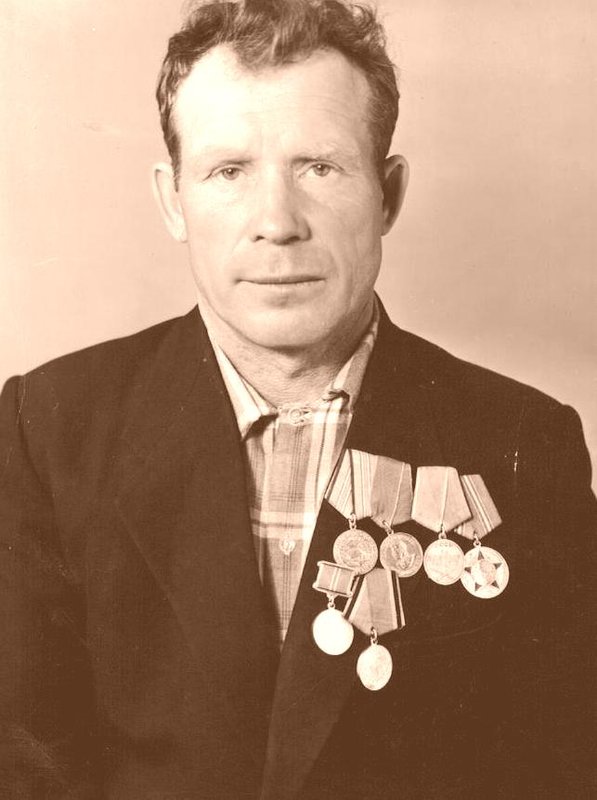

Alexey Nikolaevich Kurilov
Alexey Nikolaevich Kurilov was born in December 1914 in the village of Ditenskaya in Kharovsky district of Vologda region. After finishing seven-years school, he worked as an accountant. Served in army. In Leningrad, he got married and had children. He was called up from Smykovo in Novotorzhsky district of Tver region, where he was on the vacation with his family in his wife's homeland. As soon as he heard about the start of the war, he immediately volunteered for a recruiting station in the village of Talozhnya in the same district. He was 26 years old. His pregnant wife with two small children stayed in the village. The family returned to Leningrad only after the war, and just a few of their property remained there. Kurilov A. N. fought on the Western, Central, Voronezh, 1 Ukrainian, 4 Ukrainian fronts. The front commanders were Zhukov, Rokossovsky, Vatutin, Konev. He served as a foreman, a calculator in top-calculating platoon, went to intelligence, made a map reference for artillery, also in severe natural conditions of Kursk magnetic anomaly. Alexey Nikolaevich walked along the military roads of Moscow, through the Kursk bulge, Ukraine, Czechoslovakia and Poland. Risking his life, he liberated Ukrainian villages and cities from the Nazi invaders: Chernobyl, Sychevka village (malinsky district of Zhytomyr region), Dymer - (Vyshgorod district of Kiev region), Tarnopol. From the characteristics of the senior management for the foreman of the 1st devision of 886 ATKOK regiment Kurilov A. N.: "01.10.1943 in the battles for Chernobyl a cluster of enemy tanks and armored vehicles, preparing for a counterattack, were found, so the guns on direct fire were exposed in dangerous direction." (He wrote that 8 of our tanks were hit and set on fire during the battle. The Germans took the remaining Soviet soldiers on an armored personnel carrier, including him. He jumped over the side into the ravine at the full speed, setting an example to other fighters. In the same way, 5 soldiers and commanders escaped capture and destruction). On 03.11.1943, breaking through the enemy's defenses near Sychevka, he arrived at night and by the light of firelight produced combat documentation, and before the start of the training revealed 1 min. battery and 2 machine-gun points of the enemy. On 06.11.1943, in the battles for Dymer he found and spotted the enemy, which was later suppressed. On 08.03.1944 under Tarnopol in front of the enemy and under heavy artillery fire he made topo-binding of the division and batteries and by extending its course to the side up to 1.5 km, he misled the enemy, who concentrated artillery fire on an empty place. Commander-in-chief I. V. Stalin announced 11 thanks to the 322 Rifle Zhytomyr red banner division named after Suvorov, including 886 Artillery Tarnopol red Banner regiment named after the order of Kutuzov and personally to Kurilov A. N. for the liberation of the Soviet cities of Zhytomyr, Yampol, Tarnopol, Zlochev, Lviv; for the liberation of the Polish cities of Dembice, Krakow; for the liberation of the Czechoslovak cities: Opava, Moravian-Ostrava, Olomouc and for the capture of the German city of Ratibor. His comrades are together with him in the military photos. Here are their surnames: Akentev, Ivanov, Denisov, Kolobkov, Zharkova, Orlik, Popov, Bibikov, Kushnarenko, Stulov, Yurchuk, Garbuzenko, Roslov, Novitsky, Belyaev. All the fighters were photographed by Mykola Polishchuk, who was also often photographed himself. Kurilov A. N. finished his service in September 1945 in Germany. He was awarded the Order and medals, certificates. Always modestly silent, and only on the holiday of may 9, when guests were present, he recalled the previous years of the war. In his stories, he always spoke with respect about other peoples, considering the Soviet Army exclusively liberating in relation to European countries.
Alexey Nikolaevich Kurilov
Alexey Nikolaevich Kurilov was born in December 1914 in the village of Ditenskaya in Kharovsky district of Vologda region. After finishing seven-years school, he worked as an accountant. Served in army. In Leningrad, he got married and had children. He was called up from Smykovo in Novotorzhsky district of Tver region, where he was on the vacation with his family in his wife's homeland. As soon as he heard about the start of the war, he immediately volunteered for a recruiting station in the village of Talozhnya in the same district. He was 26 years old. His pregnant wife with two small children stayed in the village. The family returned to Leningrad only after the war, and just a few of their property remained there. Kurilov A. N. fought on the Western, Central, Voronezh, 1 Ukrainian, 4 Ukrainian fronts. The front commanders were Zhukov, Rokossovsky, Vatutin, Konev. He served as a foreman, a calculator in top-calculating platoon, went to intelligence, made a map reference for artillery, also in severe natural conditions of Kursk magnetic anomaly. Alexey Nikolaevich walked along the military roads of Moscow, through the Kursk bulge, Ukraine, Czechoslovakia and Poland. Risking his life, he liberated Ukrainian villages and cities from the Nazi invaders: Chernobyl, Sychevka village (malinsky district of Zhytomyr region), Dymer - (Vyshgorod district of Kiev region), Tarnopol. From the characteristics of the senior management for the foreman of the 1st devision of 886 ATKOK regiment Kurilov A. N.: "01.10.1943 in the battles for Chernobyl a cluster of enemy tanks and armored vehicles, preparing for a counterattack, were found, so the guns on direct fire were exposed in dangerous direction." (He wrote that 8 of our tanks were hit and set on fire during the battle. The Germans took the remaining Soviet soldiers on an armored personnel carrier, including him. He jumped over the side into the ravine at the full speed, setting an example to other fighters. In the same way, 5 soldiers and commanders escaped capture and destruction). On 03.11.1943, breaking through the enemy's defenses near Sychevka, he arrived at night and by the light of firelight produced combat documentation, and before the start of the training revealed 1 min. battery and 2 machine-gun points of the enemy. On 06.11.1943, in the battles for Dymer he found and spotted the enemy, which was later suppressed. On 08.03.1944 under Tarnopol in front of the enemy and under heavy artillery fire he made topo-binding of the division and batteries and by extending its course to the side up to 1.5 km, he misled the enemy, who concentrated artillery fire on an empty place. Commander-in-chief I. V. Stalin announced 11 thanks to the 322 Rifle Zhytomyr red banner division named after Suvorov, including 886 Artillery Tarnopol red Banner regiment named after the order of Kutuzov and personally to Kurilov A. N. for the liberation of the Soviet cities of Zhytomyr, Yampol, Tarnopol, Zlochev, Lviv; for the liberation of the Polish cities of Dembice, Krakow; for the liberation of the Czechoslovak cities: Opava, Moravian-Ostrava, Olomouc and for the capture of the German city of Ratibor. His comrades are together with him in the military photos. Here are their surnames: Akentev, Ivanov, Denisov, Kolobkov, Zharkova, Orlik, Popov, Bibikov, Kushnarenko, Stulov, Yurchuk, Garbuzenko, Roslov, Novitsky, Belyaev. All the fighters were photographed by Mykola Polishchuk, who was also often photographed himself. Kurilov A. N. finished his service in September 1945 in Germany. He was awarded the Order and medals, certificates. Always modestly silent, and only on the holiday of may 9, when guests were present, he recalled the previous years of the war. In his stories, he always spoke with respect about other peoples, considering the Soviet Army exclusively liberating in relation to European countries.
0 comment



2026 © Russian Military Historical Society Developed by Jetmix