


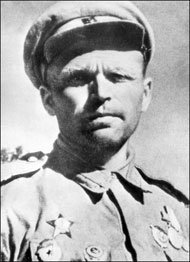
Goncharov Peter Alekseevich
Rank: Senior Sergeant. Branch of troops: Land forces, air forces (except naval aviation), coast service, NKVD troops, border guards. Peter Goncharov was born on January 15, 1903 in the village of Yerzovka (Yerzovskaya parish of the Saratov province, now-Gorodishchensky district of the Volgograd region), in a peasant family. At the age of eight, Peter became an orphan, but it was possible to him to enter the school and work as a shepherd. In Yerzovka, Pyotr Alekseyevich met his wife, Natalia Andreyevna, who came from a large family that earned its bread by producing felt boots. In 1928, the newlyweds leave for Stalingrad, where the construction of the Stalingrad tractor plant was unfolding. In Stalingrad, Pyotr Alekseyevich worked for three years as a carter on the construction of the STZ, and then was able to get a job at the Red October metallurgical plant, where he worked as a castings dresser before the war. The Goncharov family grew rapidly: Natalia Andreyevna gave birth to four sons (Fyodor in 1928, Viktor in 1930, Vladimir in 1932 and Mikhail in 1934). In the village of workers of the Red October plant at Zhukovskiy street Pyotr Alekseyevich build a small private house. During the Stalingrad battle both the house and the street were destroyed. At the front line of the Great Patriotic war, Vladimir Petrovich Goncharov (the hero's son) recalled "that once, after leaving for work, his father did not return and no one knew where he was." Pyotr Goncharov was among the soldiers of the Red October factory workers detachment of the Stalingrad people's militia, which took part in the fighting on the Northern outskirts of the village at the Tractor plant. P. A. Goncharov returned home as a soldier of the Red Army. Pyotr Alekseyevich joined the 44th guards regiment of the 15th guards rifle division on October 3, 1942. A middle-aged soldier without special skills and combat experience first got into the bakery, then ended up in a wagon train, within which he delivered ammunition and food to the regiment on the front line, and took the wounded back. In one of the battles in the area of the Old Rogachik farm, an incident occurred that changed the fate of Peter Alekseevich. During the German attack, Pyotr Goncharov found himself next to a heavily wounded in the stomach driver of an armoured truck. This young armoured car driver passed away in the arms of Pyotr Goncharov. Pyotr Alekseyevich took an anti-tank rifle and hit the enemy car with three accurate shots. This incident did not go unnoticed. The company commander, a participant in the war with Finland, senior Lieutenant Demin, drew attention to a well-aimed fighter from the wagon train and was surprised to learn that Goncharov did not serve in either the tsarist or Red Army. The platoon commander Sologubov became a tutor for Pyotr Alekseyevich. Until November 25, 1942, the future famous sniper destroyed 11 enemy soldiers and officers and burned one vehicle with ammunition from the PTR. This time, the fighter Goncharov uses a simple (as stated in the documents "Russian") rifle-three-line, prepared for him by the company commander. On November 25, 1942, Pyotr Goncharov received a sniper rifle. In battles of January 13 and 14, 1943 sniper of the 1st rifle battalion of the 44th guards rifle regiment P. A. Goncharov distinguished himself. On January 13, in a defensive battle near the village of Stary Rogachik, Pyotr Alekseevich destroyed 17 enemy snipers. During offensive battle on January 14 near the village of Peschany Karier, Pyotr Alekseevich destroyed 47 soldiers and officers. For these two fights, P. A. Goncharov was awarded the medal "for Bravery". In the days of the counter-offensive to the north of Voroponovo settlement Peter Goncharov dueled against two bunkers of the enemy. Here's how Pyotr Alekseevich described it: I was crawling, completelly exausted, and could not even catch a glimpse of the damned bunkers. Ut was so silent. But i knew for sure that the same moment our soldiers will get up from the tranches, hundreds of nazi machine gun bullets start to spray death on them. So my job was to stop nazi from doing that. And then one of our guys couldn't stand it, and rushed forward, I noticed a light smoke. Four hundred meters. Not too good. I did not even check the distance with a tracer bullet, but sent three bullets at once into the embrasure of the bunker, and immediately the machine gun was cut off and fell silent. Soldiers rushed forward. But the second bunker hits even more fiercely. I calculated by eye that it would be nine hundred meters. Reloaded the rifle and released the entire clip without a break. The bunker fell silent. I could not believe that eventually I put lead in his throat. By the end of the battle of Stalingrad, Pyotr Alekseyevich Goncharov had 64 enemy soldiers and officers on his personal account. After Stalingrad battle Peter Alekseevich was placed on leave, but on arrival at his plant village "Red October", he found no family, no home, nor even the street on which the house stood. Pyotr Alekseyevich tried to find the family in Yerzovka, but it was not there either. At this time, the Goncharov family was located in the village of Rynok. According to the memoirs of the youngest son of Mikhail Petrovich during the battle of Stalingrad, they hid at some odd hole. Later on, to search for the family, Pyotr Goncharov turned to the Chairman of the Rostov regional Executive Committee. Only in the summer of 1943, Pyotr Alekseevich received a letter from his wife. In the autumn, the chief of staff of the regiment sent P. A. Goncharov with documents to Stalingrad, where he was able to see his family. During his stay in Stalingrad, Peter Alekseevich, already a well-known sniper, spoke with workers among whom was his native team of the crimping shop about the front line affairs. Sniper P. A. Goncharov was looking for meeting famous sniper Nikolai Yakovlevich Ilyin. And then one fine day two snipers met and under the impression of meeting P. A. Goncharov wrote the poem "The sniper's Duma": "Dark wuthering cloud goes above my Fatherland, it brought bloody battles with it, the terrible war goes on. Red bright Sun, would you rise, please, and warm me, snipper-warrior, give me new, mighty power, let my hands be more firm, give my eyes more vigilance, through the fields of my native land, through the dense forests, in the gray twilight, at dawn I go...I'll wait for the nazi villain and kill him with a bullet. Oh, green Fritz, beware of me, you will not escape retribution, you will not escape justice!" . In the area of the village of Gatische (Kharkiv region, Ukraine) from March 20 to April 1, 1943 guard corporal Goncharov destroyed 32 enemy soldiers and officers, including four snipers and five machine gunners. By this time, Pyotr Alekseevich had trained 6 Red Army soldiers in sniping. For these battles in the area of the Volchansk city, Pyotr Alekseevich was awarded the order of the Red Star and the "Sniper" badge. By the time the award list was issued, the sniper had 96 invaders on his account.Once the commander asked Pyotr Goncharov where he learned to shoot so accurately, and the sniper replied: "the War taught me, comrade Senior Lieutenant! And the fires that burned over Stalingrad for three months ". Pyotr Goncharov became the initiator and soul of mass training of snipers in all parts of the division under the motto "Every fighter is a great shooter!". Peter Alekseevich was helped by his students snipers Mikhail Sokhin, Sizykov, Dmitry Strebkov, Fyodor Sherstyuk with this work. The training was conducted on a personal example: during the battle on April 15, 1943, the guard corporal P. A. Goncharov destroyed 32 enemy soldiers and officers. On April 16, Pyotr Alekseevich was presented to the order of the Red Banner. On the day of registration of the award list on the account of the famous sniper was already 128 soldiers and officers of the enemy. At one and the same time, P.A. Goncharov was awarded by the commander of the 64th army, M. S. Shumilov with the orders of the Red Star and the Red Banner. When presenting the awards, Peter Alekseevich uttered the following words: "From now on, I will increase score of my vengeance even more aggressively, thus bringing the day of our Victory closer." From April 15 to May 29, 1943, the training of fighters was conducted at training camps and practical classes (hunting) in the Seversky Donets region. On May 29, 1943, Pyotr Alekseevich's personal account reached 355 enemy soldiers and officers. After the end of the training camp, Pyotr Goncharov conducted practical training with snipers on the front line until June 25. During this time, he destroyed 25 enemy soldiers and officers, set fire to two bunkers and suppressed 7 enemy firing points. On June 25, 1943, P. A. Goncharov's personal account reached 380 enemy soldiers and officers. By this day, he had trained 9 snipers. For his military achievements, on June 26, the commander of the 44th guards rifle regiment, Lieutenant Colonel Usyk, presented Pyotr Alekseevich to the title of Hero of the Soviet Union. On the same day, the presentation was supported by the commander of the 15th guards rifle division, Major General E. I. Vasilenko, and the commander of the 24th guards rifle corps, Major General Vasiliev. On June 27, the submission was signed by the army commander, Lieutenant General M. S. Shumilov, and on July 20, by the Voronezh front commander, Lieutenant General N. F. Vatutin, and a member of the front's military Council, Lieutenant General N. S. Khrushchev. By the decree of the Presidium of the Supreme Soviet of the USSR of January 10, 1944 for "exemplary performance of command assignments at the front against the nazi invaders and outstanding courage and heroism" guard Sergeant Pyotr Goncharov was awarded the title of the Hero of the Soviet Union. However, the Order of Lenin and medal "Gold Star" were not handed to him, since on January 31, 1944 he perished in the battle for the village Vodianoe Sofiyevsky region of the Dnepropetrovsk oblast, Ukrainian SSR. Thanks to the presentation to the title Hero of the Soviet Union, Pyotr Goncharov was granted leave to travel to Stalingrad. on July 31, 1943, Pyotr Alekseevich was present at the first metal melting on the restored open-hearth furnace No. 0 ("nulik») at the Red October factory. Master Mikhail Vasilyevich Nagorny presented P. A. Goncharov with a piece of metal which he took with him to prove to his colleagues that the restored plant began to produce steel.On January 30, 1944, the 44th guards regiment within the 15th guards division took part in breaking through the enemy's defenses and by the end of the day occupied a number of localities, including the village of Vodianoe. The enemy resistant was stubborn - in the area of the village of Vodianoe, it counterattacked using up to 30 tanks, 4 self-propelled guns, armored vehicles and up to an infantry regiment. A group of snipers under the command of guard Senior Sergeant Pyotr Alekseyevich Goncharov spent the whole day fighting in the encirclement. In this battle, P. A. Goncharov destroyed 30 nazi and brought his score to 441. The guards held their position, but many of them, including Pyotr Alekseyevich Goncharov, perished. Pyotr Alekseyevich Goncharov was buried in a mass grave in the village of Vodianoe. In total, during his participation in the war, Goncharov destroyed 441 enemy soldiers and officers and trained 9 snipers.
Goncharov Peter Alekseevich
Rank: Senior Sergeant. Branch of troops: Land forces, air forces (except naval aviation), coast service, NKVD troops, border guards. Peter Goncharov was born on January 15, 1903 in the village of Yerzovka (Yerzovskaya parish of the Saratov province, now-Gorodishchensky district of the Volgograd region), in a peasant family. At the age of eight, Peter became an orphan, but it was possible to him to enter the school and work as a shepherd. In Yerzovka, Pyotr Alekseyevich met his wife, Natalia Andreyevna, who came from a large family that earned its bread by producing felt boots. In 1928, the newlyweds leave for Stalingrad, where the construction of the Stalingrad tractor plant was unfolding. In Stalingrad, Pyotr Alekseyevich worked for three years as a carter on the construction of the STZ, and then was able to get a job at the Red October metallurgical plant, where he worked as a castings dresser before the war. The Goncharov family grew rapidly: Natalia Andreyevna gave birth to four sons (Fyodor in 1928, Viktor in 1930, Vladimir in 1932 and Mikhail in 1934). In the village of workers of the Red October plant at Zhukovskiy street Pyotr Alekseyevich build a small private house. During the Stalingrad battle both the house and the street were destroyed. At the front line of the Great Patriotic war, Vladimir Petrovich Goncharov (the hero's son) recalled "that once, after leaving for work, his father did not return and no one knew where he was." Pyotr Goncharov was among the soldiers of the Red October factory workers detachment of the Stalingrad people's militia, which took part in the fighting on the Northern outskirts of the village at the Tractor plant. P. A. Goncharov returned home as a soldier of the Red Army. Pyotr Alekseyevich joined the 44th guards regiment of the 15th guards rifle division on October 3, 1942. A middle-aged soldier without special skills and combat experience first got into the bakery, then ended up in a wagon train, within which he delivered ammunition and food to the regiment on the front line, and took the wounded back. In one of the battles in the area of the Old Rogachik farm, an incident occurred that changed the fate of Peter Alekseevich. During the German attack, Pyotr Goncharov found himself next to a heavily wounded in the stomach driver of an armoured truck. This young armoured car driver passed away in the arms of Pyotr Goncharov. Pyotr Alekseyevich took an anti-tank rifle and hit the enemy car with three accurate shots. This incident did not go unnoticed. The company commander, a participant in the war with Finland, senior Lieutenant Demin, drew attention to a well-aimed fighter from the wagon train and was surprised to learn that Goncharov did not serve in either the tsarist or Red Army. The platoon commander Sologubov became a tutor for Pyotr Alekseyevich. Until November 25, 1942, the future famous sniper destroyed 11 enemy soldiers and officers and burned one vehicle with ammunition from the PTR. This time, the fighter Goncharov uses a simple (as stated in the documents "Russian") rifle-three-line, prepared for him by the company commander. On November 25, 1942, Pyotr Goncharov received a sniper rifle. In battles of January 13 and 14, 1943 sniper of the 1st rifle battalion of the 44th guards rifle regiment P. A. Goncharov distinguished himself. On January 13, in a defensive battle near the village of Stary Rogachik, Pyotr Alekseevich destroyed 17 enemy snipers. During offensive battle on January 14 near the village of Peschany Karier, Pyotr Alekseevich destroyed 47 soldiers and officers. For these two fights, P. A. Goncharov was awarded the medal "for Bravery". In the days of the counter-offensive to the north of Voroponovo settlement Peter Goncharov dueled against two bunkers of the enemy. Here's how Pyotr Alekseevich described it: I was crawling, completelly exausted, and could not even catch a glimpse of the damned bunkers. Ut was so silent. But i knew for sure that the same moment our soldiers will get up from the tranches, hundreds of nazi machine gun bullets start to spray death on them. So my job was to stop nazi from doing that. And then one of our guys couldn't stand it, and rushed forward, I noticed a light smoke. Four hundred meters. Not too good. I did not even check the distance with a tracer bullet, but sent three bullets at once into the embrasure of the bunker, and immediately the machine gun was cut off and fell silent. Soldiers rushed forward. But the second bunker hits even more fiercely. I calculated by eye that it would be nine hundred meters. Reloaded the rifle and released the entire clip without a break. The bunker fell silent. I could not believe that eventually I put lead in his throat. By the end of the battle of Stalingrad, Pyotr Alekseyevich Goncharov had 64 enemy soldiers and officers on his personal account. After Stalingrad battle Peter Alekseevich was placed on leave, but on arrival at his plant village "Red October", he found no family, no home, nor even the street on which the house stood. Pyotr Alekseyevich tried to find the family in Yerzovka, but it was not there either. At this time, the Goncharov family was located in the village of Rynok. According to the memoirs of the youngest son of Mikhail Petrovich during the battle of Stalingrad, they hid at some odd hole. Later on, to search for the family, Pyotr Goncharov turned to the Chairman of the Rostov regional Executive Committee. Only in the summer of 1943, Pyotr Alekseevich received a letter from his wife. In the autumn, the chief of staff of the regiment sent P. A. Goncharov with documents to Stalingrad, where he was able to see his family. During his stay in Stalingrad, Peter Alekseevich, already a well-known sniper, spoke with workers among whom was his native team of the crimping shop about the front line affairs. Sniper P. A. Goncharov was looking for meeting famous sniper Nikolai Yakovlevich Ilyin. And then one fine day two snipers met and under the impression of meeting P. A. Goncharov wrote the poem "The sniper's Duma": "Dark wuthering cloud goes above my Fatherland, it brought bloody battles with it, the terrible war goes on. Red bright Sun, would you rise, please, and warm me, snipper-warrior, give me new, mighty power, let my hands be more firm, give my eyes more vigilance, through the fields of my native land, through the dense forests, in the gray twilight, at dawn I go...I'll wait for the nazi villain and kill him with a bullet. Oh, green Fritz, beware of me, you will not escape retribution, you will not escape justice!" . In the area of the village of Gatische (Kharkiv region, Ukraine) from March 20 to April 1, 1943 guard corporal Goncharov destroyed 32 enemy soldiers and officers, including four snipers and five machine gunners. By this time, Pyotr Alekseevich had trained 6 Red Army soldiers in sniping. For these battles in the area of the Volchansk city, Pyotr Alekseevich was awarded the order of the Red Star and the "Sniper" badge. By the time the award list was issued, the sniper had 96 invaders on his account.Once the commander asked Pyotr Goncharov where he learned to shoot so accurately, and the sniper replied: "the War taught me, comrade Senior Lieutenant! And the fires that burned over Stalingrad for three months ". Pyotr Goncharov became the initiator and soul of mass training of snipers in all parts of the division under the motto "Every fighter is a great shooter!". Peter Alekseevich was helped by his students snipers Mikhail Sokhin, Sizykov, Dmitry Strebkov, Fyodor Sherstyuk with this work. The training was conducted on a personal example: during the battle on April 15, 1943, the guard corporal P. A. Goncharov destroyed 32 enemy soldiers and officers. On April 16, Pyotr Alekseevich was presented to the order of the Red Banner. On the day of registration of the award list on the account of the famous sniper was already 128 soldiers and officers of the enemy. At one and the same time, P.A. Goncharov was awarded by the commander of the 64th army, M. S. Shumilov with the orders of the Red Star and the Red Banner. When presenting the awards, Peter Alekseevich uttered the following words: "From now on, I will increase score of my vengeance even more aggressively, thus bringing the day of our Victory closer." From April 15 to May 29, 1943, the training of fighters was conducted at training camps and practical classes (hunting) in the Seversky Donets region. On May 29, 1943, Pyotr Alekseevich's personal account reached 355 enemy soldiers and officers. After the end of the training camp, Pyotr Goncharov conducted practical training with snipers on the front line until June 25. During this time, he destroyed 25 enemy soldiers and officers, set fire to two bunkers and suppressed 7 enemy firing points. On June 25, 1943, P. A. Goncharov's personal account reached 380 enemy soldiers and officers. By this day, he had trained 9 snipers. For his military achievements, on June 26, the commander of the 44th guards rifle regiment, Lieutenant Colonel Usyk, presented Pyotr Alekseevich to the title of Hero of the Soviet Union. On the same day, the presentation was supported by the commander of the 15th guards rifle division, Major General E. I. Vasilenko, and the commander of the 24th guards rifle corps, Major General Vasiliev. On June 27, the submission was signed by the army commander, Lieutenant General M. S. Shumilov, and on July 20, by the Voronezh front commander, Lieutenant General N. F. Vatutin, and a member of the front's military Council, Lieutenant General N. S. Khrushchev. By the decree of the Presidium of the Supreme Soviet of the USSR of January 10, 1944 for "exemplary performance of command assignments at the front against the nazi invaders and outstanding courage and heroism" guard Sergeant Pyotr Goncharov was awarded the title of the Hero of the Soviet Union. However, the Order of Lenin and medal "Gold Star" were not handed to him, since on January 31, 1944 he perished in the battle for the village Vodianoe Sofiyevsky region of the Dnepropetrovsk oblast, Ukrainian SSR. Thanks to the presentation to the title Hero of the Soviet Union, Pyotr Goncharov was granted leave to travel to Stalingrad. on July 31, 1943, Pyotr Alekseevich was present at the first metal melting on the restored open-hearth furnace No. 0 ("nulik») at the Red October factory. Master Mikhail Vasilyevich Nagorny presented P. A. Goncharov with a piece of metal which he took with him to prove to his colleagues that the restored plant began to produce steel.On January 30, 1944, the 44th guards regiment within the 15th guards division took part in breaking through the enemy's defenses and by the end of the day occupied a number of localities, including the village of Vodianoe. The enemy resistant was stubborn - in the area of the village of Vodianoe, it counterattacked using up to 30 tanks, 4 self-propelled guns, armored vehicles and up to an infantry regiment. A group of snipers under the command of guard Senior Sergeant Pyotr Alekseyevich Goncharov spent the whole day fighting in the encirclement. In this battle, P. A. Goncharov destroyed 30 nazi and brought his score to 441. The guards held their position, but many of them, including Pyotr Alekseyevich Goncharov, perished. Pyotr Alekseyevich Goncharov was buried in a mass grave in the village of Vodianoe. In total, during his participation in the war, Goncharov destroyed 441 enemy soldiers and officers and trained 9 snipers.
0 comment



2026 © Russian Military Historical Society Developed by Jetmix