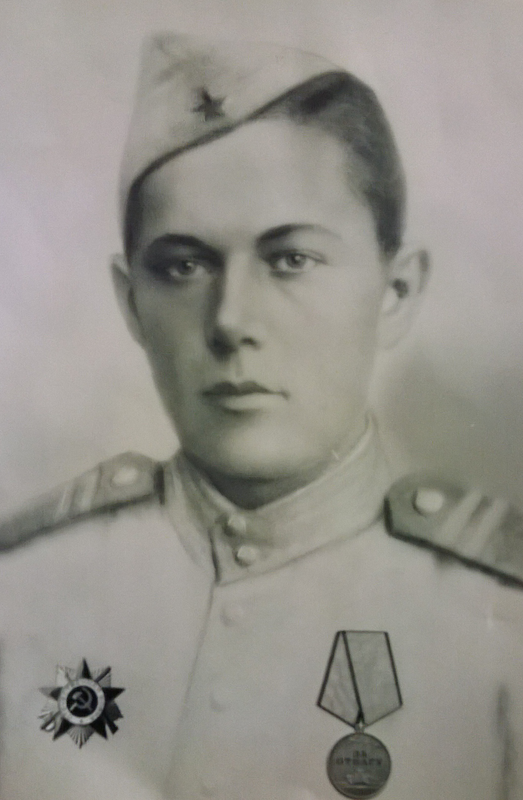
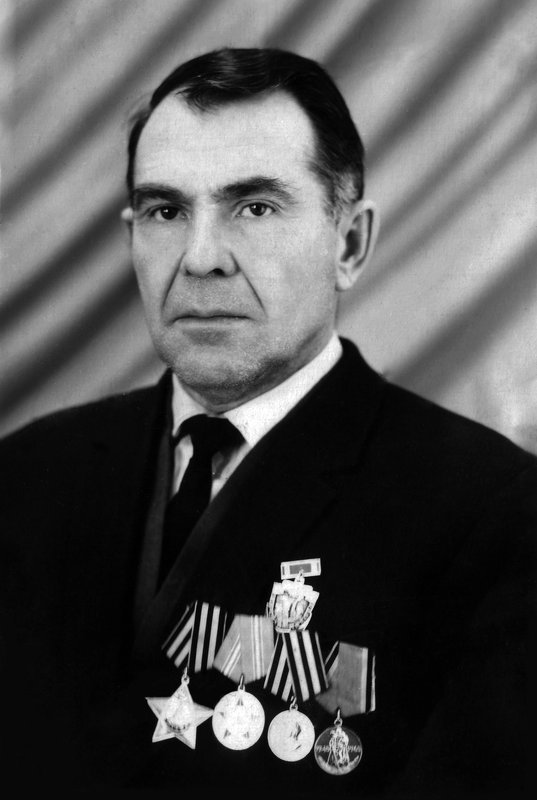
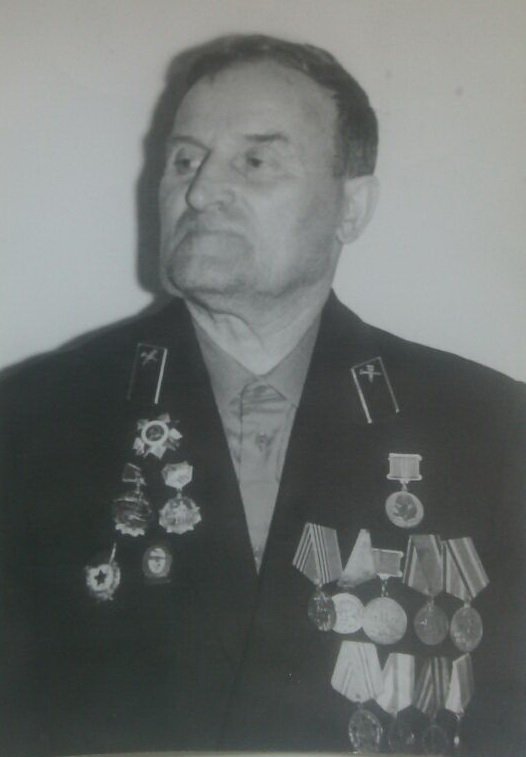
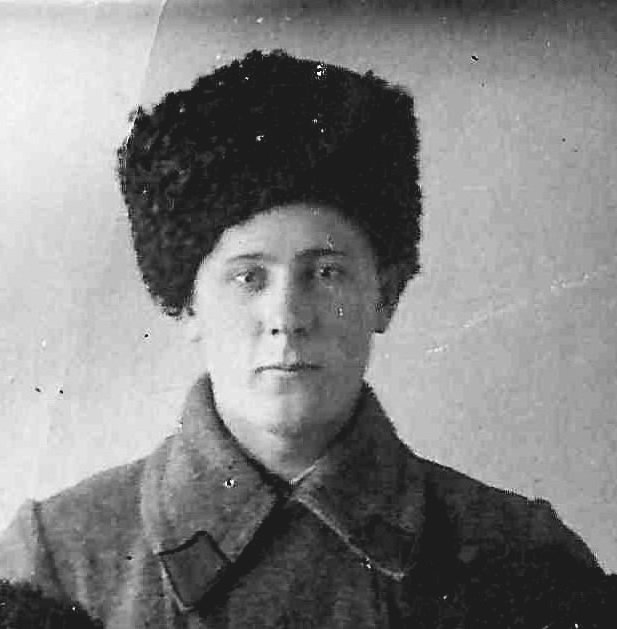
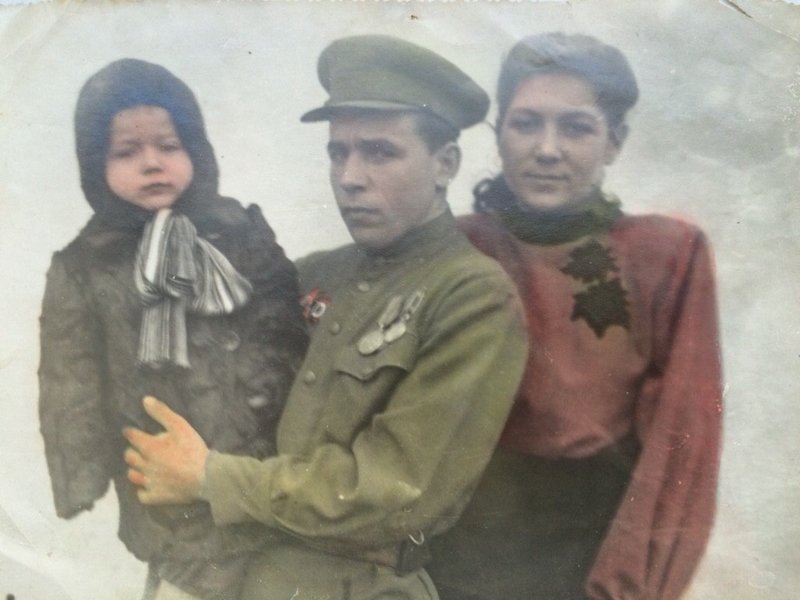


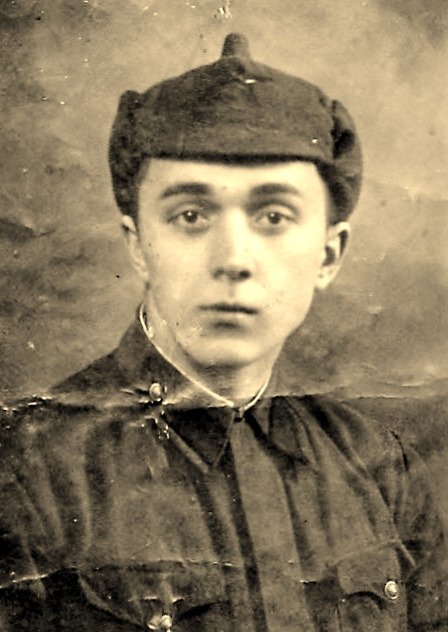
Alexey Vasilevich Gulyaev
Alexey Vasilevich Gulyaev
Rank: Sergeant – Major. Type of troops: Land forces, Air forces (except naval aviation), coast service, NKVD troops (troops of the People's Commissariat of Internal Affairs), border guards Unit: 1st Brest Red banner rifle division. Memories of my grandfather recorded from his personal diary: "To live through ones life is not that easy as to cross a field. I was born into a peasant family. My father died in 1925. The mother was left with five children – the youngest was 9 months old, the eldest was 11 years old. In 1930, the family joined the collective farm. We all helped my mother when she worked on the collective farm. I, as the only man in our family, was engaged in stocking and chopping of firewood. After finishing seven classes, entered the Vologda road technical school and graduated in 1938". He was sent to work in the Ivanovo region to the Semyonovsky district, where he worked as a technician in the road department. On November 24, 1939, he was drafted by the Semyonovsky district military enlistment office of the Kostroma region into the Red Army. While his train with the other conscripts was in Moscow, it was announced at the night time by radio at Krasnaya Presnya, that the war with Finland began. Right after that his train left Moscow. Arrived in the city of Novozybkov in the reserve 800 rifle regiment. Conscripts were placed in a school building with 2-story bunks. They were given a uniform that was already many times used, with the exception of underwear. My boots were torn and my greatcoat was torn. The study began in cramped rooms. During the month of study, no courses for shooting were held. Almost every week, night, and even daytime emergency trainings took place. At the end of December, they began to update uniforms and shoes. Then, without weapons, they were loaded into the train and taken to the city of Brest-Litovsk. Arrived by the night time on January 1, 1940." I got into 1 company 333 rifle regiment 6 Red Banner rifle division. “After a while, I was transferred to a sapper company." He was promoted to the rank of Sergeant, was a foreman of a sapper company and head of a warehouse of engineering property. Most of the sappers were engaged in work: setting up an artillery range, summer camps, and then working on strengthening the border - building trenches with full-length walls, machine-gun nests, artillery protective shelters, wire fences. On the eve of the war, Brest received new samples of weapons and military equipment. Our company was given new diving suits, and it was urgent to master them. A team of 7 people and a company commander were sent to the Mukhovets river to master light diving suits. "I was ordered to take underwear and bedclothes to the comrades working on the border fortification, and also to arrange bath for them until June 20, 1941. When I arrived at the border an order was issued to move 10 kilometers closer to the fortress together with an anti-tank 45 mm battery on horse traction. We arrived at the specified place and started putting up tents. We were joined by 2 lieutenants who graduated from military schools. The company was prepared to increase in size in wartime. They had binoculars, personal weapons, and tablets. When the young people began to view the other side of the river, they told me that we would put the tents under direct fire of German guns. I said that it would be better to put them behind the bushes. But they replied that this very spot was shown on the map. On Saturday, we were engaged in pulling barbed wire on previously scored stakes (six stakes). All the fortifications were finished, but there was no one in them. About two weeks before the war, everyone had sixty rounds in their pouches, but they were ordered to hand over all the cartridges and get six boxes without the right to open them until a special order was issued. I had one box and 420 pieces of an armor-piercing incendiaries as a loose items. All day on Saturday, June 21, "Messer`s" (german aircraft) flew across the border and watched what we were doing. In the morning of June 22, 1941 (Sunday), I got a kick on the legs and someone shouted: "Comrade Sergeant, get up, war started, shells are exploding all around, the tent is torn, bombers are flying in the sky like at a parade formation." I replied: "Comrade commanders, what will be the order?» They respond: "Take weapons and ammunition and withdraw deep into the territory." Together with another Red Army soldier we crawled into the tent to the commanders, took a box with 420 rounds. There was an old road from the border, we ran out, it became brighter, and we saw a balloon with an observer on the other side who was shifting nazi artillery fire to our retreating troops. We left the road, took the cartridges by the tunic and ran. We have not reached the river a little, as Messer catches up with us and scribbles from a machine gun. We were saved by a cliff in the river. We jumped off and I hurt my leg badly. The river was forded. I decided to go to the fortress, there the fires were visible. We met the Sergeant of the signal battalion of our division (we were familiar with him). He said: "we were on exercises yesterday, the commanders went home, but we stayed." We told them it was a war. He fed us and gave us each a pot and a spoon and biscuits with butter. We came to the road Brest-Minsk, it was full of troops. We were recognized as sappers and ordered to help the car with the women and children to get on the road, which we did. On the first day we reached Kobrin. On the second day, they started bombing and shelling. I was hit in the leg by shrapnel during the bombing. My friend perished. Then I got on a cannon that was pulled by C-80 tractor. Suddenly an aircraft bomber attack started on us but I managed to run twenty meters away. The bomb exploded at the gun, and it was turned upside down, but the tractor was still standing intact. I recalled that I had armor-piercing incendiary cartridges, and I started shooting at the second plane diving on the tractor. The plane flew off and there was a big explosion – my bullets hit the target. I heard cheers. The traffic started again. I walked with a limp. Soviet tank caught up with me. On its board a crew from the another tank was riding and several other Red Army soldiers. I was invited as well. The tank moved without stopping during the bombing. The road went through a forest, then out into a field. The infantry standing on the defensive before the exit of the road from the forest, withdrew from the place of defense and left. We drove about 1 km, and the tankers decided to stop. The tank was placed under a tree. Suddenly, a black tank appears from the forest, with a red flag on it. They began to argue that we do not have black tanks, but why the red flag? From the infantry that left, there was only one Red Army man. He was about seventy meters away from us, turned around and raised his hand for a ride. Machine-gun fire rang out from the tank, and the Red Army soldier fell dead. Other tanks were moving behind this tank. We realized that they were nazi. They jumped up and ran across the road to the tank. I ran last. Everyone who ran fell in the middle of the road. I ran across the meadow from the road, I was shot at from a machine gun and even from a cannon. I took short runs to the rye and lay down in the furrow. Small planes flew on both sides of the road and grenades were dropped on the Red Army soldiers who were spotted. I decided to shoot myself when I was alone. Wanted the last round in the chamber on the bolt - does not move. The shrapnel damaged the feed trigger. Tanks and motorcycles went on until the evening, there were at least a hundred of them. When the plane was far away, I went to the farm. The hostess shouts: "Come quickly to the hut, the plane is close, he has already burned one hut, noticing the Red Army man." It turns out that small planes are flying on both sides of the road, cutting off communication. The owners fed me and offered to go to the village to surrender. I said I would not be captured alive. The owner asked me for a tunic in exchange for a jacket and bread. Two days later I caught up with my troops, who were marching along country roads. There were only divisions, there were no small squads. There were about two and a half thousand of us. Some with weapons, some without. An old Colonel was in command, accompanied by a very physically fit nurse. The Colonel asked not to enter the village, but to move on. Nazi began to pursue those who went to the village. Intelligence reported that a hundred meters beyond the pine forest, tanks and cars are starting up. We crawled toward the road. We suddenly got up with a shout of "hurrah" and ran out into the road. I fired armor-piercing incendiary rounds. Nazi were disarrayed, many of the cars caught fire. On the other side of the road was a swamp with small bushes, and then a forest. Planes came and bombed and shelled us. Five hundred of us reached the forest. There was no food. People fell from hunger and were left without help. One day they came to the village and they were shouting: "Hurry up, we'll blow up the bridge." I walked with difficulty, and with me a Red Army soldier from our company. Suddenly someone is shouting from below: "Sergeant-Major, come to us." I didn't react to it. Then they shout: "Gulyaev, come to us." There were seven people who had gone to learn diving suits on the eve of the war. The company commander was with them. We asked for food. They had two loaves of bread and sugar. The company commander said that they are in a fighter squad, destroying bridges and other valuables. We were taken into the squad, there was a car and a T-34 tank. All the retreating troops have passed through the bridge, and the company commander says: "You and I will blow up this bridge." But nazi been watching us from somewhere, paying special attention to the most convenient place to light the cord, and when we were approaching this place they fired at us. The guys and the tank left, the three of us remained. I offered to remove the barrel with the remaining gasoline and ride it over the bridge. Which we actually did. Throwing a match, we jumped on the board of the running car and drove away. The bridge caught fire, then exploded. With our company commander we have also blown up the next big bridge. When they all went in the car, the engine started to sneeze. The car stopped, a Major, the former head of the division's engineering service (who knew me by sight), got out of the cab, and ordered the company commander: "Now we drop off those two guys who came to us from the tank." They left us with a loaf of bread. I never saw the company commander again. We were ordered to arrive at the Lunino railway station. From the station Lunino with another consolidated division on July 6-7 we approached the area of the city of Zhitkovichi. But before entering the city limits I was met by the head of the engineering service of the 125th regiment. He knew that I was the foreman of the sapper company of the 333 rifle regiment in the fortress, and enlisted me as the foreman of the 34th rifle regiment of the 75th rifle division. Gomel was already occupied, and we were in the deep rear. From the Kalinkovichi station, our company was marched to the Sozh river to set up a ferry crossing. The troops were loaded onto railway transport in order to have time to cross the Dnieper river to the city of Rechitsa. In the afternoon, a nazi bomber that we called "the Frame" dropped five missiles over the ferry, and shells flew through us. All the troops went South without stopping. We passed through Chernigov early in the morning and all the city was covered in smoke. We crossed a river by wooden bridge and destroyed this bridge completelly. During the following night nazi have landed their troops and made a river crossing. Our troops failed to destroy the crossing. The retreat began. Suddenly I get an order to drive all horse-drawn carts along a given route to the city of Piriatyn. When I made my way toward mentioned destination, on a large meadow, to the east of Piriatyn, i saw hundreds of carts without horses, and in the middle of the carts was a passenger car ZIS-101 without wheels. I threw everything on the cart into the river, unharnessed the horses, and let them go. I found crackers, lard, and shag in the carts. All my findings i secured in a haversack. After that I found a float of the assault bridge, filled it with hay, and began to ferry it to the other bank. Out of a sudden a wounded Red Army soldier got next to the float and climbed on it. The float began to sink, but we crossed the river. I passed through the Pinsk swamps. I was accompanied by two Red Army men with carbines. To the east of Piriatyn, nazi tank armies had enclosed the ring around the South-Western front. We had to fought our way out of the encirclement. We got to the road. Tanks and motorcycles appeared on the road. I and six other people ran across the plowed field, followed by a motorcycle, but soon it was replaced by a tank. It had already stopped shooting, apparently trying to run us down, but there was a channel with water in front of us and there was a wide board laid across it. We have crossed the channel by this board, and got to a huge stack of hay next to a small hut. The tank came back. Everyone who was on the road was surrounded by motorcycles and tanks. We took a break and moved on. Two days later we again found a large group of our troops. The command told us that the army of Budyonny is behind the Suloy river, we will break through at any cost. Once we were met by eight tanks and infantry. In an open field, we were to fight in hand-to-hand combat, but nazi retreated with their tanks, and so did we. The dead were buried in the village of Luchki, soldier`s medallions that we collected overfilled a military cap, and the church nearby was overcrowded with wounded. The order was given: it is forbidden to cross the river. We decided to defend Luchki. Nazi began to destroy the encircled in small groups. Eventually nazi came close to Luchki. I and another Red Army man were stationed in the garden near the street that runs from the mill. We dug trenches for shooting from the knee and were on duty for three days in a row. On the fourth day, we noticed a nazi tank that came from the mill and someone threw a grenade at it. The tank retreated to the slope. We started throwing grenades. There was a hand-to-hand fight on the slope, we started shooting, just the two of us, no one else. A mortar started to shoot at us. Eight enemy tanks appeared on the mountain near the mill and nazi airplanes start to drop bombes from the skies. I noticed that one of the bombs was flying straight at me and immediatelly i crouched in a small trench like a ball. The bomb exploded. I was shaken and covered with earth. When the clods of earth stopped falling, I saw a shard on my knee like a razor blade. I cut my trousers and underpants. I pulled it out and start to bled. I couldn't get up, I was stuck with clods of earth, and my friend got out first and took me by the hands, and I got out with difficulty. The tanks behind the fence of the garden were ten meters away. We rushed to a shed made of reeds, buried ourselves in the straw, and I fell asleep at once. When i woke up, I feel someone was approaching me. Guessed that it was a friend. It turned out that it was already morning, about 10 o'clock. A boy of 8-10 years old runs into the barn. I ask: "Nazi are in the village?» He responds: "There is no one in the village, yesterday some people were killed by them, some were drowned, and this morning the commanders got on a car, raised a white flag and left to surrender." We decided to cross the river. We went to the church and turned off the main street to the river. Around the corner, six nazi attacked us, brought us to the square and put us into the jail. There were not less than fifteen or twenty people. A soldier started kicking me and shouting something. One of our men understood German and said that he wanted an asterisk from my cap. I gave it to him, and he put it in his wallet. There were no searches, no interrogations. They led us across the bridge, over which we went to attack nazi tanks, there was no Red Army soldiers there. The firs
night we slept in a rabbit shed with two people in a cage. On the second day, we were taken to the city of Mirgorod, where we were engaged in unloading food from the trucks into the church. We spent the night in the attic of a 2-storey building. Then we were arrayed into the column of 10 people. We were escorted by a car with a machine gun mounted on it. Those who could not walk were shot down right away. We were fed once a day. In advance of the arrival of our column, a filthy soup usually had been cooked from corn and potatoes and its ingridients were unwashed and unsalted. At noon, the barrels were placed in the middle of the occupied territory, each barrel had a queue, where there was a dispenser with a ladle and a soldier with a stick. The portion was poured into the dishes, whatever they were, and if there was no pot, then they poured soup into the cap, in the floor of the greatcoat or tunic. If anyone stopped and hesitated, they beat them with a stick. There were very terrible places to stay for the night: one in an open field without any buildings, barbed wire, towers and holes for shelter from the wind, in which two or three people slept. Then we were taken to Kirovograd prison on October 20, 1941. After that we had to move to the city of Uman. I had dysentery. From the courtyard of the old prison nazi start to relocate us to the new 4-story prison building, at night we were allowed into it. It was raining and snowing, and I couldn't find the door. Soon i found out that people were also walking down the concrete stairs on the other side of the building. There they climbed into some rectagular hole on their knees. I did so too, and found myself in a cell on the first floor. But there were so many people there that I could hardly stand up. We slept standing up all night. In the morning they began to expel us. I didn't want to go out, I was cold and thirsty. I went to the farthest cell on the 4th floor. The cell was with two rooms, in the second room there were two dead men, one on top of the other. I sat behind them and began to doze off. I was awakened by the sound of forged boots. Soldiers entered the cell with a shepherd dog, and the dog grabbed my hand, but did not bite. I got up and went. I was the last to be brought to the door of the old prison. They gave me a ration of bread and a ladle of Balanda soup. There was no room, so the soldiers began to push me in the back to close the door. At this time, some hands reached my morsel of bread and began to pull it out of my hands. The pot with a soup was snatched from the other hand below. I started to look for place where I could get medical help. I was told help is provided only if you're dead - nazi will bury you somewhere. A guy comes up to me and asks: "Are you Ukrainian?» I said "i am Russian". He says: "Now the Ukrainians of the city of Kirovohrad and the region are allowed to go home. You look like a Ukrainian, but you should know the address where to check out and the Ukrainian name." He gave me the address. Grebenyuk served with me in our company in the fortress, and I took his last name. I got in line, wrote everything down, and was given a paper certificate. At the exit, they took away my greatcoat and cap, said: "You'll get home without it." This was done by all Ukrainians. Once in the street, a woman called me to her apartment and gave me a plate of borsh soup and a piece of bread: "You can't have more than that now or you'll die." Her husband came and we had a talk. Their son was in military service somewhere. In the evening, they took me to the fence, moved one board and said: "Go, they'll meet you there." A young man met me, called me to the veranda, told me to strip down completelly and put my uniform aside. There were plenty of diffenent clothes next to the door. He offered me to lie down on the bed, which i did and fell asleep immediately. Then when i was abruptly woked up, he said: "Its morning already." He gave me a cup of milk, a piece of white bread, a ragged coat, and a hat. And told me to forget this address. I went in the opposite direction from where they led. I couldn't walk. I asked to spend the night in the first village. I was told to take everything off. They put me in a russian oven to kill lice, and they washed me in a trough and put me on a bench on a mat, and covered me with a rug. After the uniforms were heat treated I was woken up. I got dressed. They fed me and asked me to leave. I was told that I can't cross the Dnieper, it's like a border. Everything that can float was confiscated. The Germans are somewhere near Moscow, but Odessa is not taken, Recommended me to go to Odessa. I decided to bypass Kirovograd from the Eastern side. I asked to spend the night in the first village. There were elderly people - a husband and his wife. I was warmly welcomed and they decided to treat me. I was still lying on the stove. The owner – an old beekeeper - treated me with herbs, and my dysentery passed, and I got stronger myself. They saw me off with tears. They wished they had a son (he was at war), otherwise they would have fed me until the Red Army arrived. They said that Odessa was taken and it is better to go to Moscow, which I did. I walked with the great difficulty and got to the Minsk-Moscow road. In 20 km from this very road in 1937 I been staying at the village of Guta of the Kholopenitsky district while beeing on practical studies. From the army, I wrote letters to a girl who invited me to visit them when I returned from the army. And here I was in rags and barely alive. She was a respectable girl, and I was a beggar. Two days later I saw that the village was surrounded by nazi. All locals were taken out to the street. The frost was 25 degrees or more. I was wearing a raincoat shirt and ragged trousers, and no underwear. I was taken to the brink of the village. In March, a local agronomist together with the police officer came to pick me up. I was transfered to Kholopenichi and locked up at the bullpen. Then they took me to the Krupki station. Next from Krupki i was transfered to Minsk and held there for four days before my train to Germany departed. I was so hungry that I don't remember being taken from the train to the city. We were put in a big trucks and taken to the mountains. We worked in the mountains, cutting down the windfall ridges suitable for the paper mill, prepared holes among the rocks and carried earth into them for planting Christmas trees. Twelve people-teenagers, the elderly, and myself - were sent down to the city since we were unable to work effectivelly. We were bought, apparently, by the city Council. We took part in restoring of the roadway, and on Sunday`s we were engaged in unloading of the mosaic stone blocks for paving the streets. The food was very poor. One fell ill with tuberculosis and was sent somewhere. I became sick with the pneumonia as well. One of us had swollen legs from hunger. Three from our "squad" decided to run away. I was also invited, but I could hardly walk. Two days later we saw them under police escort. They shouted to us that we couldn't escape from here. They were never seen again. Over the summer, we, nine people, dug three ponds, then worked on the construction of cottages for high authorities. For the winter, we were resold to the city of Weidenau for a refractory brick factory. Our fellow compatriots were already there. They lived in a former stable. The guards were from volksturm. First we worked in a quarry for the extraction of kaolin (white clay), then we were transferred to work at the factory. Cars with coal, stone, sand and fireclay were unloaded, fireclay cement and purified white clay were loaded into the cars. The work was very hard, even on Sundays the coal wagons were unloaded. The food was poor. We lived in a brick building (a former stable) with two windows and an iron door. There were 3-story bunks with straw stuffed mattresses. Each time after the job was over we prefered to stay naked since it was so hot. On Sunday`s, we usually boiled all our clothes in a cauldron in the street to got rid of lice. There were bedbugs and fleas in our humble dweling. At night, a latrine bucket was placed next to the door and the door was locked. The guards had shepherd dogs. But apparently we were resold once again. They delivered us to the city of Hohenelbe to the sawmill. At this plant throughout the winter we were cleaning the tracks for trolleys from snow. There was so much snow this winter that you couldn't see the communication poles. At night, no one was guarding us, since it was impossible to escape. In the spring, we were transferred to the camp of another factory, and then we worked at it. The factory produced gliders and a rocket Fagu-1. It was a hard job: unloading wagons with coal, carrying boards to and from the dryer to the factory, cleaning toilets. The food was better than in other places. One guy worked in a pigsty, where we were stealing potatoes that was stored for pigs. The also brought leftovers of the meals from another factory to the pigsty, and we were consuming them. On May 5 or 6, the Czechs came to the city, and power passed into their hands. On May 11, the Red Army arrived. The first train that went from Germany was occupied by russians. We were transfered to the city of the Moravian Islands, there was a repatriation point, at which we were told as follows: "Who was in the captivity, go to the railway station, there is a collection point." I went there. When a hundred and twenty people were gathered, rations were given and, accompanied by a Senior Sergeant, we were transfered to the former Auschwitz concentration camp at the distance of 120 km from the city of Moravian Island. We marched, we rode on the roof of the train coaches. Whatever , we made it, we got there, but not all of us. In the evening we approached the camp and entered it the following morning. Interrogations started. 31 investigators worked. I was called up by the Investigator-Captain, who said: "Prove that you are not a spy – and you will go home." After that, they called me to the commandant's office with my things. There were about twenty of us there, all of us with secondary or higher education. An officer and four submachine gunners came out. We stood in a line. "Call for attention" command sounded. We were taken out of the main camp and taken to a single barrack. There were former major criminals, former commanders and officers of the traitor`s Vlasov army. From this restricted company we were called to the commandant's office for questioning around the clock under the escort of a submachine gunner. If a person was called for interrogation in the night time with belongings, he never returned since he was sent to a prison, most probably to the city of Krakow.
Alexey Vasilevich Gulyaev
Alexey Vasilevich Gulyaev
Rank: Sergeant – Major. Type of troops: Land forces, Air forces (except naval aviation), coast service, NKVD troops (troops of the People's Commissariat of Internal Affairs), border guards Unit: 1st Brest Red banner rifle division. Memories of my grandfather recorded from his personal diary: "To live through ones life is not that easy as to cross a field. I was born into a peasant family. My father died in 1925. The mother was left with five children – the youngest was 9 months old, the eldest was 11 years old. In 1930, the family joined the collective farm. We all helped my mother when she worked on the collective farm. I, as the only man in our family, was engaged in stocking and chopping of firewood. After finishing seven classes, entered the Vologda road technical school and graduated in 1938". He was sent to work in the Ivanovo region to the Semyonovsky district, where he worked as a technician in the road department. On November 24, 1939, he was drafted by the Semyonovsky district military enlistment office of the Kostroma region into the Red Army. While his train with the other conscripts was in Moscow, it was announced at the night time by radio at Krasnaya Presnya, that the war with Finland began. Right after that his train left Moscow. Arrived in the city of Novozybkov in the reserve 800 rifle regiment. Conscripts were placed in a school building with 2-story bunks. They were given a uniform that was already many times used, with the exception of underwear. My boots were torn and my greatcoat was torn. The study began in cramped rooms. During the month of study, no courses for shooting were held. Almost every week, night, and even daytime emergency trainings took place. At the end of December, they began to update uniforms and shoes. Then, without weapons, they were loaded into the train and taken to the city of Brest-Litovsk. Arrived by the night time on January 1, 1940." I got into 1 company 333 rifle regiment 6 Red Banner rifle division. “After a while, I was transferred to a sapper company." He was promoted to the rank of Sergeant, was a foreman of a sapper company and head of a warehouse of engineering property. Most of the sappers were engaged in work: setting up an artillery range, summer camps, and then working on strengthening the border - building trenches with full-length walls, machine-gun nests, artillery protective shelters, wire fences. On the eve of the war, Brest received new samples of weapons and military equipment. Our company was given new diving suits, and it was urgent to master them. A team of 7 people and a company commander were sent to the Mukhovets river to master light diving suits. "I was ordered to take underwear and bedclothes to the comrades working on the border fortification, and also to arrange bath for them until June 20, 1941. When I arrived at the border an order was issued to move 10 kilometers closer to the fortress together with an anti-tank 45 mm battery on horse traction. We arrived at the specified place and started putting up tents. We were joined by 2 lieutenants who graduated from military schools. The company was prepared to increase in size in wartime. They had binoculars, personal weapons, and tablets. When the young people began to view the other side of the river, they told me that we would put the tents under direct fire of German guns. I said that it would be better to put them behind the bushes. But they replied that this very spot was shown on the map. On Saturday, we were engaged in pulling barbed wire on previously scored stakes (six stakes). All the fortifications were finished, but there was no one in them. About two weeks before the war, everyone had sixty rounds in their pouches, but they were ordered to hand over all the cartridges and get six boxes without the right to open them until a special order was issued. I had one box and 420 pieces of an armor-piercing incendiaries as a loose items. All day on Saturday, June 21, "Messer`s" (german aircraft) flew across the border and watched what we were doing. In the morning of June 22, 1941 (Sunday), I got a kick on the legs and someone shouted: "Comrade Sergeant, get up, war started, shells are exploding all around, the tent is torn, bombers are flying in the sky like at a parade formation." I replied: "Comrade commanders, what will be the order?» They respond: "Take weapons and ammunition and withdraw deep into the territory." Together with another Red Army soldier we crawled into the tent to the commanders, took a box with 420 rounds. There was an old road from the border, we ran out, it became brighter, and we saw a balloon with an observer on the other side who was shifting nazi artillery fire to our retreating troops. We left the road, took the cartridges by the tunic and ran. We have not reached the river a little, as Messer catches up with us and scribbles from a machine gun. We were saved by a cliff in the river. We jumped off and I hurt my leg badly. The river was forded. I decided to go to the fortress, there the fires were visible. We met the Sergeant of the signal battalion of our division (we were familiar with him). He said: "we were on exercises yesterday, the commanders went home, but we stayed." We told them it was a war. He fed us and gave us each a pot and a spoon and biscuits with butter. We came to the road Brest-Minsk, it was full of troops. We were recognized as sappers and ordered to help the car with the women and children to get on the road, which we did. On the first day we reached Kobrin. On the second day, they started bombing and shelling. I was hit in the leg by shrapnel during the bombing. My friend perished. Then I got on a cannon that was pulled by C-80 tractor. Suddenly an aircraft bomber attack started on us but I managed to run twenty meters away. The bomb exploded at the gun, and it was turned upside down, but the tractor was still standing intact. I recalled that I had armor-piercing incendiary cartridges, and I started shooting at the second plane diving on the tractor. The plane flew off and there was a big explosion – my bullets hit the target. I heard cheers. The traffic started again. I walked with a limp. Soviet tank caught up with me. On its board a crew from the another tank was riding and several other Red Army soldiers. I was invited as well. The tank moved without stopping during the bombing. The road went through a forest, then out into a field. The infantry standing on the defensive before the exit of the road from the forest, withdrew from the place of defense and left. We drove about 1 km, and the tankers decided to stop. The tank was placed under a tree. Suddenly, a black tank appears from the forest, with a red flag on it. They began to argue that we do not have black tanks, but why the red flag? From the infantry that left, there was only one Red Army man. He was about seventy meters away from us, turned around and raised his hand for a ride. Machine-gun fire rang out from the tank, and the Red Army soldier fell dead. Other tanks were moving behind this tank. We realized that they were nazi. They jumped up and ran across the road to the tank. I ran last. Everyone who ran fell in the middle of the road. I ran across the meadow from the road, I was shot at from a machine gun and even from a cannon. I took short runs to the rye and lay down in the furrow. Small planes flew on both sides of the road and grenades were dropped on the Red Army soldiers who were spotted. I decided to shoot myself when I was alone. Wanted the last round in the chamber on the bolt - does not move. The shrapnel damaged the feed trigger. Tanks and motorcycles went on until the evening, there were at least a hundred of them. When the plane was far away, I went to the farm. The hostess shouts: "Come quickly to the hut, the plane is close, he has already burned one hut, noticing the Red Army man." It turns out that small planes are flying on both sides of the road, cutting off communication. The owners fed me and offered to go to the village to surrender. I said I would not be captured alive. The owner asked me for a tunic in exchange for a jacket and bread. Two days later I caught up with my troops, who were marching along country roads. There were only divisions, there were no small squads. There were about two and a half thousand of us. Some with weapons, some without. An old Colonel was in command, accompanied by a very physically fit nurse. The Colonel asked not to enter the village, but to move on. Nazi began to pursue those who went to the village. Intelligence reported that a hundred meters beyond the pine forest, tanks and cars are starting up. We crawled toward the road. We suddenly got up with a shout of "hurrah" and ran out into the road. I fired armor-piercing incendiary rounds. Nazi were disarrayed, many of the cars caught fire. On the other side of the road was a swamp with small bushes, and then a forest. Planes came and bombed and shelled us. Five hundred of us reached the forest. There was no food. People fell from hunger and were left without help. One day they came to the village and they were shouting: "Hurry up, we'll blow up the bridge." I walked with difficulty, and with me a Red Army soldier from our company. Suddenly someone is shouting from below: "Sergeant-Major, come to us." I didn't react to it. Then they shout: "Gulyaev, come to us." There were seven people who had gone to learn diving suits on the eve of the war. The company commander was with them. We asked for food. They had two loaves of bread and sugar. The company commander said that they are in a fighter squad, destroying bridges and other valuables. We were taken into the squad, there was a car and a T-34 tank. All the retreating troops have passed through the bridge, and the company commander says: "You and I will blow up this bridge." But nazi been watching us from somewhere, paying special attention to the most convenient place to light the cord, and when we were approaching this place they fired at us. The guys and the tank left, the three of us remained. I offered to remove the barrel with the remaining gasoline and ride it over the bridge. Which we actually did. Throwing a match, we jumped on the board of the running car and drove away. The bridge caught fire, then exploded. With our company commander we have also blown up the next big bridge. When they all went in the car, the engine started to sneeze. The car stopped, a Major, the former head of the division's engineering service (who knew me by sight), got out of the cab, and ordered the company commander: "Now we drop off those two guys who came to us from the tank." They left us with a loaf of bread. I never saw the company commander again. We were ordered to arrive at the Lunino railway station. From the station Lunino with another consolidated division on July 6-7 we approached the area of the city of Zhitkovichi. But before entering the city limits I was met by the head of the engineering service of the 125th regiment. He knew that I was the foreman of the sapper company of the 333 rifle regiment in the fortress, and enlisted me as the foreman of the 34th rifle regiment of the 75th rifle division. Gomel was already occupied, and we were in the deep rear. From the Kalinkovichi station, our company was marched to the Sozh river to set up a ferry crossing. The troops were loaded onto railway transport in order to have time to cross the Dnieper river to the city of Rechitsa. In the afternoon, a nazi bomber that we called "the Frame" dropped five missiles over the ferry, and shells flew through us. All the troops went South without stopping. We passed through Chernigov early in the morning and all the city was covered in smoke. We crossed a river by wooden bridge and destroyed this bridge completelly. During the following night nazi have landed their troops and made a river crossing. Our troops failed to destroy the crossing. The retreat began. Suddenly I get an order to drive all horse-drawn carts along a given route to the city of Piriatyn. When I made my way toward mentioned destination, on a large meadow, to the east of Piriatyn, i saw hundreds of carts without horses, and in the middle of the carts was a passenger car ZIS-101 without wheels. I threw everything on the cart into the river, unharnessed the horses, and let them go. I found crackers, lard, and shag in the carts. All my findings i secured in a haversack. After that I found a float of the assault bridge, filled it with hay, and began to ferry it to the other bank. Out of a sudden a wounded Red Army soldier got next to the float and climbed on it. The float began to sink, but we crossed the river. I passed through the Pinsk swamps. I was accompanied by two Red Army men with carbines. To the east of Piriatyn, nazi tank armies had enclosed the ring around the South-Western front. We had to fought our way out of the encirclement. We got to the road. Tanks and motorcycles appeared on the road. I and six other people ran across the plowed field, followed by a motorcycle, but soon it was replaced by a tank. It had already stopped shooting, apparently trying to run us down, but there was a channel with water in front of us and there was a wide board laid across it. We have crossed the channel by this board, and got to a huge stack of hay next to a small hut. The tank came back. Everyone who was on the road was surrounded by motorcycles and tanks. We took a break and moved on. Two days later we again found a large group of our troops. The command told us that the army of Budyonny is behind the Suloy river, we will break through at any cost. Once we were met by eight tanks and infantry. In an open field, we were to fight in hand-to-hand combat, but nazi retreated with their tanks, and so did we. The dead were buried in the village of Luchki, soldier`s medallions that we collected overfilled a military cap, and the church nearby was overcrowded with wounded. The order was given: it is forbidden to cross the river. We decided to defend Luchki. Nazi began to destroy the encircled in small groups. Eventually nazi came close to Luchki. I and another Red Army man were stationed in the garden near the street that runs from the mill. We dug trenches for shooting from the knee and were on duty for three days in a row. On the fourth day, we noticed a nazi tank that came from the mill and someone threw a grenade at it. The tank retreated to the slope. We started throwing grenades. There was a hand-to-hand fight on the slope, we started shooting, just the two of us, no one else. A mortar started to shoot at us. Eight enemy tanks appeared on the mountain near the mill and nazi airplanes start to drop bombes from the skies. I noticed that one of the bombs was flying straight at me and immediatelly i crouched in a small trench like a ball. The bomb exploded. I was shaken and covered with earth. When the clods of earth stopped falling, I saw a shard on my knee like a razor blade. I cut my trousers and underpants. I pulled it out and start to bled. I couldn't get up, I was stuck with clods of earth, and my friend got out first and took me by the hands, and I got out with difficulty. The tanks behind the fence of the garden were ten meters away. We rushed to a shed made of reeds, buried ourselves in the straw, and I fell asleep at once. When i woke up, I feel someone was approaching me. Guessed that it was a friend. It turned out that it was already morning, about 10 o'clock. A boy of 8-10 years old runs into the barn. I ask: "Nazi are in the village?» He responds: "There is no one in the village, yesterday some people were killed by them, some were drowned, and this morning the commanders got on a car, raised a white flag and left to surrender." We decided to cross the river. We went to the church and turned off the main street to the river. Around the corner, six nazi attacked us, brought us to the square and put us into the jail. There were not less than fifteen or twenty people. A soldier started kicking me and shouting something. One of our men understood German and said that he wanted an asterisk from my cap. I gave it to him, and he put it in his wallet. There were no searches, no interrogations. They led us across the bridge, over which we went to attack nazi tanks, there was no Red Army soldiers there. The firs
night we slept in a rabbit shed with two people in a cage. On the second day, we were taken to the city of Mirgorod, where we were engaged in unloading food from the trucks into the church. We spent the night in the attic of a 2-storey building. Then we were arrayed into the column of 10 people. We were escorted by a car with a machine gun mounted on it. Those who could not walk were shot down right away. We were fed once a day. In advance of the arrival of our column, a filthy soup usually had been cooked from corn and potatoes and its ingridients were unwashed and unsalted. At noon, the barrels were placed in the middle of the occupied territory, each barrel had a queue, where there was a dispenser with a ladle and a soldier with a stick. The portion was poured into the dishes, whatever they were, and if there was no pot, then they poured soup into the cap, in the floor of the greatcoat or tunic. If anyone stopped and hesitated, they beat them with a stick. There were very terrible places to stay for the night: one in an open field without any buildings, barbed wire, towers and holes for shelter from the wind, in which two or three people slept. Then we were taken to Kirovograd prison on October 20, 1941. After that we had to move to the city of Uman. I had dysentery. From the courtyard of the old prison nazi start to relocate us to the new 4-story prison building, at night we were allowed into it. It was raining and snowing, and I couldn't find the door. Soon i found out that people were also walking down the concrete stairs on the other side of the building. There they climbed into some rectagular hole on their knees. I did so too, and found myself in a cell on the first floor. But there were so many people there that I could hardly stand up. We slept standing up all night. In the morning they began to expel us. I didn't want to go out, I was cold and thirsty. I went to the farthest cell on the 4th floor. The cell was with two rooms, in the second room there were two dead men, one on top of the other. I sat behind them and began to doze off. I was awakened by the sound of forged boots. Soldiers entered the cell with a shepherd dog, and the dog grabbed my hand, but did not bite. I got up and went. I was the last to be brought to the door of the old prison. They gave me a ration of bread and a ladle of Balanda soup. There was no room, so the soldiers began to push me in the back to close the door. At this time, some hands reached my morsel of bread and began to pull it out of my hands. The pot with a soup was snatched from the other hand below. I started to look for place where I could get medical help. I was told help is provided only if you're dead - nazi will bury you somewhere. A guy comes up to me and asks: "Are you Ukrainian?» I said "i am Russian". He says: "Now the Ukrainians of the city of Kirovohrad and the region are allowed to go home. You look like a Ukrainian, but you should know the address where to check out and the Ukrainian name." He gave me the address. Grebenyuk served with me in our company in the fortress, and I took his last name. I got in line, wrote everything down, and was given a paper certificate. At the exit, they took away my greatcoat and cap, said: "You'll get home without it." This was done by all Ukrainians. Once in the street, a woman called me to her apartment and gave me a plate of borsh soup and a piece of bread: "You can't have more than that now or you'll die." Her husband came and we had a talk. Their son was in military service somewhere. In the evening, they took me to the fence, moved one board and said: "Go, they'll meet you there." A young man met me, called me to the veranda, told me to strip down completelly and put my uniform aside. There were plenty of diffenent clothes next to the door. He offered me to lie down on the bed, which i did and fell asleep immediately. Then when i was abruptly woked up, he said: "Its morning already." He gave me a cup of milk, a piece of white bread, a ragged coat, and a hat. And told me to forget this address. I went in the opposite direction from where they led. I couldn't walk. I asked to spend the night in the first village. I was told to take everything off. They put me in a russian oven to kill lice, and they washed me in a trough and put me on a bench on a mat, and covered me with a rug. After the uniforms were heat treated I was woken up. I got dressed. They fed me and asked me to leave. I was told that I can't cross the Dnieper, it's like a border. Everything that can float was confiscated. The Germans are somewhere near Moscow, but Odessa is not taken, Recommended me to go to Odessa. I decided to bypass Kirovograd from the Eastern side. I asked to spend the night in the first village. There were elderly people - a husband and his wife. I was warmly welcomed and they decided to treat me. I was still lying on the stove. The owner – an old beekeeper - treated me with herbs, and my dysentery passed, and I got stronger myself. They saw me off with tears. They wished they had a son (he was at war), otherwise they would have fed me until the Red Army arrived. They said that Odessa was taken and it is better to go to Moscow, which I did. I walked with the great difficulty and got to the Minsk-Moscow road. In 20 km from this very road in 1937 I been staying at the village of Guta of the Kholopenitsky district while beeing on practical studies. From the army, I wrote letters to a girl who invited me to visit them when I returned from the army. And here I was in rags and barely alive. She was a respectable girl, and I was a beggar. Two days later I saw that the village was surrounded by nazi. All locals were taken out to the street. The frost was 25 degrees or more. I was wearing a raincoat shirt and ragged trousers, and no underwear. I was taken to the brink of the village. In March, a local agronomist together with the police officer came to pick me up. I was transfered to Kholopenichi and locked up at the bullpen. Then they took me to the Krupki station. Next from Krupki i was transfered to Minsk and held there for four days before my train to Germany departed. I was so hungry that I don't remember being taken from the train to the city. We were put in a big trucks and taken to the mountains. We worked in the mountains, cutting down the windfall ridges suitable for the paper mill, prepared holes among the rocks and carried earth into them for planting Christmas trees. Twelve people-teenagers, the elderly, and myself - were sent down to the city since we were unable to work effectivelly. We were bought, apparently, by the city Council. We took part in restoring of the roadway, and on Sunday`s we were engaged in unloading of the mosaic stone blocks for paving the streets. The food was very poor. One fell ill with tuberculosis and was sent somewhere. I became sick with the pneumonia as well. One of us had swollen legs from hunger. Three from our "squad" decided to run away. I was also invited, but I could hardly walk. Two days later we saw them under police escort. They shouted to us that we couldn't escape from here. They were never seen again. Over the summer, we, nine people, dug three ponds, then worked on the construction of cottages for high authorities. For the winter, we were resold to the city of Weidenau for a refractory brick factory. Our fellow compatriots were already there. They lived in a former stable. The guards were from volksturm. First we worked in a quarry for the extraction of kaolin (white clay), then we were transferred to work at the factory. Cars with coal, stone, sand and fireclay were unloaded, fireclay cement and purified white clay were loaded into the cars. The work was very hard, even on Sundays the coal wagons were unloaded. The food was poor. We lived in a brick building (a former stable) with two windows and an iron door. There were 3-story bunks with straw stuffed mattresses. Each time after the job was over we prefered to stay naked since it was so hot. On Sunday`s, we usually boiled all our clothes in a cauldron in the street to got rid of lice. There were bedbugs and fleas in our humble dweling. At night, a latrine bucket was placed next to the door and the door was locked. The guards had shepherd dogs. But apparently we were resold once again. They delivered us to the city of Hohenelbe to the sawmill. At this plant throughout the winter we were cleaning the tracks for trolleys from snow. There was so much snow this winter that you couldn't see the communication poles. At night, no one was guarding us, since it was impossible to escape. In the spring, we were transferred to the camp of another factory, and then we worked at it. The factory produced gliders and a rocket Fagu-1. It was a hard job: unloading wagons with coal, carrying boards to and from the dryer to the factory, cleaning toilets. The food was better than in other places. One guy worked in a pigsty, where we were stealing potatoes that was stored for pigs. The also brought leftovers of the meals from another factory to the pigsty, and we were consuming them. On May 5 or 6, the Czechs came to the city, and power passed into their hands. On May 11, the Red Army arrived. The first train that went from Germany was occupied by russians. We were transfered to the city of the Moravian Islands, there was a repatriation point, at which we were told as follows: "Who was in the captivity, go to the railway station, there is a collection point." I went there. When a hundred and twenty people were gathered, rations were given and, accompanied by a Senior Sergeant, we were transfered to the former Auschwitz concentration camp at the distance of 120 km from the city of Moravian Island. We marched, we rode on the roof of the train coaches. Whatever , we made it, we got there, but not all of us. In the evening we approached the camp and entered it the following morning. Interrogations started. 31 investigators worked. I was called up by the Investigator-Captain, who said: "Prove that you are not a spy – and you will go home." After that, they called me to the commandant's office with my things. There were about twenty of us there, all of us with secondary or higher education. An officer and four submachine gunners came out. We stood in a line. "Call for attention" command sounded. We were taken out of the main camp and taken to a single barrack. There were former major criminals, former commanders and officers of the traitor`s Vlasov army. From this restricted company we were called to the commandant's office for questioning around the clock under the escort of a submachine gunner. If a person was called for interrogation in the night time with belongings, he never returned since he was sent to a prison, most probably to the city of Krakow.
0 comment




2026 © Russian Military Historical Society Developed by Jetmix