


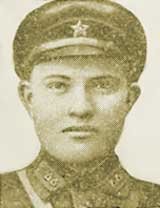

Gorbunov Dmitry Ivanovich
Rank: Red Army. My great-grandfather is Dmitry Ivanovich Gorbunov, born on 02.04.1902, a native of the village of Okatovo, Nikologorsky (now Vyaznikovsky) district of the Vladimir region. On August 29, 1941, he was drafted into the ranks of the Red Army, fought on the Southern Front, took part in the Kharkov operation in May 1942, and disappeared without a trace in 1942. For many years, our family did not know anything about his fate, but we believed and hoped that he would definitely be found. Last year, on May 9, in TsAMO, we finally found our great-grandfather, grandfather and father and learned about his difficult fate. My grandmother saw her dad again, whom she had not seen for 75 years, from the very minute he went to the front ... she was then only 4 years old. This photo from a German concentration camp is his only photo. Here's what we learned: in May 1942, during the battle for Kharkov, our troops went over to the offensive, but after the counter-offensive of the Wehrmacht troops by May 23, a significant part of the troops of the Red Army's shock group was surrounded in the Merefa-Lozovaya-Balakleya triangle. Two days later, the encircled units launched incessant mass infantry attacks eastward to break out of the encirclement. They suffered heavy losses, but could not escape. Attempts to break through the encirclement from the east continued until May 30. It was not possible to break through the German defenses, either from the inside or from the outside. Only every tenth of those surrounded could escape from the “Barvenkovo trap”. Soviet losses amounted to more than a quarter of a million people. My great-grandfather was captured on May 24, 1942. On May 4, 1944, he died in the German camp for Soviet prisoners of war Stalag VI K (326), never waiting for Victory. He was buried in a mass grave in the same camp in Bergen-Belsen. He left a wife and four children: Elizaveta, Yegor, Sergei and Nina - my grandmother (the elder Yegor was then also called to the front). When she was told that her dad was found, finally found !!! Granny cried, looked at the photo and cried, because she had not seen her father for 75 years! And now she herself is already a gray-haired old woman, she looks at an old photo taken in the camp by her father's tormentors (someone's ruthless indifferent hand in a German uniform holds a plate with flip-flops, and on it his camp number ...) and now we see in front of us is not an old woman ... not a grandmother ... but that four-year-old girl with blond curls, who, like millions of Soviet children, the war took the most precious thing: dad, and with him a happy carefree childhood ... # ImmortalPolkVladimirskaya
Gorbunov Dmitry Ivanovich
Rank: Red Army. My great-grandfather is Dmitry Ivanovich Gorbunov, born on 02.04.1902, a native of the village of Okatovo, Nikologorsky (now Vyaznikovsky) district of the Vladimir region. On August 29, 1941, he was drafted into the ranks of the Red Army, fought on the Southern Front, took part in the Kharkov operation in May 1942, and disappeared without a trace in 1942. For many years, our family did not know anything about his fate, but we believed and hoped that he would definitely be found. Last year, on May 9, in TsAMO, we finally found our great-grandfather, grandfather and father and learned about his difficult fate. My grandmother saw her dad again, whom she had not seen for 75 years, from the very minute he went to the front ... she was then only 4 years old. This photo from a German concentration camp is his only photo. Here's what we learned: in May 1942, during the battle for Kharkov, our troops went over to the offensive, but after the counter-offensive of the Wehrmacht troops by May 23, a significant part of the troops of the Red Army's shock group was surrounded in the Merefa-Lozovaya-Balakleya triangle. Two days later, the encircled units launched incessant mass infantry attacks eastward to break out of the encirclement. They suffered heavy losses, but could not escape. Attempts to break through the encirclement from the east continued until May 30. It was not possible to break through the German defenses, either from the inside or from the outside. Only every tenth of those surrounded could escape from the “Barvenkovo trap”. Soviet losses amounted to more than a quarter of a million people. My great-grandfather was captured on May 24, 1942. On May 4, 1944, he died in the German camp for Soviet prisoners of war Stalag VI K (326), never waiting for Victory. He was buried in a mass grave in the same camp in Bergen-Belsen. He left a wife and four children: Elizaveta, Yegor, Sergei and Nina - my grandmother (the elder Yegor was then also called to the front). When she was told that her dad was found, finally found !!! Granny cried, looked at the photo and cried, because she had not seen her father for 75 years! And now she herself is already a gray-haired old woman, she looks at an old photo taken in the camp by her father's tormentors (someone's ruthless indifferent hand in a German uniform holds a plate with flip-flops, and on it his camp number ...) and now we see in front of us is not an old woman ... not a grandmother ... but that four-year-old girl with blond curls, who, like millions of Soviet children, the war took the most precious thing: dad, and with him a happy carefree childhood ... # ImmortalPolkVladimirskaya
0 comment



2026 © Russian Military Historical Society Developed by Jetmix