
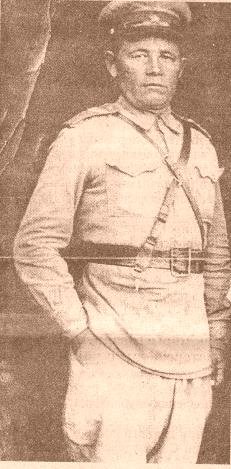


Gerasimov Fedor Vladimirovich
In 1937, voluntarily, through the Shakhty city military commissariat, he entered the Tambov cavalry school, graduating in 1939. 1939 -1941 – he was a platoon commander of a regimental school of the 155th cavalry regiment of the 6th cavalry brigade and the 22nd cavalry division Yugojiri-Khid (Mongolia) and the station of Hadabolak Transbaikal military district. From January 1941 to May 1941 he served as a commander of a reconnaissance platoon of the Sretensk Transbaikal military district. From May 1941 to June 1942 he was a senior adjutant of the construction battalion and assistant to chief of staff of the 152nd rifle regiment of the 94th rifle division of the Transbaikal military district, the station of Matsievskaya. From June 1942 to March 1944 assistant to chief of operations staff of the 36th army of the Western frong, the Borzya railway station. From March 1944 to June 1944 - the Academy named after Frunze of Moscow. From June 1944 to April 1945 - commander of the 93rd separate penal troop of the 33rd army of the 3rd and the 1st Belorussian fronts. From April 1945 to May 1945 - hospital no. 7775 for injuries in the town of Lodz (Poland). From June 1945 to July 1947 he was chief of staff of the 137th separate battalion of the Soviet military administration in Germany (Berlin). From July 1947 to November 1948 he was an officer assigned to the Secretariat of the commander-in-Chief of the Soviet military administration in Germany (Berlin). Description of the feat. “My grandfather received his main award, the order of the Red Banner, for the events of the 5th of February, 1945, in the area of Furstenberg, in Lower Saxony, where, commanding the 93rd separate army penal troop, he crossed the Oder river in the most difficult conditions. On that difficult day despite the fragile, sinking ice, with no boats or ferry, the troop managed to reach the western bank of the river with a bold throw. The enemy put up an extremely fierce resistance using all types of firepower and secured themselves on the dam. However, the grandfather, showing personal courage and bravery that inspires the fighters, managed to quickly pull up the means of reinforcement and drove the enemy from the dam with a decisive attack. Developing further success, relentlessly pursuing and destroying the enemy, he broke into the village of Vogelsang and gained a foothold in it. Numerous German counterattacks with the support of tanks and self-propelled guns were skillfully repelled by my grandfather, who was wounded at that time, but led the battle until reinforcements arrived, and the settlement was held. In the battle to capture and expand the bridgehead, the troop destroyed more than 10 firing points, 8 snipers and destroyed more than 400 Nazis, and the troop commander showed personal courage and bravery.
Gerasimov Fedor Vladimirovich
In 1937, voluntarily, through the Shakhty city military commissariat, he entered the Tambov cavalry school, graduating in 1939. 1939 -1941 – he was a platoon commander of a regimental school of the 155th cavalry regiment of the 6th cavalry brigade and the 22nd cavalry division Yugojiri-Khid (Mongolia) and the station of Hadabolak Transbaikal military district. From January 1941 to May 1941 he served as a commander of a reconnaissance platoon of the Sretensk Transbaikal military district. From May 1941 to June 1942 he was a senior adjutant of the construction battalion and assistant to chief of staff of the 152nd rifle regiment of the 94th rifle division of the Transbaikal military district, the station of Matsievskaya. From June 1942 to March 1944 assistant to chief of operations staff of the 36th army of the Western frong, the Borzya railway station. From March 1944 to June 1944 - the Academy named after Frunze of Moscow. From June 1944 to April 1945 - commander of the 93rd separate penal troop of the 33rd army of the 3rd and the 1st Belorussian fronts. From April 1945 to May 1945 - hospital no. 7775 for injuries in the town of Lodz (Poland). From June 1945 to July 1947 he was chief of staff of the 137th separate battalion of the Soviet military administration in Germany (Berlin). From July 1947 to November 1948 he was an officer assigned to the Secretariat of the commander-in-Chief of the Soviet military administration in Germany (Berlin). Description of the feat. “My grandfather received his main award, the order of the Red Banner, for the events of the 5th of February, 1945, in the area of Furstenberg, in Lower Saxony, where, commanding the 93rd separate army penal troop, he crossed the Oder river in the most difficult conditions. On that difficult day despite the fragile, sinking ice, with no boats or ferry, the troop managed to reach the western bank of the river with a bold throw. The enemy put up an extremely fierce resistance using all types of firepower and secured themselves on the dam. However, the grandfather, showing personal courage and bravery that inspires the fighters, managed to quickly pull up the means of reinforcement and drove the enemy from the dam with a decisive attack. Developing further success, relentlessly pursuing and destroying the enemy, he broke into the village of Vogelsang and gained a foothold in it. Numerous German counterattacks with the support of tanks and self-propelled guns were skillfully repelled by my grandfather, who was wounded at that time, but led the battle until reinforcements arrived, and the settlement was held. In the battle to capture and expand the bridgehead, the troop destroyed more than 10 firing points, 8 snipers and destroyed more than 400 Nazis, and the troop commander showed personal courage and bravery.
0 comment



2026 © Russian Military Historical Society Developed by Jetmix