


Alexey Bolotov
Rank: First Lieutenant.
Branch of service: Army, Air Force (except Naval Aviation), Coast Guard, NKVD troops, Border Guards.
Duty station: 81st Kalinkovichi Red Banner Order of Suvorov Rifle Division
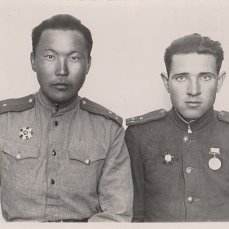
On the photo - my father, Bolotov Alexey, with First Lieutenant Gorbunov, as it is written on the back. Maybe someone knows Lieutenant Gorbunov?
Since 1941, my father served in the Tans-Baikal Military District as a squad commander and Deputy Company Commander for Political Affairs until January 1943. Then he graduated from the training courses for political officers of the Bryansk Military-political School and with the rank of Lieutenant, in November 1943 he arrived in the active army of the Belarusian Front. In February 1944, he was promoted to First Lieutenant.
In 1944, he was appointed agitator of the 519th Rifle Regiment of the 81st Kalinkovichi Red Banner Order of Suvorov Rifle Division. At the behest of time, and this is not a beautiful word, but a life situation, he joins the Communist Party. The division as part of the 1st Ukrainian Front with heavy battles, with losses, with new reinforsments, steadily moved forward, pushing out the fascist invaders. On May 19, 1944, a group of officers was awarded at the regimental headquarters. My father received his first award in life - the Order of the Patriotic War of the 2nd degree for the battles for the liberation of Kalinkovichi in 1943.
From notes made from memory in 1980-1987.
The summer offensives of 1944 began in July. The division was preparing to break through the Southern Bug, crossing the state border. Before the battle, there was a short meeting, and the regimental banner was taken out. Starting from the battalion commander to the driver, everyone came up to him, got down on one knee, kissed the banner, swore to beat the enemy to victory, to clear our native land. Every faces was stern, ready to go to death for the sake of victory, one could not hear jokes. If they would not be killed, they wished each other a light injury. Artillery preparation began on July 19. The ground seemed to shake. Went through defense battle formations of the 89th Division, joined the battle for the village Porytsk. Behind it was the Southern Bug. The last piece of native land. After three days of hard fighting, the fascists were knocked out and on the morning of July 21st they crossed the Bug, that was the state border. They liberated their long-suffering land. But there was no time to exult, the Germans were to be pursued. His second award the Order of the Red Banner for summer offensives he received in October 1944.
On May 8, 1945 on the approach to Prague in one locality sappers were restoring a broken bridge. Suddenly, two planes appeared in the sky and scattered leaflets, they fell like flakes of snow. They reported that today, on the night of May 9, 1945, the surrender of German troops would be signed. End of the war. We all kissed each other and stopped for the night in the nearest village. In the morning we learned about the end of the war. All fired their personal weapons into the air. Even artillery men fired from the 45 mm Gun. In the midst of the fun before the evening came the order to move forward. A large group of German troops stationed in Czechoslovakia refused to lay down their arms in front of the Red Army and moved West into the American zone. The war continued until May 16, and many people were lost after the war.
This is how the war ended for my father
120 km from Prague.
On May 9, 1991, he was congratulated on the holiday, and he drank his last commander's hundred grams for the Victory. He died on May 11.
Alexey Bolotov
Rank: First Lieutenant.
Branch of service: Army, Air Force (except Naval Aviation), Coast Guard, NKVD troops, Border Guards.
Duty station: 81st Kalinkovichi Red Banner Order of Suvorov Rifle Division
On the photo - my father, Bolotov Alexey, with First Lieutenant Gorbunov, as it is written on the back. Maybe someone knows Lieutenant Gorbunov?
Since 1941, my father served in the Tans-Baikal Military District as a squad commander and Deputy Company Commander for Political Affairs until January 1943. Then he graduated from the training courses for political officers of the Bryansk Military-political School and with the rank of Lieutenant, in November 1943 he arrived in the active army of the Belarusian Front. In February 1944, he was promoted to First Lieutenant.
In 1944, he was appointed agitator of the 519th Rifle Regiment of the 81st Kalinkovichi Red Banner Order of Suvorov Rifle Division. At the behest of time, and this is not a beautiful word, but a life situation, he joins the Communist Party. The division as part of the 1st Ukrainian Front with heavy battles, with losses, with new reinforsments, steadily moved forward, pushing out the fascist invaders. On May 19, 1944, a group of officers was awarded at the regimental headquarters. My father received his first award in life - the Order of the Patriotic War of the 2nd degree for the battles for the liberation of Kalinkovichi in 1943.
From notes made from memory in 1980-1987.
The summer offensives of 1944 began in July. The division was preparing to break through the Southern Bug, crossing the state border. Before the battle, there was a short meeting, and the regimental banner was taken out. Starting from the battalion commander to the driver, everyone came up to him, got down on one knee, kissed the banner, swore to beat the enemy to victory, to clear our native land. Every faces was stern, ready to go to death for the sake of victory, one could not hear jokes. If they would not be killed, they wished each other a light injury. Artillery preparation began on July 19. The ground seemed to shake. Went through defense battle formations of the 89th Division, joined the battle for the village Porytsk. Behind it was the Southern Bug. The last piece of native land. After three days of hard fighting, the fascists were knocked out and on the morning of July 21st they crossed the Bug, that was the state border. They liberated their long-suffering land. But there was no time to exult, the Germans were to be pursued. His second award the Order of the Red Banner for summer offensives he received in October 1944.
On May 8, 1945 on the approach to Prague in one locality sappers were restoring a broken bridge. Suddenly, two planes appeared in the sky and scattered leaflets, they fell like flakes of snow. They reported that today, on the night of May 9, 1945, the surrender of German troops would be signed. End of the war. We all kissed each other and stopped for the night in the nearest village. In the morning we learned about the end of the war. All fired their personal weapons into the air. Even artillery men fired from the 45 mm Gun. In the midst of the fun before the evening came the order to move forward. A large group of German troops stationed in Czechoslovakia refused to lay down their arms in front of the Red Army and moved West into the American zone. The war continued until May 16, and many people were lost after the war.
This is how the war ended for my father
120 km from Prague.
On May 9, 1991, he was congratulated on the holiday, and he drank his last commander's hundred grams for the Victory. He died on May 11.
0 comment



2026 © Russian Military Historical Society Developed by Jetmix