


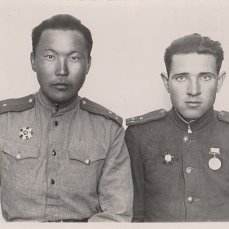


Khazbi Besolov
Rank: Lieutenant.
Branch of service: Army, Air Force (except Naval Aviation), Coast Guard, NKVD troops, Border Guards.
Duty station: 333rd Sinelnikovo Red Banner Order of Suvorov Rifle Division.
Khazbi Besolov is my father. Awarded the Medal For Bravery. As the commander of a reconnaissance platoon of the regiment in the winter of 1942, Kh. Besolov received a task from the regimental commander: to take a prisoner to get data about the enemy. He chose 12 people for this mition. After an unsuccessful attempt, they returned to the location of the regiment. Suddenly the watchers reported that a group of German scouts was returning from our side. They met in the neutral zone of a wooded area and immediately took up the defense. As the Germans approached them, the squad opened fire. Most of the Germans were killed. Since the group was surrounded, the remaining three Germans, led by a corporal, were forced to surrender. Kh. Besolov delivered them to the commander of the regiment, for which he was presented with a reward. He received the medal For Bravery after the war, in 1946.
He received the Order of the Patriotic War 2nd degree for an episode that occurred in January 1942. At that time, Kh. Besolov was the commander of a rifle company (160 people). Their battalion crossed the Seversky Donets River in the Donbas in 40-degree cold. In the middle of the river, the Germans met them with heavy artillery and machine gun fire. As a result, the ice was broken, and 17 people immediately drowned. Dad was very upset about the loss of people, as this was his first fight as a company leader and the first losses. Commissar Sinelnikov, a participant of the Civil War, was twice the age of my father. He reassured him: "This is war, and there are always losses in war." As they neared the opposite Bank under fire, dad sank into another hole up to his neck, but he felt the bottom, and realized that he would not drown. His company took cover in ravines, and a sniper shot at him from the roof of the house of the village of Sidorovka. He told an interesting fact when the bullet hit the inside of his helmet, spun inside and flew out without even hitting him. Such things happen in war. He gave the command to his machine gunner to open fire on the facade of the white house, where the sniper was supposed to be. During this time, he climbed ashore and joined the company. His uniform immediately froze, making it difficult to move. The company drove the Germans out of the building of the broken power plant and occupied it. Germans surrounded the building. They fought off German attacks for three days. My father did not notice that the inside of his clothes was dry. Then a messenger from the regimental headquarters made his way to them with a map showing the plan for getting out of the encirclement. By this time, the battalion commander was missing, and my dad decided to take command. Before dawn, they began to leave the encirclement under fire. During this, he was wounded in the left thigh, but despite the wound, they came out of the encirclement and the soldiers helped him, and sent him to a field hospital. For the withdrawal of the battalion from the encirclement, my father was presented with an award, but he found out about it 62 years later, when he received the order.
After being discharged from the hospital, he was sent as a Deputy Commander of the training company of the reserve rifle regiment of the reserve rifle brigade of the North Coucuses Military District. In 1952, he entered and in 1955 graduated from the Frunze Military Academy, receiving a red diploma with "Honors". He was sent as the commander of a motor rifle battalion of the 82nd Guards Mechanized Regiment of the 25th Guards Mechanized Division in Romania, where he served until 1957. Then he served in Ukraine, and after mobilization, after 28 years in army he returned to his homeland in 1968. He worked at the Civil Defense Headquarters of the Republic, at the OZATE plant, and as a member of the district party Commission. He has three children, 7 grandchildren and 11 great-grandchildren who live in different parts of the country and abroad.
Khazbi Besolov
Rank: Lieutenant.
Branch of service: Army, Air Force (except Naval Aviation), Coast Guard, NKVD troops, Border Guards.
Duty station: 333rd Sinelnikovo Red Banner Order of Suvorov Rifle Division.
Khazbi Besolov is my father. Awarded the Medal For Bravery. As the commander of a reconnaissance platoon of the regiment in the winter of 1942, Kh. Besolov received a task from the regimental commander: to take a prisoner to get data about the enemy. He chose 12 people for this mition. After an unsuccessful attempt, they returned to the location of the regiment. Suddenly the watchers reported that a group of German scouts was returning from our side. They met in the neutral zone of a wooded area and immediately took up the defense. As the Germans approached them, the squad opened fire. Most of the Germans were killed. Since the group was surrounded, the remaining three Germans, led by a corporal, were forced to surrender. Kh. Besolov delivered them to the commander of the regiment, for which he was presented with a reward. He received the medal For Bravery after the war, in 1946.
He received the Order of the Patriotic War 2nd degree for an episode that occurred in January 1942. At that time, Kh. Besolov was the commander of a rifle company (160 people). Their battalion crossed the Seversky Donets River in the Donbas in 40-degree cold. In the middle of the river, the Germans met them with heavy artillery and machine gun fire. As a result, the ice was broken, and 17 people immediately drowned. Dad was very upset about the loss of people, as this was his first fight as a company leader and the first losses. Commissar Sinelnikov, a participant of the Civil War, was twice the age of my father. He reassured him: "This is war, and there are always losses in war." As they neared the opposite Bank under fire, dad sank into another hole up to his neck, but he felt the bottom, and realized that he would not drown. His company took cover in ravines, and a sniper shot at him from the roof of the house of the village of Sidorovka. He told an interesting fact when the bullet hit the inside of his helmet, spun inside and flew out without even hitting him. Such things happen in war. He gave the command to his machine gunner to open fire on the facade of the white house, where the sniper was supposed to be. During this time, he climbed ashore and joined the company. His uniform immediately froze, making it difficult to move. The company drove the Germans out of the building of the broken power plant and occupied it. Germans surrounded the building. They fought off German attacks for three days. My father did not notice that the inside of his clothes was dry. Then a messenger from the regimental headquarters made his way to them with a map showing the plan for getting out of the encirclement. By this time, the battalion commander was missing, and my dad decided to take command. Before dawn, they began to leave the encirclement under fire. During this, he was wounded in the left thigh, but despite the wound, they came out of the encirclement and the soldiers helped him, and sent him to a field hospital. For the withdrawal of the battalion from the encirclement, my father was presented with an award, but he found out about it 62 years later, when he received the order.
After being discharged from the hospital, he was sent as a Deputy Commander of the training company of the reserve rifle regiment of the reserve rifle brigade of the North Coucuses Military District. In 1952, he entered and in 1955 graduated from the Frunze Military Academy, receiving a red diploma with "Honors". He was sent as the commander of a motor rifle battalion of the 82nd Guards Mechanized Regiment of the 25th Guards Mechanized Division in Romania, where he served until 1957. Then he served in Ukraine, and after mobilization, after 28 years in army he returned to his homeland in 1968. He worked at the Civil Defense Headquarters of the Republic, at the OZATE plant, and as a member of the district party Commission. He has three children, 7 grandchildren and 11 great-grandchildren who live in different parts of the country and abroad.
0 comment



2026 © Russian Military Historical Society Developed by Jetmix