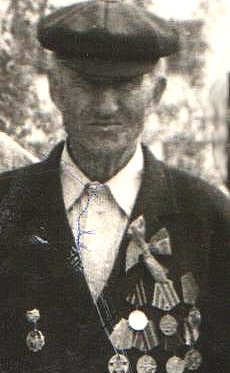


Eremeev, Philip Sergeevich
Rank: Junior Sergeant. Type of troops: Signal troops. Division: 129th Infantry Division (1st Formation). From the memoirs of F.S. Eremeeva: “The war for me began at 4 am on June 22, 1941 with the bombing of the cities of Vilkaviskis, Kalvarija, Alytus, as well as units of our division located at the exercises. The enemy knew all the coordinates of the deployment of our units. At the same time, tank columns of fascists and motorized infantry marched along the roads. Having broken through the defenses of the rifle battalions, enemy tanks went along the roads, bypassing the centers of resistance of our units. Communication was lost on June 23rd. In the absence of fuel, the signalmen, including myself, were forced to abandon their vehicles and join the retreating infantry and border guards. The battles went everywhere, in large and small groups up to the Nemunas north of Alytus. On the crossing of the Neman River I was wounded and wounded. Was picked up by German rear units. Cadets - Poryadkov, Astanin, Petrov, Khrenov - were killed in defensive battles. The prisoner was taken to the city of Suwalki on Polish territory. Then there was the camp of Thorn on the Vistula, then - the camp near Blomberg in Germany, then on the North Rhine in Westphalia, Recklinghausen in coal mines. In the spring of 1942, two other prisoners and I attempted to escape from the Thorn camp while cleaning a gutter. The ditch ran through a stone wall into which a grating was set. She managed to break it out and get out. The escape was not thought out, done out of despair and hunger. Three days of freedom, 80 kilometers of the way to the East. Instead of the promised bread, the Pole brought policemen. All three were the initiators of the escape. One of them has the surname Nosov, from the Stavropol Territory. Later, in the camp, they were separated and his fate is unknown ... ”Dad did not like to remember the years of captivity, so there are no details. On May 9, 1945, my father was in a camp near the city of Lemberger in the zone of American troops, where at the end of April he was taken from the mine in Recklinghausen. In August 1945, my father was taken from Paderborn to the Elbe and handed over to the Soviet Repatriation Commission. After that, he served in the 321st reserve rifle regiment, where he underwent an appropriate check and commission. Then he was sent to the 986th Cannon Regiment in a reconnaissance platoon in the area of Neuenstadt. The last transfer was to the intelligence platoon of the 592nd mortar regiment, from where my father was transferred to the reserve on May 12, 1946. Combat path: Was drafted into the Red Army on October 26, 1940 by the Yuryev-Polsky RVK. He served in the 129th Infantry Division of the 741st Regiment, then in the 212nd Separate Signal Battalion. On June 23, 1941, he was wounded and taken prisoner, where he remained until 1945. After liberation, he was sent to the 321st reserve rifle regiment. Then he was sent to the 986th Cannon Regiment in a reconnaissance platoon near the city of Neuenstadt. Then he was transferred to a reconnaissance platoon in the 592nd mortar regiment. Dismissed on May 12, 1946. After the war, my father worked for many years in the Yuryev-Polskaya city network as an electrician.
0 comment



2026 © Russian Military Historical Society Developed by Jetmix