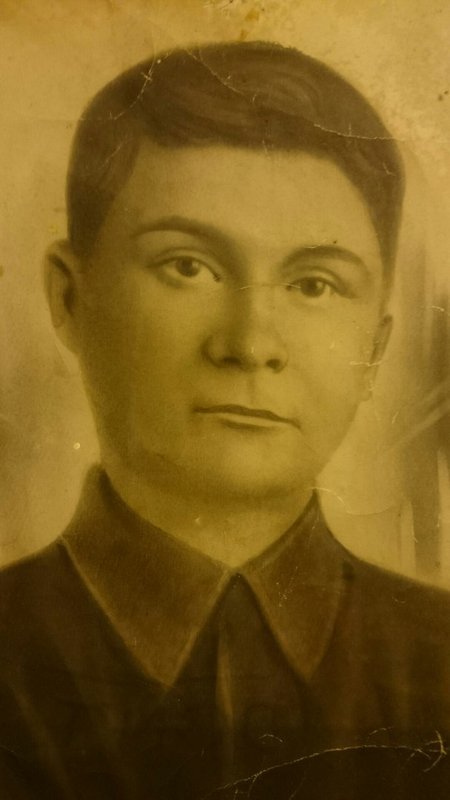
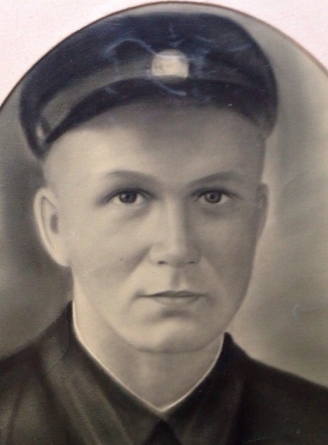
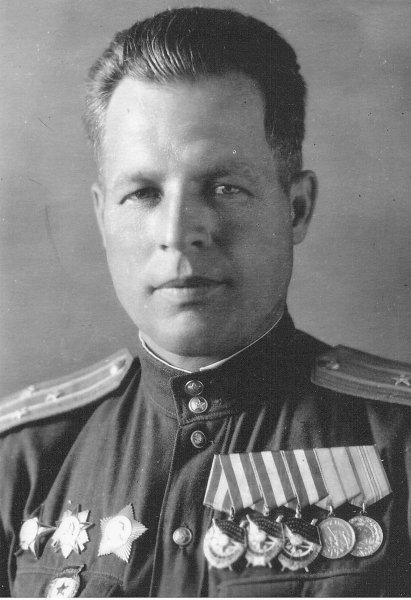
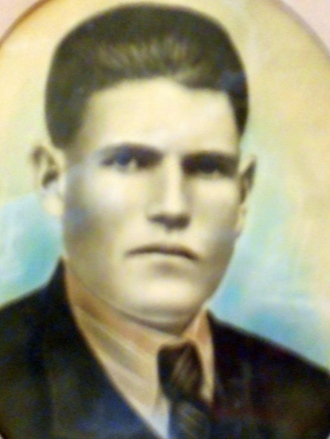
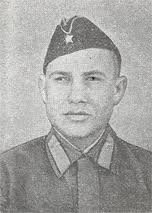
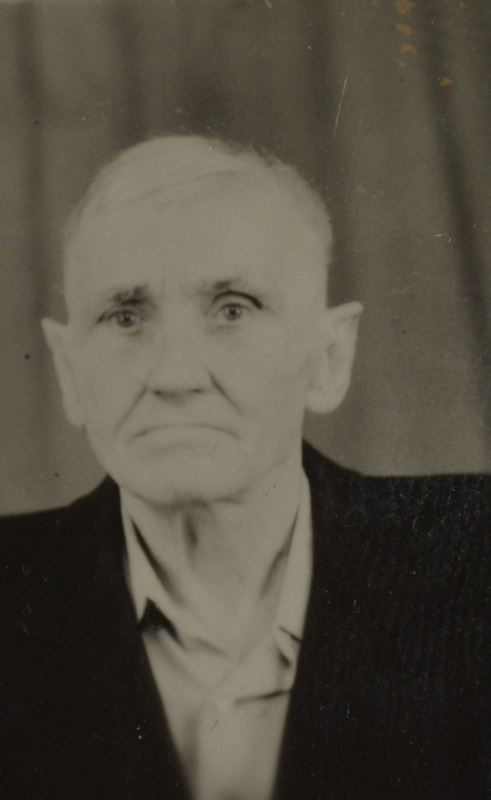
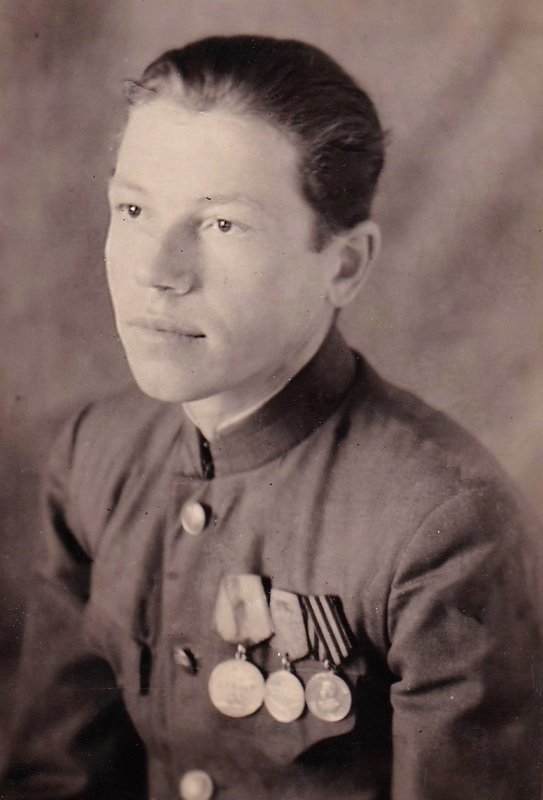
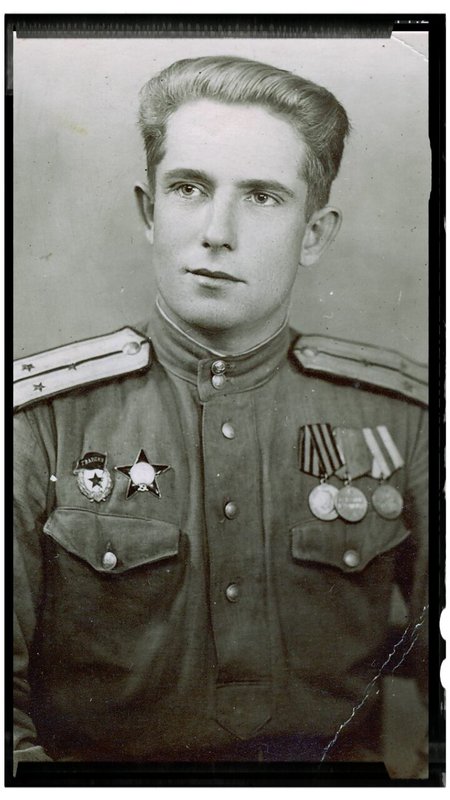
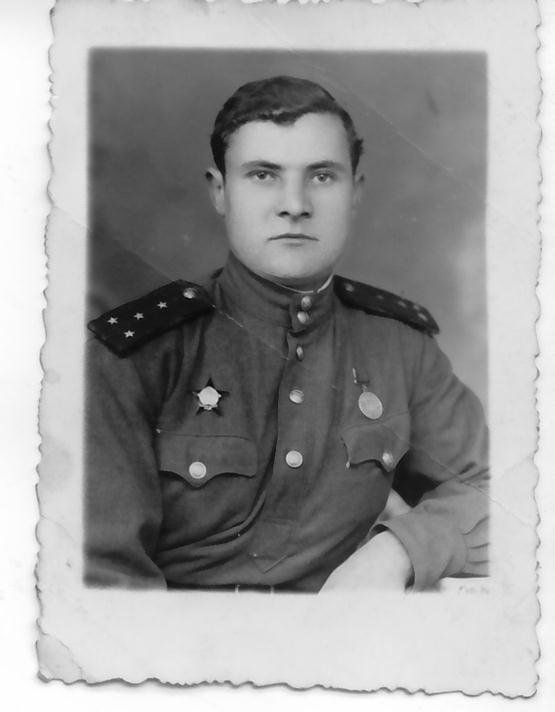
Kolesnikov Nikolay Alexandrovich
Rank: major. Service rank: Artillery. Division: 19th rifle Voronezh-Shumlin red banner of the Suvorov Order and the red banner of the Division Work. My grandfather-Kolesnikov N. A. Kolesnikov Nikolay Alexandrovich, (on my mother's side), was born on November 20, 1919 in the village of Lokot in the Loktevskiy district in a family of poor farmers. The Soviet power in the Siberian region was just taking the first steps towards strengthening it. The situation in the country was aggravated by the fact that the civil war was gaining strength. Nikolai's father, Alexander Kolesnikov, was killed by the White Guards in 1920. Mother Vera Ivanovna remained a widow. She raised Nikolay alone under these tragic circumstances. At the age of ten, Kolya Kolesnikov began studying at the 112 school in Rubzowsk. In spite of all the difficulties during the time of the formation of the Soviet power, the boy studied with dignity. And in 1939 the People's Commissariat of Railways, which owned the school, issued a certificate confirming the completion of the entire ten-year course. It seems that a young person opened wide horizons for self-realization, especially since many people could only dream of such an education. Nikolay Kolesnikov also dreamed. He was attracted to mining. But all the boy's plans were changed by an event that became fateful for all citizens of the young Soviet Republic: the beginning of the World War II and then the Great Patriotic War, which was waged by Hitler's Germany against USSR. The 20-year-old Nikolay Alexandrovich Kolesnikov, like many volunteers, made a choice, as the documents show. In his military ticket it says that from December 13, 1939 to January 25, 1947 Major Kolesnikov of the Red Army served in their ranks. After completing the courses for sub-lieutenants in Tashkent in the specialty: commander of a mortar platoon, the fighting epic of a fighter, a communist, a man began. The cadet prepared to become a commander of a mortar platoon and became the commander of a cavalry division along the line of signalmen. This is what it says in the documentary testimony on Lieutenant Kolesnikov Nikolay Alexandrovich signed by the senior political instructor of the School of Lieutenants in Tashkent. "From December 1939 to September 1940 Kolesnikov N. A. cadet of the School of Junior Commanders 9 OES 18 GKD, and from October 1940 to July 1941 he was commander of the Radio 33 OKTAD 18 GKD division. From July to August 1941 on the course of junior lieutenants in Uzbekistan. From August to November 1941 deputy head of the intelligence of this department". And signature: the first lieutenant Colonel Zimin: Maksimov. As the head of the communications department Nikolay Alexandrovich managed to put together combat units. He is persistent, energetic and proactive in his work. He is committed to the party of Lenin and Stalin - this is how many characteristics of soldiers during the Great Patriotic War ended. This allows us to judge how much it was necessary to know whether or not a person was faithful to the cause who decided the fate of the Fatherland and all mankind in the period from 1941 to 1945, since German fascism was a threat not only to USSR. Ways of war (memoirs by N. A. Kolesnikov). At least up to the present, or more precisely, state awards have been preserved for a long time. Since the declaration of war the government of USSR, the Supreme Commander-in-Chief and. Stalin organized several fronts to protect the state in many geographical areas. First of all: this is the Ukrainian direction, the Western front, the Belarusian front and so on. So my grandfather, starting with the defense of Kharkiv, walked the streets of Moldova, Hungary and Yugoslavia... But everything is better off. And so: the invocation! This time in the life of Nikolay Kolesnikov is of special importance, because the people he met for the first time during the war became his friends - fellow soldiers, teachers and students. Nobody could have imagined that the human soul, after walking the streets of war all the way to Berlin and looking into the eyes of death, would record all the moments, facts, experiences and joys of this movement. Nikolay Alexandrovich was not only a soldier doing his military service to protect the fatherland, but also a writer who is indeed a moral evaluator of the tragedies of life. From the very first day of the war, N. Kolesnikov dreamed of writing a book about the war, about the heroic deeds of Russian soldiers, about the suffering and faith in victory of those who are, however, lagging behind. This was realized only after the war. In the story "about what the heart aches", a journalist of the newspaper G. Rubtsovsk "Battle Tempo" outlines his view of the war. And the first step, as the first movement of a child, is very memorable. "The most important trace of a person, which is stopped in life by him, is the memory of him", writes Nikolay Alexandrovich in his story. Maybe this idea is the idea of entire work and the life of a person who has learned the price of life and ... death." In the chapter "Supplies" the author of the story, "about what the heart aches", does not draw attention to himself but to his comrades in arms - fellow commanders, simply people. He gave us pictures of the characters of real people, because the story is a documentary. Very memorable people! This is Ivan Sysoevich Viktorchik-Commissar of art. Battalion, San. Instructor- Vera Sokolova, Giant- Foreman Semyon Trofimovich Klyuyev, who for the death of the political instructor Viktorchik challenged a German soldier - wrestler Wili to a wrestling match and won a duel with the enemy. The heroic deeds of the soldiers in the first months of the war were a certain behavior of the result of the beginning of the freedom fight. The friends of N. Alexandrovich did not return from the war, but he survived. All of them defended the western direction from 1941 to 1942, because they were stationed in the area of Bila Tserkva (Ukraine). The most important document for a fighter at any time are his "fighting qualities". "From the first days of participation in the front informed the art. politruk Maximov-tov. Kolesnikov ensured constant, uninterrupted communication with the divisions of the division and was constantly "at the front". But there is a silver lining. Lieutenant Kolesnikov receives a long-awaited message from home saying: "Evacuated from the European part to Western Siberia, to the Urals and to Central Asia, our factories have already provided everything necessary for the front. Rubtsovsk was transformed into an industrial city and supplied the necessary products for the front. The victory of our army in Moscow and especially in Stalingrad has finally dispelled the myth of invincibility of Nazi Germany Reinforced by almost all of Western Europe, the German Wehrmacht collapses. But the enemy is still very strong. And the Red Army still had much to do to achieve the final defeat of the enemy. Life at the front forced the people to master many specialties. They were taught by life itself. And it is better to say it yourself in the words of Nikolay Alexandrovich: "Where the Party sends, they go." He was sent to the Artillery Battalion - rewarded as a battalion commander, as if he were opening the report on his future success. It was the third year of the war. The summer. Then there was relative calm along the entire front line from the Arctic Ocean to the Black Sea, and only in some areas, as the Sovinformburo reported, was there local fighting. Two huge armies prepared and waited to fight to the death again. The Germans maintained the approach to Kharkiv and opposed the Russians in this direction with Romanian brigades occupied by Germans from SS, by degraded Romanian officers, in a word - suicide bombers. N. Kolesnikov writes about it in his story "RAID". On the basis of authentic documents, it is dedicated to the 40th anniversary of the people's great victory over the fascist invaders, as well as to the story "what the heart aches". Kolesnikov received his first decision near Kharkiv, when its artillery guns repulsed an attack of an enemy tank division. In August 1944 the Soviet troops of the 2nd and 3rd Ukrainian Front were attacked under the command of Generals R. Y. Malinovsky and F. I. Tolbukhin, in cooperation with the Black Sea Front, surrounded and defeated the main forces of the German fascist group "South Ukraine" and liberated Moldova and the eastern part of Romania. "The newspaper "Pravda" wrote at that time: "...The Iasi-Kishinev operation to encircle the German troops is one of the biggest and in its political and strategic importance most outstanding. In August the Red Army German-Romanian defeated troops in a southern direction near Kishinev. 22 enemy divisions were encircled and destroyed after they refused to surrender. As a result, the entire southern front of the German army collapsed. The town of Iasi, located on the territory of Romania, is famous for having been here in 1787. In 1791 the Russian-Turkish war ended. The Yasski peace, concluded on 9.01.1792, confirmed the annexation of Crimea and Cuban to Russia. The great importance of military operations in this direction was made clear to soldiers by commanders and political trainers. There was a reason for the communists to go into battle. A call: "Communists forward" became the most important one for Captain Nikolay Alexandrovich Kolesnikov, my grandfather. In 1944 he was already a member of the 1310th Rifle Regiment for the artillery of the 19th Voronezh Rifle Division. He was on the left bank of the Dniester, 40 kilometers from Tiraspol. In the story "What the heart aches" the author writes: "About 2 thousand guns and mortars, 3 thousand tanks, 5 regiments of RS were concentrated on the 2-kilometer section of the breakthrough". The author dedicated his work to the operation Iasi-Kishinev. "Here the gates were opened in the direction of victory", writes N. A. Kolesnikov in the chapter "Breakthrough". After 20 minutes of artillery preparation the first Katyusha salvo was heard. Immediately 180 installations said their weighty word." At the front line and in the depths of the defense the Germans raged", says Nikolay Alexandrovich, "the boys even took off their tunics". Despite the fact that the fight was particularly fierce, the Russians got along with small forces. After the Soviet troops had broken through the defense, they started a counter offensive. Tanks pushed through to the Prut River to get several Nazi divisions into the ring. "Battles were thundering in the West and the East, and the sound of victory was drawing ever closer," says the author of the work. In my grandfather's book there is a chapter "Ivan Sysoevich". It is dedicated to the commissar of the Art Battalion, where Nikolay Alexandrovich served as battalion commander, as mentioned above. Since 1943 Captain Kolesnikov served shoulder to shoulder with this man. Of course they knew each other, as they say, from and to ... trusted each other completely, as they say: common bread and salt brought them closer together. After the death of the political commissar, Captain Kolesnikov was very concerned. In general Ivan Sysoevich Viktorchik, the favorite of the whole division. The human factor, which is very fashionable to talk about today, he considered important for a communist. As Secretary of the Gomel Regional Committee, Ivan Sysoevich was able to communicate with the people. And he taught Kolesnikov that. Once in a mutual quarrel Viktorchik convinced his grandfather: "Draw your own conclusions: where to pull the reins and where to stroke. Today we are on a campaign, and tomorrow we are at the front. So stroke today: tomorrow it will be too late". Perhaps after such a conversation, which was equipped with great powers of persuasion, Nikolay Alexandrovich decided to join the CPSU (b) party. The experience of communication with such psychologists as Ivan Sysoevich shows that among the communists there were people who were chased by bullets and died in a bayonet attack. "I want to go into battle as a communist" - sounded from the lips of the recruits in 1943, because they trusted the Bolshevik Party. In the chapter "Ivan Sysoevich" N. Kolesnikov proves a similar characteristic of the human psyche. "The commissar is dead, and the war goes on" - the author's words sound throughout the book and throughout his life. Two days after this tragic event in the battalion, an event occurred which in some way justifies the death of the commissar. On August 23, 1944, Romania declared war on Germany. This ended the operation Iasi-Kishinev. During the whole operation, the command of the entire Red Army did not forget to take care of the soldiers: to feed them, to give them a break. Grandfather remembers the arrival of Marshal Zhukov who joined his division in 1943. He said: "Blow up at least all the equipment down to the last mortar, - the motherland will forgive us, we will lose people - their wives, mothers, children will never forgive us". The fighters cherished his words... The order of the commander-in-chief and Stalin was announced in the mass media: "The soldiers of the 3rd Ukrainian Front crossed the Danube, thus extending the breakthrough by 150 km along the front. During the offensive 330 villages in Hungary were occupied by the Soviets. Parts (29.11.1944). This appeal was addressed to the marshal of USSR Tolbukhin F. I. and Malinovsky R. Ya. Below you will find a list of those awarded for a successful operation. Among the heroes is my grandfather, Captain Kolesnikov N. Aber. at that time Captain Kolesnikov N. And. he had the medal "for military merits", the Order of the Red Star, the Order of Alexander Nevsky. In the regulations about the orders of USSR from 7.05.1936 he is listed as the highest award for special merits. On December 5, 1945 my grandfather receives the medal "for the capture of Budapest" (the capital of Hungary). After the decree of the Presidium of the Supreme Soviet of USSR (A # 077349), Guard Major Kolesnikov was able to receive the award on June 9, 1945, the day the decree was signed. Almost 190 thousandth group of Germans of the Army "South" was surrounded and eliminated. Awards of the Motherland. For a long time after the war, historians have studied the causes of the Great Patriotic War, brilliant examples of the heroic deeds of Owls. Soldiers became the most important proof of success in war. Awards have found heroes in peacetime. By decree of the presidium of the Supreme Soviet of USSR my grandfather received the Order of the Patriotic War, 2nd class, for bravery, steadfastness and courage in the fight against the German fascist troops. This happened on March 11, 1985. In general piggy bank of the soldier of the order and medal: For the capture of Kharkiv, breakthrough of the Danube. For the domination of the city of Bendery. For the capture of Belgrade. For the operations on the territory of Bulgaria. For the control of the city of Constanta and other places in the East and Western Europe. It began in 1947. Nikolay Kolesnikov rode with a full cavalier of all awards. And yet the most important reward was waiting for him at home - this is marriage and the birth of 3 wonderful children and grandchildren who will never forget all that their father and grandfather did for them, which was the meaning of his whole life. He died on may 9, 1991, after waiting for his new victory in the civil war.
Kolesnikov Nikolay Alexandrovich
Rank: major. Service rank: Artillery. Division: 19th rifle Voronezh-Shumlin red banner of the Suvorov Order and the red banner of the Division Work. My grandfather-Kolesnikov N. A. Kolesnikov Nikolay Alexandrovich, (on my mother's side), was born on November 20, 1919 in the village of Lokot in the Loktevskiy district in a family of poor farmers. The Soviet power in the Siberian region was just taking the first steps towards strengthening it. The situation in the country was aggravated by the fact that the civil war was gaining strength. Nikolai's father, Alexander Kolesnikov, was killed by the White Guards in 1920. Mother Vera Ivanovna remained a widow. She raised Nikolay alone under these tragic circumstances. At the age of ten, Kolya Kolesnikov began studying at the 112 school in Rubzowsk. In spite of all the difficulties during the time of the formation of the Soviet power, the boy studied with dignity. And in 1939 the People's Commissariat of Railways, which owned the school, issued a certificate confirming the completion of the entire ten-year course. It seems that a young person opened wide horizons for self-realization, especially since many people could only dream of such an education. Nikolay Kolesnikov also dreamed. He was attracted to mining. But all the boy's plans were changed by an event that became fateful for all citizens of the young Soviet Republic: the beginning of the World War II and then the Great Patriotic War, which was waged by Hitler's Germany against USSR. The 20-year-old Nikolay Alexandrovich Kolesnikov, like many volunteers, made a choice, as the documents show. In his military ticket it says that from December 13, 1939 to January 25, 1947 Major Kolesnikov of the Red Army served in their ranks. After completing the courses for sub-lieutenants in Tashkent in the specialty: commander of a mortar platoon, the fighting epic of a fighter, a communist, a man began. The cadet prepared to become a commander of a mortar platoon and became the commander of a cavalry division along the line of signalmen. This is what it says in the documentary testimony on Lieutenant Kolesnikov Nikolay Alexandrovich signed by the senior political instructor of the School of Lieutenants in Tashkent. "From December 1939 to September 1940 Kolesnikov N. A. cadet of the School of Junior Commanders 9 OES 18 GKD, and from October 1940 to July 1941 he was commander of the Radio 33 OKTAD 18 GKD division. From July to August 1941 on the course of junior lieutenants in Uzbekistan. From August to November 1941 deputy head of the intelligence of this department". And signature: the first lieutenant Colonel Zimin: Maksimov. As the head of the communications department Nikolay Alexandrovich managed to put together combat units. He is persistent, energetic and proactive in his work. He is committed to the party of Lenin and Stalin - this is how many characteristics of soldiers during the Great Patriotic War ended. This allows us to judge how much it was necessary to know whether or not a person was faithful to the cause who decided the fate of the Fatherland and all mankind in the period from 1941 to 1945, since German fascism was a threat not only to USSR. Ways of war (memoirs by N. A. Kolesnikov). At least up to the present, or more precisely, state awards have been preserved for a long time. Since the declaration of war the government of USSR, the Supreme Commander-in-Chief and. Stalin organized several fronts to protect the state in many geographical areas. First of all: this is the Ukrainian direction, the Western front, the Belarusian front and so on. So my grandfather, starting with the defense of Kharkiv, walked the streets of Moldova, Hungary and Yugoslavia... But everything is better off. And so: the invocation! This time in the life of Nikolay Kolesnikov is of special importance, because the people he met for the first time during the war became his friends - fellow soldiers, teachers and students. Nobody could have imagined that the human soul, after walking the streets of war all the way to Berlin and looking into the eyes of death, would record all the moments, facts, experiences and joys of this movement. Nikolay Alexandrovich was not only a soldier doing his military service to protect the fatherland, but also a writer who is indeed a moral evaluator of the tragedies of life. From the very first day of the war, N. Kolesnikov dreamed of writing a book about the war, about the heroic deeds of Russian soldiers, about the suffering and faith in victory of those who are, however, lagging behind. This was realized only after the war. In the story "about what the heart aches", a journalist of the newspaper G. Rubtsovsk "Battle Tempo" outlines his view of the war. And the first step, as the first movement of a child, is very memorable. "The most important trace of a person, which is stopped in life by him, is the memory of him", writes Nikolay Alexandrovich in his story. Maybe this idea is the idea of entire work and the life of a person who has learned the price of life and ... death." In the chapter "Supplies" the author of the story, "about what the heart aches", does not draw attention to himself but to his comrades in arms - fellow commanders, simply people. He gave us pictures of the characters of real people, because the story is a documentary. Very memorable people! This is Ivan Sysoevich Viktorchik-Commissar of art. Battalion, San. Instructor- Vera Sokolova, Giant- Foreman Semyon Trofimovich Klyuyev, who for the death of the political instructor Viktorchik challenged a German soldier - wrestler Wili to a wrestling match and won a duel with the enemy. The heroic deeds of the soldiers in the first months of the war were a certain behavior of the result of the beginning of the freedom fight. The friends of N. Alexandrovich did not return from the war, but he survived. All of them defended the western direction from 1941 to 1942, because they were stationed in the area of Bila Tserkva (Ukraine). The most important document for a fighter at any time are his "fighting qualities". "From the first days of participation in the front informed the art. politruk Maximov-tov. Kolesnikov ensured constant, uninterrupted communication with the divisions of the division and was constantly "at the front". But there is a silver lining. Lieutenant Kolesnikov receives a long-awaited message from home saying: "Evacuated from the European part to Western Siberia, to the Urals and to Central Asia, our factories have already provided everything necessary for the front. Rubtsovsk was transformed into an industrial city and supplied the necessary products for the front. The victory of our army in Moscow and especially in Stalingrad has finally dispelled the myth of invincibility of Nazi Germany Reinforced by almost all of Western Europe, the German Wehrmacht collapses. But the enemy is still very strong. And the Red Army still had much to do to achieve the final defeat of the enemy. Life at the front forced the people to master many specialties. They were taught by life itself. And it is better to say it yourself in the words of Nikolay Alexandrovich: "Where the Party sends, they go." He was sent to the Artillery Battalion - rewarded as a battalion commander, as if he were opening the report on his future success. It was the third year of the war. The summer. Then there was relative calm along the entire front line from the Arctic Ocean to the Black Sea, and only in some areas, as the Sovinformburo reported, was there local fighting. Two huge armies prepared and waited to fight to the death again. The Germans maintained the approach to Kharkiv and opposed the Russians in this direction with Romanian brigades occupied by Germans from SS, by degraded Romanian officers, in a word - suicide bombers. N. Kolesnikov writes about it in his story "RAID". On the basis of authentic documents, it is dedicated to the 40th anniversary of the people's great victory over the fascist invaders, as well as to the story "what the heart aches". Kolesnikov received his first decision near Kharkiv, when its artillery guns repulsed an attack of an enemy tank division. In August 1944 the Soviet troops of the 2nd and 3rd Ukrainian Front were attacked under the command of Generals R. Y. Malinovsky and F. I. Tolbukhin, in cooperation with the Black Sea Front, surrounded and defeated the main forces of the German fascist group "South Ukraine" and liberated Moldova and the eastern part of Romania. "The newspaper "Pravda" wrote at that time: "...The Iasi-Kishinev operation to encircle the German troops is one of the biggest and in its political and strategic importance most outstanding. In August the Red Army German-Romanian defeated troops in a southern direction near Kishinev. 22 enemy divisions were encircled and destroyed after they refused to surrender. As a result, the entire southern front of the German army collapsed. The town of Iasi, located on the territory of Romania, is famous for having been here in 1787. In 1791 the Russian-Turkish war ended. The Yasski peace, concluded on 9.01.1792, confirmed the annexation of Crimea and Cuban to Russia. The great importance of military operations in this direction was made clear to soldiers by commanders and political trainers. There was a reason for the communists to go into battle. A call: "Communists forward" became the most important one for Captain Nikolay Alexandrovich Kolesnikov, my grandfather. In 1944 he was already a member of the 1310th Rifle Regiment for the artillery of the 19th Voronezh Rifle Division. He was on the left bank of the Dniester, 40 kilometers from Tiraspol. In the story "What the heart aches" the author writes: "About 2 thousand guns and mortars, 3 thousand tanks, 5 regiments of RS were concentrated on the 2-kilometer section of the breakthrough". The author dedicated his work to the operation Iasi-Kishinev. "Here the gates were opened in the direction of victory", writes N. A. Kolesnikov in the chapter "Breakthrough". After 20 minutes of artillery preparation the first Katyusha salvo was heard. Immediately 180 installations said their weighty word." At the front line and in the depths of the defense the Germans raged", says Nikolay Alexandrovich, "the boys even took off their tunics". Despite the fact that the fight was particularly fierce, the Russians got along with small forces. After the Soviet troops had broken through the defense, they started a counter offensive. Tanks pushed through to the Prut River to get several Nazi divisions into the ring. "Battles were thundering in the West and the East, and the sound of victory was drawing ever closer," says the author of the work. In my grandfather's book there is a chapter "Ivan Sysoevich". It is dedicated to the commissar of the Art Battalion, where Nikolay Alexandrovich served as battalion commander, as mentioned above. Since 1943 Captain Kolesnikov served shoulder to shoulder with this man. Of course they knew each other, as they say, from and to ... trusted each other completely, as they say: common bread and salt brought them closer together. After the death of the political commissar, Captain Kolesnikov was very concerned. In general Ivan Sysoevich Viktorchik, the favorite of the whole division. The human factor, which is very fashionable to talk about today, he considered important for a communist. As Secretary of the Gomel Regional Committee, Ivan Sysoevich was able to communicate with the people. And he taught Kolesnikov that. Once in a mutual quarrel Viktorchik convinced his grandfather: "Draw your own conclusions: where to pull the reins and where to stroke. Today we are on a campaign, and tomorrow we are at the front. So stroke today: tomorrow it will be too late". Perhaps after such a conversation, which was equipped with great powers of persuasion, Nikolay Alexandrovich decided to join the CPSU (b) party. The experience of communication with such psychologists as Ivan Sysoevich shows that among the communists there were people who were chased by bullets and died in a bayonet attack. "I want to go into battle as a communist" - sounded from the lips of the recruits in 1943, because they trusted the Bolshevik Party. In the chapter "Ivan Sysoevich" N. Kolesnikov proves a similar characteristic of the human psyche. "The commissar is dead, and the war goes on" - the author's words sound throughout the book and throughout his life. Two days after this tragic event in the battalion, an event occurred which in some way justifies the death of the commissar. On August 23, 1944, Romania declared war on Germany. This ended the operation Iasi-Kishinev. During the whole operation, the command of the entire Red Army did not forget to take care of the soldiers: to feed them, to give them a break. Grandfather remembers the arrival of Marshal Zhukov who joined his division in 1943. He said: "Blow up at least all the equipment down to the last mortar, - the motherland will forgive us, we will lose people - their wives, mothers, children will never forgive us". The fighters cherished his words... The order of the commander-in-chief and Stalin was announced in the mass media: "The soldiers of the 3rd Ukrainian Front crossed the Danube, thus extending the breakthrough by 150 km along the front. During the offensive 330 villages in Hungary were occupied by the Soviets. Parts (29.11.1944). This appeal was addressed to the marshal of USSR Tolbukhin F. I. and Malinovsky R. Ya. Below you will find a list of those awarded for a successful operation. Among the heroes is my grandfather, Captain Kolesnikov N. Aber. at that time Captain Kolesnikov N. And. he had the medal "for military merits", the Order of the Red Star, the Order of Alexander Nevsky. In the regulations about the orders of USSR from 7.05.1936 he is listed as the highest award for special merits. On December 5, 1945 my grandfather receives the medal "for the capture of Budapest" (the capital of Hungary). After the decree of the Presidium of the Supreme Soviet of USSR (A # 077349), Guard Major Kolesnikov was able to receive the award on June 9, 1945, the day the decree was signed. Almost 190 thousandth group of Germans of the Army "South" was surrounded and eliminated. Awards of the Motherland. For a long time after the war, historians have studied the causes of the Great Patriotic War, brilliant examples of the heroic deeds of Owls. Soldiers became the most important proof of success in war. Awards have found heroes in peacetime. By decree of the presidium of the Supreme Soviet of USSR my grandfather received the Order of the Patriotic War, 2nd class, for bravery, steadfastness and courage in the fight against the German fascist troops. This happened on March 11, 1985. In general piggy bank of the soldier of the order and medal: For the capture of Kharkiv, breakthrough of the Danube. For the domination of the city of Bendery. For the capture of Belgrade. For the operations on the territory of Bulgaria. For the control of the city of Constanta and other places in the East and Western Europe. It began in 1947. Nikolay Kolesnikov rode with a full cavalier of all awards. And yet the most important reward was waiting for him at home - this is marriage and the birth of 3 wonderful children and grandchildren who will never forget all that their father and grandfather did for them, which was the meaning of his whole life. He died on may 9, 1991, after waiting for his new victory in the civil war.
0 comment




2026 © Russian Military Historical Society Developed by Jetmix