
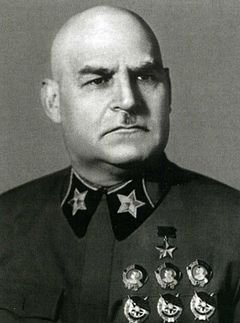

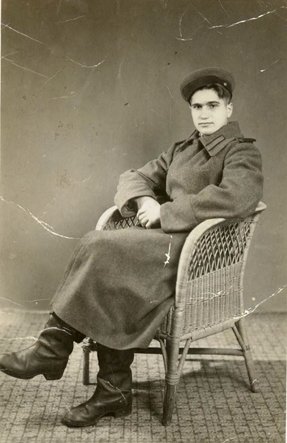


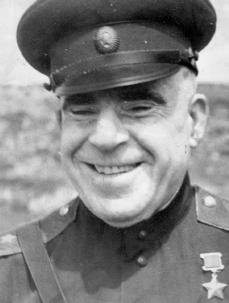
Kazaryan, Andranik Abramovich
Militaty rank is Major General. Branch of Troops: Ground service, Air Forces (except Marine aviation), shore service, NKVD troops, frontier troops. In 2013, the 70th anniversary of the beginning of the historic "Battle of the Dnieper" was celebrated. During the crossing of the Dnieper (August-December 1943), multinational Soviet troops showed mass heroism. The battle for the Dnieper, from its source to its mouth, was fought by five fronts: the Central, Voronezh, Steppe, South-Western and somewhat later the Southern front came to the lower course. During the fighting, these fronts were renamed the Belarussian, the 1st, the 2nd, thr 3rd and 4th Ukrainian, respectively, on October 20, 1943. For their courage and bravery, 2605 soldiers of the Red Army were awarded the high title of Hero of the Soviet Union. Among them are 15 sons of the Armenian nation. Among them was the commander of the 74th Rifle Division, Major General A. A. Kazaryan, whose post-war fate is inextricably linked with the Crimea. Few people know that among more than 40 Armenians who received the title of Heroes of the Soviet Union in the battles for Ukraine and Crimea, major- General A. A. Kazaryan was the first. It was no surprise at all that on May 9th, 2004, on the occasion of the 100th anniversary of the birth of Hero of the Soviet Union Major General Andranik Abramovich Kazaryan (14.05.1904-18.01.1992), the Crimean Armenian society, at the suggestion and at the expense of the author of this essay, installed a modest memorial plaque in Simferopol. In 2014, an alley or square was planned to be opened in Simferopol on 14 th May for the 110th anniversary of Andranik Abrahamyan. But the events of the Crimean spring and the latest political twists and turns have postponed the solution of this issue for an indefinite period… Having retired to the reserve in 1959, from the position of first Deputy of the 32nd Army corps stationed in the Crimea, Andranik Abramovich carried out a huge public work on military-patriotic education of the population. What he did not do. Think of that … He was: the Chairman of the scientific and methodological Council for the promotion of military knowledge and military-patriotic education of the Crimean regional organization "Knowledge»; the head of the Crimean regional staff of Komsomol members and youth "In places of glory of the Soviet people"; the head of the Crimean regional staff of the military sports game "Zarnitsa"; the Chairman of the Crimean regional Commission on GTO (Ready for Labour and Defence). In addition, he participated in the work of DOSAAF, made reports and lectures. He published in newspapers, not only in the Crimean, but also in Moscow. A. A. Kazaryan is the author and compiler of the book "Heroes of the battles for the Crimea" (Tavria publishing house, Simferopol, 1972), which tells about 350 Heroes of the Soviet Union, representatives of 30 nationalities of the USSR who received this title in the battles for the Crimea, including ten Armenian soldiers. The General also wrote the book "Honorary citizen" — seven essays about Crimeans who fought in Europe, who were awarded the title of Honorary citizens of foreign cities (by the way, the author himself is an honorary citizen of Shakyai, Lithuania). He is also the author of methodological materials to help the lecturer "30 years of liberation of the Crimea from the Nazi invaders»… In Soviet times, a lot was said and written about A. A. Kazaryan. His active work in the military-patriotic education of young people, in the search for and identification of nameless heroes who went missing on the fronts of the Great Patriotic War is invaluable. His work was marked by more than 300 certificates of honor and commendations. What he did, can tell and a small article in the Central newspaper. In 1966, in "Krymskaya Pravda", in a note by V. Tolmacheva "where are you, General?" one can read: "Only last year, the youth of Crimea found 1,400 nameless heroes. Andranik Abramovich took part in the search for many of them." The Pathfinder General was then often seen in Podolsk, where the military archive was located. In May 1974, all Crimean newspapers celebrated the seventieth anniversary of the famous General. His 80th birthday was especially celebrated in 1984. First Secretary of the Nagorno-Karabakh regional Committee of the Komsomol M. sh.Musaelyan and Deputy of the Supreme Soviet of the Azerbaijan SSR S. V. Hayrapetyan came to congratulate their countryman on the glorious anniversary. For his forty-year service in the Armed Forces, the General received all his 12 battle orders during the war. Among his awards are the"Gold Star" of the Hero of the Soviet Union, as well as the Order of Lenin (2), Suvorov 2nd class (3), Red banner (5), Patriotic war 1st class, Chinese Order. In 1978, the Soviet writer publishing house in Moscow published Leonid Kudryavtsev's book “My General”, a documentary story about A. A. Kazaryan. You can learn about the heroic deeds of soldiers and officers of the division under the command of the General during the war from the book by Alexey Gordienko "the Dnieper were". The book "Dnipro-river of heroes" refers to 2605 Heroes of the Soviet Union who received these titles for crossing the Dnieper. Among them are 43 soldiers and officers of the 74th Rifle division (13th army, Central front). About the General, the participation of units under his command, the exploits of soldiers and officers can be read in dozens of books published both in Moscow and in the cities of Ukraine, Belarus, Lithuania. After the collapse of the Soviet Union and the death of the General, the memory of him in the media was forgotten. The newspaper of the Crimean Armenian society "Dove of Masis"has not written about A. Kazaryan for more than 10 years. But it seemed that new times had come. In the revived and renewed community, new people have appeared, striving to preserve the rich cultural and historical heritage of the Armenians in Crimea for posterity. It was no exception to pay tribute to the memory of people who, working on the ancient fertile Crimean land, glorified their people. A. A. Kazaryan belongs to such people. I was lucky enough to visit my famous compatriot several times during the first years of my studies at the Simferopol higher military-political construction school. These meetings were held thanks to the Crimean Armenian cultural society "Luys", which started its activity in 1989. It was they who gave me the address of A. A. Kazaryan on the eve of Victory Day. On behalf of the community, together with other fellow cadets and students, on May 9 and 14, 1990, and the following year, I visited Major General Andranik Kazaryan at his home and congratulated him on his holiday and birthday. Unfortunately, at the beginning of 1992, he died… In order to perpetuate the memory of the hero, at the suggestion of the author of these lines, in 2004 the Crimean Armenian society addressed a letter to the mayor of Simferopol V. F. Ermak. The community requested permission to install a memorial plaque on the facade of 71st Gogol street. Finally, the long-awaited response was received. The mayor's letter said: "The Crimean Armenian society is allowed to construct and install a memorial plaque to the Hero of the Soviet Union, major General A. A. Kazaryan on the facade of the house No. 71 on Gogol street»... The beginning of the battle path (pages from the biography). Above we talked about the General's Affairs in peacetime, after the war. So who was he, what was he famous for, and what is his biography? Andranik Abramovich Kazaryan was born on May 14, 1904 in the ancient Armenian fortress city of Shusha in the Elizavetapol province of the Russian Empire (now the Nagorno-Karabakh Republic) in the family of a craftsman. He had to experience hardships and hardships early: he was orphaned early. Already in 1920, as a sixteen-year-old boy, he voluntarily joined the Red Army. He is enlisted in the second Armenian Rifle regiment. Subsequently, he gradually takes the positions of platoon Commander; company Commander, Chief of staff of the regiment, regimental Commander, Head of the fourth division of the division headquarters. Later, he teaches at the Yerevan state University. Improving his knowledge, in 1924, A. A. Kazaryan first graduated from the Infantry school, then, in 1925 and 1927, military and political courses, and in 1939 — two courses of the military Academy named after M. V. Frunze. Andranik Kazaryan creates one of the first Komsomol cells in Armenia and heads it. In 1927, the 23-year-old Commander became a member of the CPSU (the Soviet Union Communist Party), and later held various posts in the army Komsomol. In the first months of the war, he commanded a Regiment with the rank of Major. From September 1941, the 228th Rifle Regiment fought in the area of the cities of Dnepropetrovsk-Novomoskovsk. In September 1941, Kazarian was wounded by three enemy bullets. He was hospitalized and treated in a hospital in Georgievsk. In January 1942, Lieutenant Colonel A. A. Kazaryan was appointed Chief of Staff of the 134th Separate Rifle Brigade, which was formed in the city of Kuibyshev. The Brigade was part of the 13th Army of N.P. Pukhov (Bryansk front, Commander K. K. Rokossovsky). Upon the arrival of the Brigade to the front, A. A. Kazaryan was already appointed Commander of the Brigade and receives the rank of Colonel. In the bloody battles, he was wounded twice. He skilfully commanded the Brigade from August to October 1942. Subsequently, the 74th Rifle Division was created on the basis of the Brigade, which A. A. Kazaryan successfully commanded until crossing of the Dnieper and the liberation of Kiev, where he received his next wound and severe concussion. Under his command, the 134th separate Rifle Brigade takes part in combat operations in the Bryansk region.
The commander presents Andranik Ghazaryan to the Order of the Red Banner. Extract from the award list: "The Brigade under the command of Colonel Ghazaryan conducts continuous active operations with reconnaissance groups, submachine gunners, snipers, inflicting great damage to the enemy, standing out in this respect for the better among the other formations of the army. Only for the period from August 10 to September 20, 1942, the Brigade units destroyed 7 officers, 1000 soldiers, 15 hand and machine guns, 28 dugouts and Bunkers without any significant fighting. As a result of bold intelligence actions, 2 prisoners were captured, who gave valuable testimony. On the site of comrade Kazaryan enemy cannot live and move freely during the day or at night. The enemy is kept in suspense all the time. The Brigade's combat activities were partially covered in the “Izvestia” newspaper of 9.1942 in the article "In the forward trench". The Brigade developed a special activity after the NCO Order No. 227. Currently, the team is put together and represents a strong well-prepared body. Comrade Kazaryan himself is personally brave, has two injuries, one of them is serious. On the front of the Patriotic war is 14 months. He enjoys great authority among his subordinates and colleagues. Strongly supports the discipline. Tactically prepared well. Devoted to the Lenin-Stalin party and the Socialist Motherland. For his leadership fighting brigade, caused the enemy great losses, for high combat activity parts of the brigade, Com. Kazarian worthy of awarding Order of the Red Banner. Commander of the 13th Army, Major General Pukhov, member of the Military Council, Brigadier Commissar Kozlov. September 28, 1942".
A. A. Kazaryan was awarded his first Order of the Red Banner by the decree of the USSR Supreme Council Presidium of February 14, 1943 for exemplary performance of combat tasks of the command of the fight against the German invaders and for his valor and courage. In February 1943, there are serious battles south-west of Orel. On the left flank of the front, the 13th Army is active, which was transferred from the Bryansk front to the newly formed Central front (Commander K. K. Rokossovsky). The Brigade is being replenished, and the 74th Rifle Division is being formed on its base, with A. A. Kazaryan appointed as its Commander in October 1942. On February 23, 1943, Andranik Abramovich was awarded the rank of Major General. And for the liberation of Maloarkhangelsk by storm, he is presented to the Order of the Red Banner. Extract from the Award list: "Comrade Kazarian has been Division Commander since October 1942. From August to October 1942, he commanded the 134th Separate Rifle brigade. During his time in the army as a Division Commander, he showed himself to be a capable Commander, able to organize battles and bring it to the end. Tactically competent, executive disciplined Commander, demanding of himself and his subordinates. Strong-willed, bold, determined, fearless in battles with the enemy. A lot of work on putting together combat units and headquarters. In past private combat operations, comrade Kazaryan showed examples of fighting the enemy. During the period of combat operations from January 26, 1943, when breaking through the front edge of the German defense in the Kalinovka area, the Division fought hard for the height of "Cucumber". Breaking the enemy's resistance, captured the strongly fortified point on the river Fosna. Thanks to the skilful and correct leadership of the battle by com. Kazaryan, the division's units moved forward and liberated more than 100 settlements. The division destroyed 1,060 Hitlerites and captured 925 German soldiers and officers. Captured trophies: tanks-22, cars-20, guns of various calibers-33, armored trains-1, armored platforms and locomotives-9, six-barrelled mortars-6, machine guns-42, mortars-30, radio stations-4, bicycles-70, various warehouses-20, 50 kilometers of telephone cable. For his courage and bravery, skilful leadership of the division's units in battle, Com. Kazaryan deserves to be awarded the Order of the Red Banner. Commander of the 13th Army, Major General Pukhov, Member of the Military Council, Major General Kozlov. February 5, 1943". On February 7, 1943, the document was signed by the Commander of the Bryansk front. On the award sheet there is an inscription in red pencil that A. Kazaryan, earlier, in August 1942, was also assigned to the Order of Red Banner. Unfortunately, the text of this document has not yet been found by the MNU. Award list: Central Archive of the Ministry of Defence of the Russian Federation: Fund 33, inventory No. 682525, storage unit 20.
During the Bulge of Kursk, the 74th Rifle division occupies a defensive line about 10 kilometers long south-east of Orel, at the northern end of the Kursk bulge. Multi-layered defensive lines are being built. A. A. Kazaryan enjoys a well-deserved authority and love among the personnel. In the Division, a marching song with the following words becomes popular at this time: "Our simple and strict commander, comrade Kazaryan, led a terrible battle...". July 5, 1943 begins "thunderstorm" on the Kursk bulge. The 74th Rifle Division was stationed near the village of Protasovo. Extract from the award list for Major General A. A. Kazaryan: "devoted to the Lenin-Stalin Party and the Socialist Motherland, persistent in improving the combat activity of the division units. In the battles from 5 to 9 July, the Division's units showed fortitude and courage. On July 5, parts of the division counterattacked the enemy attacking in the flank, parts of the 148th Rifle Division, advancing, fought hard with the advancing infantry and a large number of tanks. Counterattacks of the 74th Rifle Division prevented the collapse of the battle formations of the 148th Rifle Division. On June 11, 1943, the 109th Rifle Regiment defending Protasovo fought bravely. One battalion almost completely fell to the death of the brave, but did not leave its positions. Only at the cost of heavy losses did the enemy manage to occupy Protasovo. According to the testimony of prisoners of the 78th Assault Infantry Division operating in this direction, the enemy suffered losses of 60-65 %. In offensive battles, parts of the division successfully completed the task, restoring the former position of defense, while causing great damage to the enemy. Com. Kazarian firmly managed the troops and promptly went to the battle, worthy of being awarded the Order of the Red Banner. Commander of the 15th Rifle Corps, Major General Ludnikov, July 20, 1943. Commander of the 13th army, Lieutenant General Pukhov, July 27, 1943". Major General Andranik Kazaryan was awarded another Order of the Red Banner by decision of the Central front troops 118/n of July 28, 1943. Central Archive of the Defence Ministry of the Russian Federation: Fund 33, inventory No.682526, storage unit 744. The Army took the main blow of the enemy on the Northern ledge of the Kursk bulge. After a week of fierce fighting in the Ponyrei area, by the end of July 12, the 13th army launched a counteroffensive Southeast of Orel. Three fronts- Western, Bryansk, and Central-conducted a coordinated assault to liberate Orel. On August 5, 1943, Orel was captured. In honor of the capture of Orel and Belgorod, the first artillery salute of Victory was made in Moscow. 13 times the 74th Rifle Division launched counterattacks, thwarting the plans of the fascist command. In only one battle, the division's personnel repulsed the attacks of 150 enemy tanks and inflicted huge losses on the enemy in manpower and military equipment. In these battles, the 74th Rifle Division fought south of Oryol. Operating in a westerly direction through Glazunovo station, it entered the city of Kromy from the south. For the skilful and firm leadership of the division during the defensive battles on the Kursk salient, the skilful transition to the counteroffensive and the courage and bravery shown at the same time, the General was awarded another Order of the Red Banner. Years later, in his book "the Road of a lifetime" (Moscow: Voenizdat, 1969), Hero of the Soviet Union Colonel-General Ivan Ilyich Lyudnikov (1902-1976) colorfully describes those battles. Being the Commander of the 15th Corps (which included the 74th Rifle Division in addition to the 8th and 148th), he gives a clear description of the actions of Major General A. A. Kazaryan and his division: "At midnight, scouts reported that the enemy was concentrating fresh forces against the left flank of our corps, that some kind of regrouping was taking place in its immediate rear. The situation required high vigilance. Everything cleared up in the morning. Junkers Ju-87 bomb raid on the area defended by Kazarian's division immediately determined the direction of the attack that the 78th German assault division had taken. The attack was supported by tanks, trying to pave the way for their infantry through Semenovka to Held. General Kazaryan's command post was located at an altitude of 243.9, near Semyonovka. From there, he reported the situation to me over the phone. I didn't just report clearly and thoroughly. General Kazarian had a genuine ecstasy of battle. "Comrade General, I see everything clearly. Our artillery covered the tanks! On the right flank of the division, five tanks are burning, on the left — four. Two cars ahead were hit by mines… Comrade "First", two more "tigers" caught fire. Honestly, they burn like torches! - Infantry? How are the German infantry? I ask Kazarian. — Lay low. We pinned it to the ground with machine-gun fire. The main thing is to put the German down, and we won't let him get up… General Kazaryan is fighting merrily. The Nazis failed to suppress the resistance of our 74th Division. Calling new tanks, changing the direction of the attack on the move, they tried to bypass the village of Buzuluk. We responded to this maneuver of the enemy with our own maneuver: the enemy tanks were met with fire from two anti-tank artillery regiments from the corps reserve. A fierce battle lasted for three hours, in which the enemy lost thirty-five tanks and a lot of manpower. It was still far from dusk, but the attack of the Nazis had already choked, and then stopped altogether." For crossing the Desna River near the city of Korop (landed near the village of Obolon), Andranik Kazaryan was awarded his first order of Suvorov, 2nd degree; a little later-the second of the same order.
Extract from the Award list: "74th Rifle Division was assigned to cross the Desna River and capture a bridgehead on the West Bank. If you don't have the proper means to cross the river, you can't do it. Kazaryan collected fishing boats with a capacity of 3-4 people. 6 crossings were organized at the front of 30 km. Of these, 3 main ones – 20 km. 1 echelon of division 109th RR (Rifle Regiment) crossed the Desna River on the obolonye Korop section, secured on the Northern Bank. 78 SP in the first echelon transported 2 battalions, and stormed the village of Zmetnev. 74th RR (Rifle Regiment) under strong influence of the enemy 46th Infantry Regiment of Hungarians, 57th Guard Infantry Regiment of Germans, 183d and 930th Infantry Regiments of 211th Infantry Division of Germans, in difficult conditions crossed the Desna River, and provided a bridgehead for crossing the 2nd echelon of 15th RC ( Rifle Corps). And in the subsequent battles for the expansion of the bridgehead, parts of 74th RD (Rifle Division) showed cougare and bravery, the ability to force a water barrier in difficult conditions. Commander of the 74th RD (Rifle Division), Major General com. Kazaryan is awarded the Order of Suvorov, 2nd class, for his skilful leadership of the units, as a result of the success of crossing the Desna River and securing the bridgehead. Commander of the 15th Rifle Corps, major General Ludnikov, September 16, 1943."Archive TSAMO RF: Fund 33, inventory 686043, storage unit 23. Successfully crossing the Desna in September 1943, the division under his command liberated the Ukrainian cities of Novgorod-Seversky and Chernihiv. Here again, I would like to give the floor to Colonel-General I. I. Ludnikov: "The Corps covers the right flank of the army marching South-West. We update the maps, and I read on them the names of cities and villages where the 200th Division fought two years ago, bleeding to death. I really want the road of our offensive to run through these places. As far as I know, crossing the Desna is not yet part of the task of the 13th Army. But doesn't it happen in war that the course of hostilities makes you change your pre-planned plans abruptly? So it happened this time. The old-timers of Korop, two avid fishermen, showed us the most convenient areas for crossing the Desna. Just in case, we put them on our maps. It turned out that the Divisions of General A. A. Kazaryan and Colonel P. M. Gudz are now approaching these areas near the mouth of the Sejm. It was the evening of September 8. General Kazaryan said on the phone that his farm controls the Eastern Bank of the river for fifty kilometers and, according to all reports, our exit to the Desna caught the enemy by surprise. "Oh, there would be something to cross!" — laments Kazaryan. Less than five minutes after this conversation, the corps received an order: to force the Desna with two divisions, capture the bridgehead on the West Bank and then transfer it to the troops of Lieutenant General P. A. Belov's 61st Army approaching the Desna. The order is short and precise. It is unclear only one thing-what to cross? I ask the army commander about it. I don't find anything comforting in his answer: "I Can't give you what I don't have, Ivan Ilyich. And we need to cross. And immediately. The 74th Division's command post is located on the Eastern edge of the coastal village of Luklov. Together with the commander of the Artillery, Colonel Hovhannisyan, and the head of the operational Department, Colonel Zhivoderov, I am going to Kazaryan. The Division commander has already managed to scout the coast well and take into account all available means of crossing. There are few fishing boats. The soldiers knock together rafts and rafts. They fill their camping tents with hay. Empty barrels, gates, and fences are used. Everything that can stay on the water is pulled up to the shore. During two nights, on September 10 and 11, General Kazaryan's Division crossed the Desna river. The bridgehead it captured allowed the 8th Rifle Division to enter the battle on the third night. On a front twenty-two kilometers wide, we advanced twelve kilometers in depth. In the battles for the expansion of the bridgehead, five Hitler regiments were defeated. We burned eighteen tanks, captured four hundred and thirty enemy soldiers and officers, and captured rich trophies. But they also suffered significant losses. The Nazis understood that with our breakthrough through the Desna, the battle for the Dnieper begins. They tried to eliminate our bridgehead with fierce counterattacks. Parts of Kazaryan's division fought heroically. With a limited supply of shells and ammunition, they held their positions until fresh forces arrived. I was with the task force at the crossing when the city of Korop, where the corps headquarters was located, was heavily bombed. We lost many officers, including the Commander of the artillery of the 13th Army, Major General A. N. Pankov. Our corps transferred the bridgehead behind the Desna to the 61st Army, but five days later we again reached the Desna at the Yanovka, Ladvinka section South-West of Chernihiv. I begged the commander that at least one division of our corps participated in the liberation of Chernihiv. Two years ago, the 15th Infantry defended the city. Although the composition of the soldiers and commanders was completely updated, the number of the corps remained the same, its banner was preserved, and it should fly in the liberated Chernihiv. I remembered a lot when I got to the Desna river in the autumn of 1943. And how could I not remember! Two years ago, the 200th Division I commanded, which was retreating with fighting, crossed the pontoon bridge near the village of Slabino to the left Bank of the Desna River… I know these parts. Difficult to find the best site for crossing than near shore Labino. I ordered engineering of the housing to start the construction of the bridge in the same place, near Slavino. On the other side of the Desna are the well — known villages of Kuibyshev, Andreyevna, and Pakul. In Andreevka in the forty-first year, the 200th Rifle Division was engaged in fierce battles… The enemy discovered the exit of the troops of our corps to the flank of its Chernihiv group, bombing areas of possible crossings. Our ally is the dark autumn night, and we already have valuable experience of crossing the Desna river. It took only two hours for the vanguard units from Kazarian's division to reach the West Bank. Behind them, the others crossed the river. When the Junkers appeared over Desna on the morning of September 22, the crossing was empty." For me, the personality of I. I. lyudnikov is also interesting because during the bloody battles on the Kerch Peninsula in the spring of 1942, after the death of commander Simon zakiyan, he briefly commanded the 390th Armenian Rifle Division. The 74th Rifle Division was one of the first to cross the Dnieper river North of Kiev and capture a bridgehead 7-8 kilometers wide. The division reached the Dnieper river South of the destroyed railway bridge on the Chernihiv-Ovruch road, opposite the town of Kamarin, on the right Western Bank of the Dnieper, which is 700 meters wide here. The crossing of the river began. On the first night, the battalion crossed, by noon — the regiment, at midnight — the entire division, including artillery and mortars. The Nazis used everything, including tanks and aircraft. There were fierce battles, during which the General was wounded. 43 soldiers and officers of the 74th Rifle Division for their heroism and courage during the crossing of the Dnieper were awarded the title of Heroes of the Soviet Union — including A. Kazaryan (decree of the USSR Supreme Soviet Counsil of 16.10.1943). Extract from the Award list of the division commander of the 74th Rifle Division, Major General A. A. Kazaryan, which was signed on October 3, 1943 by the Commander of the 15th Rifle Corps of the guards, Lieutenant General I. I. Lyudnikov: "the 74th Rifle Division on improvised means under the strong influence of the enemy crossed the Dnieper river West of Chernihiv and fought hard to expand the bridgehead. At the same time, a large number of enemy equipment and manpower were destroyed. The 74th RD (Rifle Division) crossed the Dnieper river in difficult combat conditions, with simultaneous impact from the front and flank. The personnel of the division, its officers, sergeants and enlisted personnel showed organization and courage. For crossing the Dnieper river West of Chernihiv on improvised means, for persistent fighting for the expansion of the bridgehead, for the heroism and organization shown by the commander of the 74th Rifle Division, Major General com. Kazaryan A. A. is worthy of the title of Hero of the Soviet Union." On October 7, 1943, the Award list is signed by: the Commander of the 13th Army, Lieutenant General Pukhov, and Member of the Military Council, Major General Kozlov. October 12, this document with the PostScript "worthy of the title of Hero of the Soviet Union" is signed by the Commander of the Front Army General Rokossovsky and a Member of the Military Council Telegin. On October 16, Major General A. A. Kazaryan was awarded the title Hero of the Soviet Union. Thanks to this Award list, you can find out that at the time of crossing the Dnieper, Andranik Kazaryan was wounded three times and had 2 Orders of the Red Banner, the Order of Suvorov 2nd degree and the medal "XX years of the Red Army". Commander of the 215th thrice-decorated Rifle Division… After recovery, in March 1944, Major General AA Kazarian was appointed Commander of the 215th Smolensk Rifle Division, which was part of the 72nd Corps (com. Major General Kazartsev) of the 5th Army (com. Hero of the Soviet Union Lieutenant General N. I. Krylov) of the 3rd Belorussian front (com. Hero of the Soviet Union Colonel General Chernyakhovsky). The Division under the command of the General takes part in the liberation of Belarus and Lithuania. The division's personnel distinguished themselves during the crossing of the Berezina River and the liberation of Vitebsk, Borisovo, Minsk and Vilnius. Extract from the Award list: "During the offensive battles for the liberation of the city of Vitebsk, the city of Bogushevskoye, Vitebsk region, June 22-25, 1944, Major General Kazaryan's units showed examples of courage and bravery. During the crossing of the Berezina River, on intermediate lines, when the enemy's defenses broke through on the outskirts of the city. Vilnius and the liberation of the city itself, where the enemy had a system of long-term firing points with a highly developed fire system, the division's units overcame the stubborn resistance of the enemy as a result of the skillful leadership of major General Kazaryan, based on a sober analysis of the situation, full interaction of firepower, equipment and manpower. Relentlessly pursuing and destroying it, the division fought for more than 500 kilometers and liberated several hundred settlements.For the excellent organization of the battle and the excellent implementation of the plans of the command, inflicted on the enemy a severe defeat with small losses for themselves. I present Hero of the Soviet Union Major General Kazaryan to the order of Suvorov, 2nd class. Commander of the 72nd Rifle Corps Hero of the Soviet Union, Major General Kazartsev, July 27, 1944". On August 24, 1944, the award list was signed by the commander of the 5th army, Colonel General N. Krylov. When signed on October 29, 1944 by the Commander of the 3rd Belorussian Front, Army General Chernyakhovsky changed the award to the order of Kutuzov, 2nd class. The award list contains information about his injuries. So, according to this document, he was wounded near Dnepropetrovsk in the shoulder and knee on September 29, 1941, in the arm in Kromy in May 1943, seriously contused when crossing te Dnieper North of Kiev on October 1, 1943. One of the first formations of the front, the division entered East Prussia with battles. It conducted combat operations in East Prussia, including for the city of Konigsberg. The Division received its baptism of fire under the General's command during operation Bagration, which began at dawn on June 23, 1944. Already at dawn on June 24, parts of the division were put into battle
Kazaryan, Andranik Abramovich
Militaty rank is Major General. Branch of Troops: Ground service, Air Forces (except Marine aviation), shore service, NKVD troops, frontier troops. In 2013, the 70th anniversary of the beginning of the historic "Battle of the Dnieper" was celebrated. During the crossing of the Dnieper (August-December 1943), multinational Soviet troops showed mass heroism. The battle for the Dnieper, from its source to its mouth, was fought by five fronts: the Central, Voronezh, Steppe, South-Western and somewhat later the Southern front came to the lower course. During the fighting, these fronts were renamed the Belarussian, the 1st, the 2nd, thr 3rd and 4th Ukrainian, respectively, on October 20, 1943. For their courage and bravery, 2605 soldiers of the Red Army were awarded the high title of Hero of the Soviet Union. Among them are 15 sons of the Armenian nation. Among them was the commander of the 74th Rifle Division, Major General A. A. Kazaryan, whose post-war fate is inextricably linked with the Crimea. Few people know that among more than 40 Armenians who received the title of Heroes of the Soviet Union in the battles for Ukraine and Crimea, major- General A. A. Kazaryan was the first. It was no surprise at all that on May 9th, 2004, on the occasion of the 100th anniversary of the birth of Hero of the Soviet Union Major General Andranik Abramovich Kazaryan (14.05.1904-18.01.1992), the Crimean Armenian society, at the suggestion and at the expense of the author of this essay, installed a modest memorial plaque in Simferopol. In 2014, an alley or square was planned to be opened in Simferopol on 14 th May for the 110th anniversary of Andranik Abrahamyan. But the events of the Crimean spring and the latest political twists and turns have postponed the solution of this issue for an indefinite period… Having retired to the reserve in 1959, from the position of first Deputy of the 32nd Army corps stationed in the Crimea, Andranik Abramovich carried out a huge public work on military-patriotic education of the population. What he did not do. Think of that … He was: the Chairman of the scientific and methodological Council for the promotion of military knowledge and military-patriotic education of the Crimean regional organization "Knowledge»; the head of the Crimean regional staff of Komsomol members and youth "In places of glory of the Soviet people"; the head of the Crimean regional staff of the military sports game "Zarnitsa"; the Chairman of the Crimean regional Commission on GTO (Ready for Labour and Defence). In addition, he participated in the work of DOSAAF, made reports and lectures. He published in newspapers, not only in the Crimean, but also in Moscow. A. A. Kazaryan is the author and compiler of the book "Heroes of the battles for the Crimea" (Tavria publishing house, Simferopol, 1972), which tells about 350 Heroes of the Soviet Union, representatives of 30 nationalities of the USSR who received this title in the battles for the Crimea, including ten Armenian soldiers. The General also wrote the book "Honorary citizen" — seven essays about Crimeans who fought in Europe, who were awarded the title of Honorary citizens of foreign cities (by the way, the author himself is an honorary citizen of Shakyai, Lithuania). He is also the author of methodological materials to help the lecturer "30 years of liberation of the Crimea from the Nazi invaders»… In Soviet times, a lot was said and written about A. A. Kazaryan. His active work in the military-patriotic education of young people, in the search for and identification of nameless heroes who went missing on the fronts of the Great Patriotic War is invaluable. His work was marked by more than 300 certificates of honor and commendations. What he did, can tell and a small article in the Central newspaper. In 1966, in "Krymskaya Pravda", in a note by V. Tolmacheva "where are you, General?" one can read: "Only last year, the youth of Crimea found 1,400 nameless heroes. Andranik Abramovich took part in the search for many of them." The Pathfinder General was then often seen in Podolsk, where the military archive was located. In May 1974, all Crimean newspapers celebrated the seventieth anniversary of the famous General. His 80th birthday was especially celebrated in 1984. First Secretary of the Nagorno-Karabakh regional Committee of the Komsomol M. sh.Musaelyan and Deputy of the Supreme Soviet of the Azerbaijan SSR S. V. Hayrapetyan came to congratulate their countryman on the glorious anniversary. For his forty-year service in the Armed Forces, the General received all his 12 battle orders during the war. Among his awards are the"Gold Star" of the Hero of the Soviet Union, as well as the Order of Lenin (2), Suvorov 2nd class (3), Red banner (5), Patriotic war 1st class, Chinese Order. In 1978, the Soviet writer publishing house in Moscow published Leonid Kudryavtsev's book “My General”, a documentary story about A. A. Kazaryan. You can learn about the heroic deeds of soldiers and officers of the division under the command of the General during the war from the book by Alexey Gordienko "the Dnieper were". The book "Dnipro-river of heroes" refers to 2605 Heroes of the Soviet Union who received these titles for crossing the Dnieper. Among them are 43 soldiers and officers of the 74th Rifle division (13th army, Central front). About the General, the participation of units under his command, the exploits of soldiers and officers can be read in dozens of books published both in Moscow and in the cities of Ukraine, Belarus, Lithuania. After the collapse of the Soviet Union and the death of the General, the memory of him in the media was forgotten. The newspaper of the Crimean Armenian society "Dove of Masis"has not written about A. Kazaryan for more than 10 years. But it seemed that new times had come. In the revived and renewed community, new people have appeared, striving to preserve the rich cultural and historical heritage of the Armenians in Crimea for posterity. It was no exception to pay tribute to the memory of people who, working on the ancient fertile Crimean land, glorified their people. A. A. Kazaryan belongs to such people. I was lucky enough to visit my famous compatriot several times during the first years of my studies at the Simferopol higher military-political construction school. These meetings were held thanks to the Crimean Armenian cultural society "Luys", which started its activity in 1989. It was they who gave me the address of A. A. Kazaryan on the eve of Victory Day. On behalf of the community, together with other fellow cadets and students, on May 9 and 14, 1990, and the following year, I visited Major General Andranik Kazaryan at his home and congratulated him on his holiday and birthday. Unfortunately, at the beginning of 1992, he died… In order to perpetuate the memory of the hero, at the suggestion of the author of these lines, in 2004 the Crimean Armenian society addressed a letter to the mayor of Simferopol V. F. Ermak. The community requested permission to install a memorial plaque on the facade of 71st Gogol street. Finally, the long-awaited response was received. The mayor's letter said: "The Crimean Armenian society is allowed to construct and install a memorial plaque to the Hero of the Soviet Union, major General A. A. Kazaryan on the facade of the house No. 71 on Gogol street»... The beginning of the battle path (pages from the biography). Above we talked about the General's Affairs in peacetime, after the war. So who was he, what was he famous for, and what is his biography? Andranik Abramovich Kazaryan was born on May 14, 1904 in the ancient Armenian fortress city of Shusha in the Elizavetapol province of the Russian Empire (now the Nagorno-Karabakh Republic) in the family of a craftsman. He had to experience hardships and hardships early: he was orphaned early. Already in 1920, as a sixteen-year-old boy, he voluntarily joined the Red Army. He is enlisted in the second Armenian Rifle regiment. Subsequently, he gradually takes the positions of platoon Commander; company Commander, Chief of staff of the regiment, regimental Commander, Head of the fourth division of the division headquarters. Later, he teaches at the Yerevan state University. Improving his knowledge, in 1924, A. A. Kazaryan first graduated from the Infantry school, then, in 1925 and 1927, military and political courses, and in 1939 — two courses of the military Academy named after M. V. Frunze. Andranik Kazaryan creates one of the first Komsomol cells in Armenia and heads it. In 1927, the 23-year-old Commander became a member of the CPSU (the Soviet Union Communist Party), and later held various posts in the army Komsomol. In the first months of the war, he commanded a Regiment with the rank of Major. From September 1941, the 228th Rifle Regiment fought in the area of the cities of Dnepropetrovsk-Novomoskovsk. In September 1941, Kazarian was wounded by three enemy bullets. He was hospitalized and treated in a hospital in Georgievsk. In January 1942, Lieutenant Colonel A. A. Kazaryan was appointed Chief of Staff of the 134th Separate Rifle Brigade, which was formed in the city of Kuibyshev. The Brigade was part of the 13th Army of N.P. Pukhov (Bryansk front, Commander K. K. Rokossovsky). Upon the arrival of the Brigade to the front, A. A. Kazaryan was already appointed Commander of the Brigade and receives the rank of Colonel. In the bloody battles, he was wounded twice. He skilfully commanded the Brigade from August to October 1942. Subsequently, the 74th Rifle Division was created on the basis of the Brigade, which A. A. Kazaryan successfully commanded until crossing of the Dnieper and the liberation of Kiev, where he received his next wound and severe concussion. Under his command, the 134th separate Rifle Brigade takes part in combat operations in the Bryansk region.
The commander presents Andranik Ghazaryan to the Order of the Red Banner. Extract from the award list: "The Brigade under the command of Colonel Ghazaryan conducts continuous active operations with reconnaissance groups, submachine gunners, snipers, inflicting great damage to the enemy, standing out in this respect for the better among the other formations of the army. Only for the period from August 10 to September 20, 1942, the Brigade units destroyed 7 officers, 1000 soldiers, 15 hand and machine guns, 28 dugouts and Bunkers without any significant fighting. As a result of bold intelligence actions, 2 prisoners were captured, who gave valuable testimony. On the site of comrade Kazaryan enemy cannot live and move freely during the day or at night. The enemy is kept in suspense all the time. The Brigade's combat activities were partially covered in the “Izvestia” newspaper of 9.1942 in the article "In the forward trench". The Brigade developed a special activity after the NCO Order No. 227. Currently, the team is put together and represents a strong well-prepared body. Comrade Kazaryan himself is personally brave, has two injuries, one of them is serious. On the front of the Patriotic war is 14 months. He enjoys great authority among his subordinates and colleagues. Strongly supports the discipline. Tactically prepared well. Devoted to the Lenin-Stalin party and the Socialist Motherland. For his leadership fighting brigade, caused the enemy great losses, for high combat activity parts of the brigade, Com. Kazarian worthy of awarding Order of the Red Banner. Commander of the 13th Army, Major General Pukhov, member of the Military Council, Brigadier Commissar Kozlov. September 28, 1942".
A. A. Kazaryan was awarded his first Order of the Red Banner by the decree of the USSR Supreme Council Presidium of February 14, 1943 for exemplary performance of combat tasks of the command of the fight against the German invaders and for his valor and courage. In February 1943, there are serious battles south-west of Orel. On the left flank of the front, the 13th Army is active, which was transferred from the Bryansk front to the newly formed Central front (Commander K. K. Rokossovsky). The Brigade is being replenished, and the 74th Rifle Division is being formed on its base, with A. A. Kazaryan appointed as its Commander in October 1942. On February 23, 1943, Andranik Abramovich was awarded the rank of Major General. And for the liberation of Maloarkhangelsk by storm, he is presented to the Order of the Red Banner. Extract from the Award list: "Comrade Kazarian has been Division Commander since October 1942. From August to October 1942, he commanded the 134th Separate Rifle brigade. During his time in the army as a Division Commander, he showed himself to be a capable Commander, able to organize battles and bring it to the end. Tactically competent, executive disciplined Commander, demanding of himself and his subordinates. Strong-willed, bold, determined, fearless in battles with the enemy. A lot of work on putting together combat units and headquarters. In past private combat operations, comrade Kazaryan showed examples of fighting the enemy. During the period of combat operations from January 26, 1943, when breaking through the front edge of the German defense in the Kalinovka area, the Division fought hard for the height of "Cucumber". Breaking the enemy's resistance, captured the strongly fortified point on the river Fosna. Thanks to the skilful and correct leadership of the battle by com. Kazaryan, the division's units moved forward and liberated more than 100 settlements. The division destroyed 1,060 Hitlerites and captured 925 German soldiers and officers. Captured trophies: tanks-22, cars-20, guns of various calibers-33, armored trains-1, armored platforms and locomotives-9, six-barrelled mortars-6, machine guns-42, mortars-30, radio stations-4, bicycles-70, various warehouses-20, 50 kilometers of telephone cable. For his courage and bravery, skilful leadership of the division's units in battle, Com. Kazaryan deserves to be awarded the Order of the Red Banner. Commander of the 13th Army, Major General Pukhov, Member of the Military Council, Major General Kozlov. February 5, 1943". On February 7, 1943, the document was signed by the Commander of the Bryansk front. On the award sheet there is an inscription in red pencil that A. Kazaryan, earlier, in August 1942, was also assigned to the Order of Red Banner. Unfortunately, the text of this document has not yet been found by the MNU. Award list: Central Archive of the Ministry of Defence of the Russian Federation: Fund 33, inventory No. 682525, storage unit 20.
During the Bulge of Kursk, the 74th Rifle division occupies a defensive line about 10 kilometers long south-east of Orel, at the northern end of the Kursk bulge. Multi-layered defensive lines are being built. A. A. Kazaryan enjoys a well-deserved authority and love among the personnel. In the Division, a marching song with the following words becomes popular at this time: "Our simple and strict commander, comrade Kazaryan, led a terrible battle...". July 5, 1943 begins "thunderstorm" on the Kursk bulge. The 74th Rifle Division was stationed near the village of Protasovo. Extract from the award list for Major General A. A. Kazaryan: "devoted to the Lenin-Stalin Party and the Socialist Motherland, persistent in improving the combat activity of the division units. In the battles from 5 to 9 July, the Division's units showed fortitude and courage. On July 5, parts of the division counterattacked the enemy attacking in the flank, parts of the 148th Rifle Division, advancing, fought hard with the advancing infantry and a large number of tanks. Counterattacks of the 74th Rifle Division prevented the collapse of the battle formations of the 148th Rifle Division. On June 11, 1943, the 109th Rifle Regiment defending Protasovo fought bravely. One battalion almost completely fell to the death of the brave, but did not leave its positions. Only at the cost of heavy losses did the enemy manage to occupy Protasovo. According to the testimony of prisoners of the 78th Assault Infantry Division operating in this direction, the enemy suffered losses of 60-65 %. In offensive battles, parts of the division successfully completed the task, restoring the former position of defense, while causing great damage to the enemy. Com. Kazarian firmly managed the troops and promptly went to the battle, worthy of being awarded the Order of the Red Banner. Commander of the 15th Rifle Corps, Major General Ludnikov, July 20, 1943. Commander of the 13th army, Lieutenant General Pukhov, July 27, 1943". Major General Andranik Kazaryan was awarded another Order of the Red Banner by decision of the Central front troops 118/n of July 28, 1943. Central Archive of the Defence Ministry of the Russian Federation: Fund 33, inventory No.682526, storage unit 744. The Army took the main blow of the enemy on the Northern ledge of the Kursk bulge. After a week of fierce fighting in the Ponyrei area, by the end of July 12, the 13th army launched a counteroffensive Southeast of Orel. Three fronts- Western, Bryansk, and Central-conducted a coordinated assault to liberate Orel. On August 5, 1943, Orel was captured. In honor of the capture of Orel and Belgorod, the first artillery salute of Victory was made in Moscow. 13 times the 74th Rifle Division launched counterattacks, thwarting the plans of the fascist command. In only one battle, the division's personnel repulsed the attacks of 150 enemy tanks and inflicted huge losses on the enemy in manpower and military equipment. In these battles, the 74th Rifle Division fought south of Oryol. Operating in a westerly direction through Glazunovo station, it entered the city of Kromy from the south. For the skilful and firm leadership of the division during the defensive battles on the Kursk salient, the skilful transition to the counteroffensive and the courage and bravery shown at the same time, the General was awarded another Order of the Red Banner. Years later, in his book "the Road of a lifetime" (Moscow: Voenizdat, 1969), Hero of the Soviet Union Colonel-General Ivan Ilyich Lyudnikov (1902-1976) colorfully describes those battles. Being the Commander of the 15th Corps (which included the 74th Rifle Division in addition to the 8th and 148th), he gives a clear description of the actions of Major General A. A. Kazaryan and his division: "At midnight, scouts reported that the enemy was concentrating fresh forces against the left flank of our corps, that some kind of regrouping was taking place in its immediate rear. The situation required high vigilance. Everything cleared up in the morning. Junkers Ju-87 bomb raid on the area defended by Kazarian's division immediately determined the direction of the attack that the 78th German assault division had taken. The attack was supported by tanks, trying to pave the way for their infantry through Semenovka to Held. General Kazaryan's command post was located at an altitude of 243.9, near Semyonovka. From there, he reported the situation to me over the phone. I didn't just report clearly and thoroughly. General Kazarian had a genuine ecstasy of battle. "Comrade General, I see everything clearly. Our artillery covered the tanks! On the right flank of the division, five tanks are burning, on the left — four. Two cars ahead were hit by mines… Comrade "First", two more "tigers" caught fire. Honestly, they burn like torches! - Infantry? How are the German infantry? I ask Kazarian. — Lay low. We pinned it to the ground with machine-gun fire. The main thing is to put the German down, and we won't let him get up… General Kazaryan is fighting merrily. The Nazis failed to suppress the resistance of our 74th Division. Calling new tanks, changing the direction of the attack on the move, they tried to bypass the village of Buzuluk. We responded to this maneuver of the enemy with our own maneuver: the enemy tanks were met with fire from two anti-tank artillery regiments from the corps reserve. A fierce battle lasted for three hours, in which the enemy lost thirty-five tanks and a lot of manpower. It was still far from dusk, but the attack of the Nazis had already choked, and then stopped altogether." For crossing the Desna River near the city of Korop (landed near the village of Obolon), Andranik Kazaryan was awarded his first order of Suvorov, 2nd degree; a little later-the second of the same order.
Extract from the Award list: "74th Rifle Division was assigned to cross the Desna River and capture a bridgehead on the West Bank. If you don't have the proper means to cross the river, you can't do it. Kazaryan collected fishing boats with a capacity of 3-4 people. 6 crossings were organized at the front of 30 km. Of these, 3 main ones – 20 km. 1 echelon of division 109th RR (Rifle Regiment) crossed the Desna River on the obolonye Korop section, secured on the Northern Bank. 78 SP in the first echelon transported 2 battalions, and stormed the village of Zmetnev. 74th RR (Rifle Regiment) under strong influence of the enemy 46th Infantry Regiment of Hungarians, 57th Guard Infantry Regiment of Germans, 183d and 930th Infantry Regiments of 211th Infantry Division of Germans, in difficult conditions crossed the Desna River, and provided a bridgehead for crossing the 2nd echelon of 15th RC ( Rifle Corps). And in the subsequent battles for the expansion of the bridgehead, parts of 74th RD (Rifle Division) showed cougare and bravery, the ability to force a water barrier in difficult conditions. Commander of the 74th RD (Rifle Division), Major General com. Kazaryan is awarded the Order of Suvorov, 2nd class, for his skilful leadership of the units, as a result of the success of crossing the Desna River and securing the bridgehead. Commander of the 15th Rifle Corps, major General Ludnikov, September 16, 1943."Archive TSAMO RF: Fund 33, inventory 686043, storage unit 23. Successfully crossing the Desna in September 1943, the division under his command liberated the Ukrainian cities of Novgorod-Seversky and Chernihiv. Here again, I would like to give the floor to Colonel-General I. I. Ludnikov: "The Corps covers the right flank of the army marching South-West. We update the maps, and I read on them the names of cities and villages where the 200th Division fought two years ago, bleeding to death. I really want the road of our offensive to run through these places. As far as I know, crossing the Desna is not yet part of the task of the 13th Army. But doesn't it happen in war that the course of hostilities makes you change your pre-planned plans abruptly? So it happened this time. The old-timers of Korop, two avid fishermen, showed us the most convenient areas for crossing the Desna. Just in case, we put them on our maps. It turned out that the Divisions of General A. A. Kazaryan and Colonel P. M. Gudz are now approaching these areas near the mouth of the Sejm. It was the evening of September 8. General Kazaryan said on the phone that his farm controls the Eastern Bank of the river for fifty kilometers and, according to all reports, our exit to the Desna caught the enemy by surprise. "Oh, there would be something to cross!" — laments Kazaryan. Less than five minutes after this conversation, the corps received an order: to force the Desna with two divisions, capture the bridgehead on the West Bank and then transfer it to the troops of Lieutenant General P. A. Belov's 61st Army approaching the Desna. The order is short and precise. It is unclear only one thing-what to cross? I ask the army commander about it. I don't find anything comforting in his answer: "I Can't give you what I don't have, Ivan Ilyich. And we need to cross. And immediately. The 74th Division's command post is located on the Eastern edge of the coastal village of Luklov. Together with the commander of the Artillery, Colonel Hovhannisyan, and the head of the operational Department, Colonel Zhivoderov, I am going to Kazaryan. The Division commander has already managed to scout the coast well and take into account all available means of crossing. There are few fishing boats. The soldiers knock together rafts and rafts. They fill their camping tents with hay. Empty barrels, gates, and fences are used. Everything that can stay on the water is pulled up to the shore. During two nights, on September 10 and 11, General Kazaryan's Division crossed the Desna river. The bridgehead it captured allowed the 8th Rifle Division to enter the battle on the third night. On a front twenty-two kilometers wide, we advanced twelve kilometers in depth. In the battles for the expansion of the bridgehead, five Hitler regiments were defeated. We burned eighteen tanks, captured four hundred and thirty enemy soldiers and officers, and captured rich trophies. But they also suffered significant losses. The Nazis understood that with our breakthrough through the Desna, the battle for the Dnieper begins. They tried to eliminate our bridgehead with fierce counterattacks. Parts of Kazaryan's division fought heroically. With a limited supply of shells and ammunition, they held their positions until fresh forces arrived. I was with the task force at the crossing when the city of Korop, where the corps headquarters was located, was heavily bombed. We lost many officers, including the Commander of the artillery of the 13th Army, Major General A. N. Pankov. Our corps transferred the bridgehead behind the Desna to the 61st Army, but five days later we again reached the Desna at the Yanovka, Ladvinka section South-West of Chernihiv. I begged the commander that at least one division of our corps participated in the liberation of Chernihiv. Two years ago, the 15th Infantry defended the city. Although the composition of the soldiers and commanders was completely updated, the number of the corps remained the same, its banner was preserved, and it should fly in the liberated Chernihiv. I remembered a lot when I got to the Desna river in the autumn of 1943. And how could I not remember! Two years ago, the 200th Division I commanded, which was retreating with fighting, crossed the pontoon bridge near the village of Slabino to the left Bank of the Desna River… I know these parts. Difficult to find the best site for crossing than near shore Labino. I ordered engineering of the housing to start the construction of the bridge in the same place, near Slavino. On the other side of the Desna are the well — known villages of Kuibyshev, Andreyevna, and Pakul. In Andreevka in the forty-first year, the 200th Rifle Division was engaged in fierce battles… The enemy discovered the exit of the troops of our corps to the flank of its Chernihiv group, bombing areas of possible crossings. Our ally is the dark autumn night, and we already have valuable experience of crossing the Desna river. It took only two hours for the vanguard units from Kazarian's division to reach the West Bank. Behind them, the others crossed the river. When the Junkers appeared over Desna on the morning of September 22, the crossing was empty." For me, the personality of I. I. lyudnikov is also interesting because during the bloody battles on the Kerch Peninsula in the spring of 1942, after the death of commander Simon zakiyan, he briefly commanded the 390th Armenian Rifle Division. The 74th Rifle Division was one of the first to cross the Dnieper river North of Kiev and capture a bridgehead 7-8 kilometers wide. The division reached the Dnieper river South of the destroyed railway bridge on the Chernihiv-Ovruch road, opposite the town of Kamarin, on the right Western Bank of the Dnieper, which is 700 meters wide here. The crossing of the river began. On the first night, the battalion crossed, by noon — the regiment, at midnight — the entire division, including artillery and mortars. The Nazis used everything, including tanks and aircraft. There were fierce battles, during which the General was wounded. 43 soldiers and officers of the 74th Rifle Division for their heroism and courage during the crossing of the Dnieper were awarded the title of Heroes of the Soviet Union — including A. Kazaryan (decree of the USSR Supreme Soviet Counsil of 16.10.1943). Extract from the Award list of the division commander of the 74th Rifle Division, Major General A. A. Kazaryan, which was signed on October 3, 1943 by the Commander of the 15th Rifle Corps of the guards, Lieutenant General I. I. Lyudnikov: "the 74th Rifle Division on improvised means under the strong influence of the enemy crossed the Dnieper river West of Chernihiv and fought hard to expand the bridgehead. At the same time, a large number of enemy equipment and manpower were destroyed. The 74th RD (Rifle Division) crossed the Dnieper river in difficult combat conditions, with simultaneous impact from the front and flank. The personnel of the division, its officers, sergeants and enlisted personnel showed organization and courage. For crossing the Dnieper river West of Chernihiv on improvised means, for persistent fighting for the expansion of the bridgehead, for the heroism and organization shown by the commander of the 74th Rifle Division, Major General com. Kazaryan A. A. is worthy of the title of Hero of the Soviet Union." On October 7, 1943, the Award list is signed by: the Commander of the 13th Army, Lieutenant General Pukhov, and Member of the Military Council, Major General Kozlov. October 12, this document with the PostScript "worthy of the title of Hero of the Soviet Union" is signed by the Commander of the Front Army General Rokossovsky and a Member of the Military Council Telegin. On October 16, Major General A. A. Kazaryan was awarded the title Hero of the Soviet Union. Thanks to this Award list, you can find out that at the time of crossing the Dnieper, Andranik Kazaryan was wounded three times and had 2 Orders of the Red Banner, the Order of Suvorov 2nd degree and the medal "XX years of the Red Army". Commander of the 215th thrice-decorated Rifle Division… After recovery, in March 1944, Major General AA Kazarian was appointed Commander of the 215th Smolensk Rifle Division, which was part of the 72nd Corps (com. Major General Kazartsev) of the 5th Army (com. Hero of the Soviet Union Lieutenant General N. I. Krylov) of the 3rd Belorussian front (com. Hero of the Soviet Union Colonel General Chernyakhovsky). The Division under the command of the General takes part in the liberation of Belarus and Lithuania. The division's personnel distinguished themselves during the crossing of the Berezina River and the liberation of Vitebsk, Borisovo, Minsk and Vilnius. Extract from the Award list: "During the offensive battles for the liberation of the city of Vitebsk, the city of Bogushevskoye, Vitebsk region, June 22-25, 1944, Major General Kazaryan's units showed examples of courage and bravery. During the crossing of the Berezina River, on intermediate lines, when the enemy's defenses broke through on the outskirts of the city. Vilnius and the liberation of the city itself, where the enemy had a system of long-term firing points with a highly developed fire system, the division's units overcame the stubborn resistance of the enemy as a result of the skillful leadership of major General Kazaryan, based on a sober analysis of the situation, full interaction of firepower, equipment and manpower. Relentlessly pursuing and destroying it, the division fought for more than 500 kilometers and liberated several hundred settlements.For the excellent organization of the battle and the excellent implementation of the plans of the command, inflicted on the enemy a severe defeat with small losses for themselves. I present Hero of the Soviet Union Major General Kazaryan to the order of Suvorov, 2nd class. Commander of the 72nd Rifle Corps Hero of the Soviet Union, Major General Kazartsev, July 27, 1944". On August 24, 1944, the award list was signed by the commander of the 5th army, Colonel General N. Krylov. When signed on October 29, 1944 by the Commander of the 3rd Belorussian Front, Army General Chernyakhovsky changed the award to the order of Kutuzov, 2nd class. The award list contains information about his injuries. So, according to this document, he was wounded near Dnepropetrovsk in the shoulder and knee on September 29, 1941, in the arm in Kromy in May 1943, seriously contused when crossing te Dnieper North of Kiev on October 1, 1943. One of the first formations of the front, the division entered East Prussia with battles. It conducted combat operations in East Prussia, including for the city of Konigsberg. The Division received its baptism of fire under the General's command during operation Bagration, which began at dawn on June 23, 1944. Already at dawn on June 24, parts of the division were put into battle
0 comment




2026 © Russian Military Historical Society Developed by Jetmix