


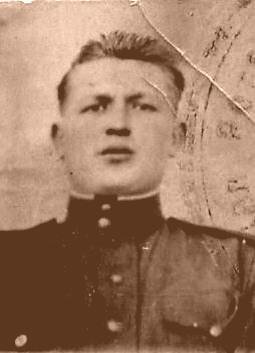

Maxim Semenovich Kovalev
Was born in 1915 in Novaya Teplovka, Buzuluk district, Chkalov (Orenburg) region. His parents were farmers, and there were three children in the family: the eldest Matryona, Marfa and Maxim. In 1921, when Maxim was 6 years old, the starvation period arrived to the country. Their father, Semyon, took the whole family to Siberia to save them from the starvation. We rode on a horsed cart for the whole summer. It was already the fall, when they found a place and hired themselves as employees. The owners provided them house and food. Matryona's older sister died and was buried in Siberia. In 1923, Kovalev's family returned to the native village, to their home. Children were brought up in labor and rigor. Maxim was literate, when they returned, he went to school, finished 7 classes - that time it was considered as a high level of education. Marfa - my future great-grandmother, finished 3 graded of the parochial school, but that time the girls studied very rarely. Maxim got married before the war. With his wife Olga, they had two children in the peaceful pre-war period: a son, Nikolai, and a daughter, Lyuba. in January 1942 Maxim called up. In total, 117 people went to the front from the small village in those terrible days. Just few of them returned home. In the center of Novaya Teplovka there is a monument to the soldiers who died in the first battles of that terrible war. Documents that were carefully kept by his family, “speak” about the soldier's fate of Maxim's great-grandfather. He went to the front in January 1942, was a soldier of the 23rd separate telegraph-construction Stettin roth NKO -USSR named after the order of the red Star. Information from his preserved "Book of the red army": position - line supervisor in a roth of signalmen; personal property- cap, overcoat, tunic, cotton trousers, undershirt, long Johns, footcloths, boots, belt, satchel and bowler hat; technical equipment and weapons-carbine. These pieces were everything that the soldier Maxim Kovalev owned. The following record about the participation of Kovalev in the battles: until February 1943 - the Central front; February, March, April 1943-the North-Western front; from April 1943 to January 1944 - the Central front again, then-the Belarusian front. As part of his native company, he took part in the liberation of Belarus, then in fighting in the territory of Pomerania, where they stormed the German defense points on the outskirts of Danzig, the city and fortress of Danzig, the main city of Pomerania and the large seaport of Stetten(Stettin). A very interesting document has been preserved - a manuscript of gratitude. The document is issued as an order signed by the unit commander (Spiridonov). It follows that private Kovalev Maxim Semenovich got gratitudes from the Supreme commander-in-Chief, Marshal of the Soviet Union Stalin for the difference in the battles with the Nazi invaders: first for participating in the liberation of our cities (in Belarus), then for the mastery of cities in Pomerania, Germany. The dates of the liberation of cities (or the capture of German cities), the numbers of orders for awards are listed. Total number of orders concerning the private Kovalev - at least 15, the last one № 360 - for the capture of Bart, Bad, Doberon, Witenberg; and in the end- for connecting Russians with the British troops on May 3-5, 1945." Due to the severe head contusion, these days were the last days of the war for soldier Kovalev. Another, no less interesting document has been preserved-from July 31, 1945. It is on a large sheet and decorated colorfully - Thank you letter. This document was signed by Marshal of the Soviet Union, Commander of the 2nd Belorussian front K. K. Rokossovskiy, a member of the military Council of the front, Lieutenant-General N. Subbotin, and chief of staff of the front, Colonel-General A. Bogolyubov. It was written:“To you, a valiant warrior of the Red army, who was fighting against the Nazi invaders, fought in the 2nd Belorussian front and was awarded commendation by the orders of the Supreme Commander, Generalissimo of the Soviet Union of comrade STALIN, the front Military Council deliver this letter of gratitude as the memory of the great Patriotic war. We wish you good health and new success in your future working life for the benefit of our great Socialist Motherland.” His wife Olga and children saw Maxim Semyonovich, their husband and father, only in 1946. Until that time, he was treating in the hospital. While there, Maxim Semyonovich wrote his family a letter in which he promised to return soon and did not mention that he was so seriously wounded. The letter is still cherished by his daughter, as a family heirloom. He returned almost blind after a severe concussion, but with a great hope for recovery and a desire to live. Maxim Semyonovich could not work, he was tormented by terrible headaches. No one could ease his suffering. Maxim Semyonovich's wife and children saw his agony, they pitied him, took care of him. Maxim Semyonovich died on April 7, 1948, in his native village of Novaya Teplovka, where my grandmother Olya was born and lived as a child, and is buried in the village cemetery. There is a plot where the entire Kovalev family buried: Maxim Kovalev, his parents - father Semyon, mother Anisya, wife Olga, son Nikolai . After many years, his daughter, Lyubov Maksimovna Kovaleva, graduated from the medical school and began to help people. As a child, she realized how important and necessary this profession was. Maxim's daughter Lyubov Maksimovna is with her family, and we all cherish the memory of Maxim Semyonovich, his heroism and his soldier's fate.
Maxim Semenovich Kovalev
Was born in 1915 in Novaya Teplovka, Buzuluk district, Chkalov (Orenburg) region. His parents were farmers, and there were three children in the family: the eldest Matryona, Marfa and Maxim. In 1921, when Maxim was 6 years old, the starvation period arrived to the country. Their father, Semyon, took the whole family to Siberia to save them from the starvation. We rode on a horsed cart for the whole summer. It was already the fall, when they found a place and hired themselves as employees. The owners provided them house and food. Matryona's older sister died and was buried in Siberia. In 1923, Kovalev's family returned to the native village, to their home. Children were brought up in labor and rigor. Maxim was literate, when they returned, he went to school, finished 7 classes - that time it was considered as a high level of education. Marfa - my future great-grandmother, finished 3 graded of the parochial school, but that time the girls studied very rarely. Maxim got married before the war. With his wife Olga, they had two children in the peaceful pre-war period: a son, Nikolai, and a daughter, Lyuba. in January 1942 Maxim called up. In total, 117 people went to the front from the small village in those terrible days. Just few of them returned home. In the center of Novaya Teplovka there is a monument to the soldiers who died in the first battles of that terrible war. Documents that were carefully kept by his family, “speak” about the soldier's fate of Maxim's great-grandfather. He went to the front in January 1942, was a soldier of the 23rd separate telegraph-construction Stettin roth NKO -USSR named after the order of the red Star. Information from his preserved "Book of the red army": position - line supervisor in a roth of signalmen; personal property- cap, overcoat, tunic, cotton trousers, undershirt, long Johns, footcloths, boots, belt, satchel and bowler hat; technical equipment and weapons-carbine. These pieces were everything that the soldier Maxim Kovalev owned. The following record about the participation of Kovalev in the battles: until February 1943 - the Central front; February, March, April 1943-the North-Western front; from April 1943 to January 1944 - the Central front again, then-the Belarusian front. As part of his native company, he took part in the liberation of Belarus, then in fighting in the territory of Pomerania, where they stormed the German defense points on the outskirts of Danzig, the city and fortress of Danzig, the main city of Pomerania and the large seaport of Stetten(Stettin). A very interesting document has been preserved - a manuscript of gratitude. The document is issued as an order signed by the unit commander (Spiridonov). It follows that private Kovalev Maxim Semenovich got gratitudes from the Supreme commander-in-Chief, Marshal of the Soviet Union Stalin for the difference in the battles with the Nazi invaders: first for participating in the liberation of our cities (in Belarus), then for the mastery of cities in Pomerania, Germany. The dates of the liberation of cities (or the capture of German cities), the numbers of orders for awards are listed. Total number of orders concerning the private Kovalev - at least 15, the last one № 360 - for the capture of Bart, Bad, Doberon, Witenberg; and in the end- for connecting Russians with the British troops on May 3-5, 1945." Due to the severe head contusion, these days were the last days of the war for soldier Kovalev. Another, no less interesting document has been preserved-from July 31, 1945. It is on a large sheet and decorated colorfully - Thank you letter. This document was signed by Marshal of the Soviet Union, Commander of the 2nd Belorussian front K. K. Rokossovskiy, a member of the military Council of the front, Lieutenant-General N. Subbotin, and chief of staff of the front, Colonel-General A. Bogolyubov. It was written:“To you, a valiant warrior of the Red army, who was fighting against the Nazi invaders, fought in the 2nd Belorussian front and was awarded commendation by the orders of the Supreme Commander, Generalissimo of the Soviet Union of comrade STALIN, the front Military Council deliver this letter of gratitude as the memory of the great Patriotic war. We wish you good health and new success in your future working life for the benefit of our great Socialist Motherland.” His wife Olga and children saw Maxim Semyonovich, their husband and father, only in 1946. Until that time, he was treating in the hospital. While there, Maxim Semyonovich wrote his family a letter in which he promised to return soon and did not mention that he was so seriously wounded. The letter is still cherished by his daughter, as a family heirloom. He returned almost blind after a severe concussion, but with a great hope for recovery and a desire to live. Maxim Semyonovich could not work, he was tormented by terrible headaches. No one could ease his suffering. Maxim Semyonovich's wife and children saw his agony, they pitied him, took care of him. Maxim Semyonovich died on April 7, 1948, in his native village of Novaya Teplovka, where my grandmother Olya was born and lived as a child, and is buried in the village cemetery. There is a plot where the entire Kovalev family buried: Maxim Kovalev, his parents - father Semyon, mother Anisya, wife Olga, son Nikolai . After many years, his daughter, Lyubov Maksimovna Kovaleva, graduated from the medical school and began to help people. As a child, she realized how important and necessary this profession was. Maxim's daughter Lyubov Maksimovna is with her family, and we all cherish the memory of Maxim Semyonovich, his heroism and his soldier's fate.
0 comment



2026 © Russian Military Historical Society Developed by Jetmix