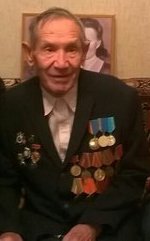
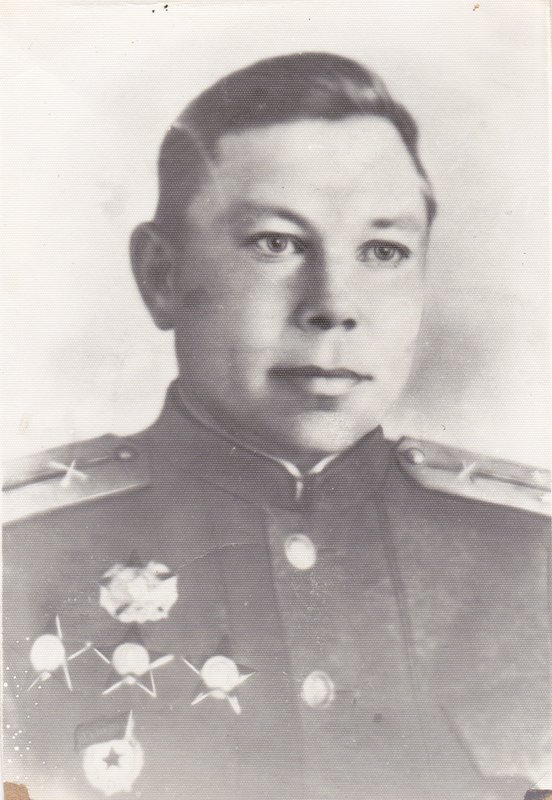


Gritsay Ivan Terentyevich
Title: Red Army soldier Type of troops: Signal troops Subdivision: 34th Guards Rifle Enakievskaya Red Banner Order of the Suvorov Division .My great-grandfather was born into a large family with four children. The Great Patriotic War began when he was 16 years old. In 1942, when he was 17, he volunteered for the front (adding one year to himself). Upon arrival at the front, he was sent as a signalman to the 34th Guards Division of the 107th Guards Regiment. With his division, he made a long way from Salsk to Budapest. My great-grandmother talked a lot about the difficulties that they had to endure during the war - she talked about the cold and hunger that did not leave them for a minute, about the constant bombing and trenches. In 1944, my great-grandfather and his regiment reached Hungary and stopped in the city of Budapest. In Budapest, they met with fierce enemy resistance. Soviet soldiers showed staunchness, courage and military skill. Thus, a unit of the 107th Guards Regiment of the 34th Guards Rifle Division in the amount of 28 fighters, including my great-grandfather, led by Lieutenant I.I.Panin, was surrounded at a small railway station near Banhida. The guardsmen were entrenched in a two-story brick building, turning it into a stronghold. In the first minutes of the battle, Lieutenant Panin died a heroic death. The command was taken over by his assistant, the party organizer of the seventh company, senior sergeant M.S.Starikov. The Nazis opened heavy machine-gun and mortar fire at the house. To support their infantry, they deployed four tanks and several armored personnel carriers. For five days the Nazis stormed the house, but they could not break the will and fortitude of the guards. A handful of brave warriors repulsed 40 attacks, destroyed up to 70 soldiers, a tank and three armored personnel carriers. Three days later, from only 34 regiment, several people survived, among whom was my great-grandfather. Being completely surrounded by the enemy, they did not surrender and continued to defend the railway station. After a while, only my great-grandfather survived. Realizing the hopelessness of his situation, he hid himself under a knocked-out German tank and called the battery fire on himself by radio. He realized that he was going to certain death, but for the sake of saving his homeland and his compatriots, he was ready to sacrifice himself. The battery destroyed three tanks, two armored vehicles and several enemy detachments. For this feat, he was awarded the following awards: "Order of the Patriotic War, 2nd degree" and "Medal of Courage". After the bombing, my great-grandfather miraculously survived, but was contused, badly burned and injured his leg, after which he was taken to the hospital, where he met my great-grandmother Gritsai Praskovya Ivanovna. During the war, my great-grandmother Gritsai Praskovya Ivanovna was a simple nurse in a military hospital and helped wounded soldiers. One of these soldiers was my great-grandfather. He was taken to the hospital in critical condition. The doctors believed that he would not live a day, but my great-grandmother did not give up and tried to save his life to the last. So they met. After recovering, despite the excuses of doctors and family, my great-grandfather again went to the front and continued to fight, not alone, but with his wife, Gritsai Praskovya Ivanovna. Towards the end of 1944, due to the pregnancy of my great-grandmother, they decided to stay in Budapest for a while. My grandmother Tamara Ivanovna Gritsai was born there. After the war, in 1948, they returned to their homeland.
0 comment



2026 © Russian Military Historical Society Developed by Jetmix