


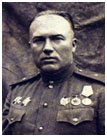


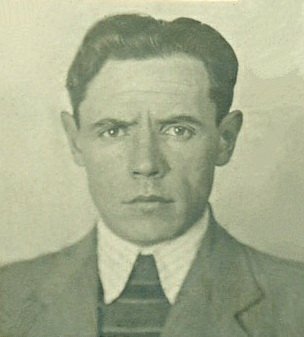

Botov Petr Ustinovich
Grade title: a red army soldier. He was called up to the front on the 15th of July, 1941, by the Magnitogorsk regional military commissariat. He was sent to the team no. 2000 of the Chelyabinsk regional military commissariat. He was at the front since the 28th of July, 1942. He fought at the South-Western front as a driver of the car "ZIS-5" of the 565th auto troop of the 82nd guard rifle division. He was wounded in the right leg on the 9th of January, 1943. On the 16th of April, 1943, he was awarded the medal "For Bravery" for a heroic act committed on the 10th of February, 1943, near Belaya Kalitva. On the 18th of February, 1945, Botov Petr Ustinovich, a guard soldier, a driver of the 87th separate transport troop of the 82nd guard rifle division of the order of Bogdan Khmelnitsky, was awarded the order of the Red Star for heroic actions in the area of the Polish city of Poznań. Combat path: the 82nd Zaporozhye guard rifle division of the Red Banner and the order of Bogdan Khmelnitsky of the second degree was formed on the 19th of March, 1943, on the basis of parts of the 321st rifle devision (II). The division included (this new unit numbering was assigned to the division on the 11th of April, 1943) the 242nd, 244th, 246th guards rifle regiments and the 185th guards aviation regiment. For success in the liberation of Odessa the devision was awarded the order of Bogdan Khmelnitsky of the second degree. On the 8th of May, 1944, having marched, the division concentrated in the villages of Novo-Alexandrovka, Komarovka and Lazorevka. On the 9th of May the division was placed in reserve in order to concentrate in the gullies to the north-east from the village of Tashlyk and to organize defense along the left bank of the Dniester. The 246th guard rifle regimen of the division crossed the Dniester river and captured the area. The task of the regiment was in cooperation with the 30th rifle devision to rescue from the encirclement the headquarters of the 28th guard rifle corps and the commander general S. I. Morozov himself, who were defending in the forest near the village of Vainovo. The task assigned to the 246th regiment was completed. On the 11th of May the main forces of the division crossed the river and were engaged in fierce fighting on a small area near the village of Vainovo. Heavy fighting continued until early June. On the 2nd of June the division, having surrendered the line to the units of the 32nd guard rifle corps, returned to the eastern bank of the Dniester, to their previous positions. A day later the division was withdrawn to the reserve and at the night marched along the route Temush, Shibka and reached the forest to the south-east of the village of Pavlovka, where it was replenished, rested and conducted scheduled classes until the middle of June 1944. On the 12th of June, 1944, the division was awarded the order of Bogdan Khmelnitsky of the second degree. From the 18th of June, 1944, the division's units were loaded into echelons and unloaded on the 22nd and on the 23rd of June, 1944, at the station of Swarin. Then the devision became part of the 1st Belorussian front, where it was to participate in the operation "Bagration" (the Belarusian offensive operation). Since the 18th of July, 1944, the division being in the second echelon of the 8th guard army participated in the liberation of Belarus. On the 4th of August, 1944, the division came on the river of Svmder and took the defense on its southern bank. On the 12th of August the division's regiments crossed the Vistula river in the Tarnovo area and took up defensive positions near the settlements of Stara, Tselenov, Sukha Volya, Bosinov, and became part of the 4th guard rifle corps. In this area the division with the neighboring 47th guard division repulsed a fierce attack of the enemy. On the 18th of August, 1944, the division again returned to the 29th guard rifle corps and on the 19th of August stroke in the direction of Glovachuva. Suffering heavy losses in manpower and equipment the enemy began to withdraw to the second defensive line near Henricus, Manihi, Emilyw. On the 29th the division captured Glowachow. Having met strong enemy resistance the division moved to a tough defense on the occupied line where it was located until the 9th of September, 1944. On the 10th of September, 1944, having surrendered positions to parts of the 27th guard rifle devision, the division concentrated in the forests to the east from Malen, Trzeben. A day later the division marched through Trzeben, Magnuszew, Wilckovice, Dolne, and Zhelezna Stara to the mouth of the Pilica river. Here the division replaced the 3rd Polish infantry division which was preparing to attack Warsaw. On the 2nd of October, 1944, having transferred their rather heavily fortified section of defense, the division's regiments went to the second echelon of the corps and occupied the defense to the east from Roznishevsky and to the north from Lutsyanov. Almost until the end of November the division was in the second echelon of the corps. Combat training of personnel was widely deployed in the units. On the 25th of November, 1944, the guards went to the first echelon and took up the defense near the settlements of Bogushkov, Grabuv, Zalesny. Until January the devision was improving their defense, preparing for an offensive and collecting intelligence information. On the 11th of January, 1945, the division, reinforced by the 46th mortar brigade, the 1504th light self-propelled artillery regiment and by two batteries of the 351st heavy howitzer artillery regiment, took up the initial position for the offensive. Before the command of the division the task was assigned to break through the enemy’s defenses in the area of Gelenov, Henrykow and, stepping in the direction of Zielonka and Buckthorn, to go with the main forces on the highway near Urbanov, Berna, Shlyahetske, and the advanced troops were to move to the line near Kadlubek, Trambone. On the 14th of January parts of the division started to go on the offensive along the entire line. Having cut the railroad Warka-Radom the devision rapidly went to the line Kadlubek-Nova, Kadlubek, Frantiskuv, Jeziorna. On the 19th of January, pursuing the enemy, the division resumed the offensive and liberated the city of Lodz and advanced to Zgezh. Having captured the cities of Zgierz and Schwarzenec, the guards in the vanguard of the 29th guard rifle corps moved to Poznań. On the 23th of January, 1945, parts of the division encountered stubborn resistance of the Nazis who took up defense in front of the outer defensive perimeter of the fortress city. Within six days the regiments were able to master the line of Janikowo, Globenet, Zieleniec. Since the 1st of February the division began to storm Poznań. The enemy was resisting hard. By the 16th of February, 1945, the division transferred its combat section to the 27th guard rifle devision and completed regrouping to the south-western approaches to the citadel. The enemy "Everest Group" was standing in front of the division's offensive line. On the 18th of February the division again started to attack the fortress, on the 23rd of February Poznan fell. On the 24th of February, after handing over the city to the 2nd assault brigade, the division marched along the route Poznań-Schlechen-Pinne-Kema-Warzbaum-Betsche-Meseritz-Radach and concentrated in the area of the Kustrin fortress. Here the division was put in reserve, replenished and rested. Since the 26th of March, 1945, the 82nd guard devision was fighting to capture Kustrin. On the 29th of March the assault troops broke into the fortress and cleared it of the enemy. Having captured the fortress the division left one battalion there and all other units and divisions concentrated on the zaodersky area. The command post of the division was located to the north-east from the Seelow heights, near Zapiga. Since the 18th of April the division was attacking Berlin at the border of the Guzover forest. After having crossed the Fleece river guards flanking maneuver to the east and the north captured an important strongpoint of the enemy – Ansfelden. From the 19th of April the division was part of the 29th guard rifle corps of the 8th guard army and developed an offensive along the Berlin highway in the direction of Munchenberg. Having captured Munchenberg the division went to the rear of the enemy group which was still resisting to the parts of the 8th guard army at the Seelow heights. On the 23th of April, 1945, parts of the division crossed the Spree river and on the 25th of April they captured Tempelhof. On the 28th of April they crossed the Landwehr canal and continued to fight near the Anhalt and Potsdam railway stations. The fighting here lasted for 4 days and on the 1st of May at 3 p.m. the Berlin garrison capitulated. On the 2nd of May, 1945, for the successful combat operations to capture Berlin the division was awarded the order of the Red Banner. On the 10th of May, 1945, the division as part of the 29th guard rifle corps was withdrawn from Berlin and concentrated in the area of Oschatz-the city of Riza. Commander: major general I. A. Makarenko (- 01.4.1944), lieutenant colonel M. Ya. Karnaukhov (02.4.1944 - 04.5.1944), G. I. Khetagurov (05.5.1944 - 18.4.1945), M. I. Duk (from 19.4.1945 until the end of the war). Military commissar, a deputy political commissar: lieutenant colonel D. N. Travin. Knyazeva Lyudmila, a granddaughter, remembers: “I didn't know much about my grandfather. My grandmother passed away very early. From the stories of my grandmother which I heard as a child only "fragments" remained in my memory. But thanks to them 70 years later I found my grandfather, although deceased, and acquired numerous relatives. I am grateful to all the people who responded to my requests. These are employees of the Magnitogorsk military enlistment office, the Central Archives of the Ministry of Defence of the city of Podolsk, the site " Feat of the people” and namely to Alexander Lukin. He gave me the coordinates of the award documents and when I found them I learned about the exploits of my grandfather; to the program "Wait for me", in particular, to Komarova Marina Pavlovna. With her help and my childhood memories I got to my grandfather's homeland. And special thanks to the teacher, the kindest-hearted person Polyakova Galina Gennadyevna who served as the last link in the search chain and connected the whole chain together. Thanks to her efforts I visited my grandfather's homeland, was able to put flowers on his grave and acquired numerous relatives. Having already personal information about my grandfather and comparing the facts with the chronology of events, I collected material about the division in which he passed his combat path. I learned that after arriving at the front, from the very first day he became a direct participant in the battle of Stalingrad and went all the way to Berlin”. Galina Polyakova recalls: “I was little but I remember him. We kids all loved him, he was very kind and was always joking....he always loved us kids. He was always telling jokes, jokes, and incidents... I remember him always crying at the meetings dedicated to the 9th of May.....not all veterans were crying......but he always-always...
0 comment



2026 © Russian Military Historical Society Developed by Jetmix