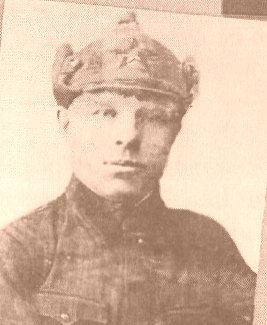


Strekalovsky Ivan Gerasimovich
Strekalovsky I. G. was called up for military service in 1939 and sent to the Far East to a tank unit, where he studied at the Junior command school. In March 1941, the tank unit of the 328th Separate Red Banner Battalion, where he served, was urgently transferred to the West in Belarus to a place called "Belaya Tserkov’ (the White church)", where he met the war. His unit was surrounded and fought its way through to join other Russian units, but they couldn't. In the winter of 1942, the Kotovsky partisan detachment was created from scattered groups of fighters who were surrounded, and it was constantly replenished. Later, Strekalovsky I. G. fought in the Voroshilov Partisan Detachment, Dzerzhinskiy brigade, as a platoon commander under the pseudonym Strelkovsky Nikolai Nikolaevich. Later, after the war, fellow soldiers in correspondence with Ivan Gerasimovich recalled many combat episodes. They wrote that for his fearless actions Strelkovsky was very well known to the Germans and traitors. A large monetary reward was set for his head by the fascists. They considered it a "precious trophy" and ambushed it. Many books have been written about the partisans who fought in Belarus. In the story of Dryagin D. Ya. "Genka's accordion" there is a character Strelkovsky Nikolai, the prototype of which was Strekalovsky I. G. The Author described his courage and bravery in battles with vlasovtsy and fascists, and also wrote that in rare moments of rest, he joked a lot, was an open and cheerful person, under Genka's accordion could dance so that he infected others with his optimism and fatigue as if removed. Here is one of the episodes of this story: "The retreating German divisions were on the highway Novogrudok-Liubcha. The partisans of the Dzerzhinsky Brigade were preparing to meet enemis. They were rearming, putting in order the equipment taken from the Germans. The Kotovsky detachment, in which Gena was, took up defensive positions West of Lubki in the former landowner manor Voynovo. Technical platoon commander Vartan was preparing for a hot battle. Pozharov's assault group kept in touch with the brigade. There were four detachments in the city. The offensive began in the early morning. German Junkers flew over the city. But immediately our Soviet fighters sailed towards them. The Junkers didn't have time to drop their bombs. The battle lasted more than 8 hours. The partisans did not allow a single German to enter the city. But by evening, more and more German troops were flocking to the city, retreating from the East. Gena was the first to see a huge black spot in the distance. The squad leader Leoshko looked through his binoculars and said: "The crows come to the feast." They were riders in black uniforms. Commissar Chentsov explained that this was a black pack of traitors who had sold out to the Germans, led by General Vlasov. They raised a sword against their brothers, so there will be no mercy for them! A black cloud approached the group. At the same moment, everything was mixed up: the shouting of people, the neighing of horses, the crackle of machine guns and automatic shooting. The horses shied from side to side, crushing each other and people. And the partisans poured and poured machine-gun fire on the enemies. The Vlasov formation thinned, and many of them ran away. Those on foot who had lost their horses tried to ride away together on the same horse, and some managed to grab the horse's tail to escape the partisan fire. Strelkovsky and his platoon crashed into the thick of the Vlasovites. He cut them right and left, not letting them recover. But one of the Vlasovites hit him on the head with a saber. His cap flew off, and blood ran down his face, but he continued to fight with even greater ferocity. Suddenly there were dark circles before my eyes, the sun faded, silence enveloped me, my head became heavy. He wanted to shout, but he didn't have strength, his lips wouldn't obey. Nikolai slowly slid off his horse and fell to the ground, losing consciousness. An order came from the command headquarters of the 1st Belorussian Front to leave the city of lyubcha and withdraw the entire population. The partisans decided to retreat to Nalibotskaya Pushcha through the Neman. The wounded and shell-shocked Strelkovsky was carried on a cart. He didn't regain consciousness for a long time. He was sent to the hospital and never returned to the squad. Nothing is known about his future fate." N. Grebenkin, with whom he fought together on Belarusian soil, wrote a book about that time, which is called "Sign of the hour" (it’s a pity, it is in Belarusian). It was published in 1984 in Belarus in the newspaper "Novaya zitse". N. Grebenkin sent a newspaper subscription with this story to Ivan Gerasimovich. After the war in Belarus, the village of Chereshlya of Novogrudok district was created a Museum of partisan glory. Since, in one of the battles with vlasovtsy N. Strelkovsky was very seriously wounded and sent to the hospital, the partisans considered him dead and in the Museum he was listed for a long time in the lists of the dead. In one of his letters to Strekalovsky I. G. from 03.02.1983, N. Grebenkin writes: "Hello, Ivan Gerasimovich. I am immensely glad that Lenya Shestyan found you. I'm glad you're alive and well. I don't know what your post-war life was like,what your health is like, because a lot of time has passed, a lot of water has flowed, but I think that you are doing well. It is a pity that you were found with some delay, because last year Novogrudok celebrated the 40th anniversary of our partisan detachment. About 100 people were present. I hope that Lenya Shestyan wrote to you about this or will tell you when you meet. He is planning such a meeting (for you and Philip Pozhar). Believe me, I've missed you. Remember that I have your photos, they are in the museums of every school in Novogrudok, but you were not there. I hope you will visit me. I must inform you that I have started writing a book about our partisan unit. I've been working hard on it for 2 weeks now, and it's already started. And while we meet, write to me who was involved in the ambush on the police commander, in what place it was. There was Vasya Morozov, I remember that. What do you know about Morozov, Perkov, Polyakov? Who were you with when you caught a police officer Yanchuk from Nizovtsev? I think Shchegortsov was with you. After whom were you the commander of the intelligence unit? What do you remember about Tchaikovsky?. You lived with him in Polinkah strong friends. Did he tell you anything about himself? What do you remember about the Rubezhevichi fight? Morozov and Linevsky were wounded there. I'm retired, which is why I took up the book. Before that, my materials were published in Newspapers and magazines. I bombarded you with questions, I hope you remember all this? Waiting for an answer. Write about everything, because no one has heard about you, and you yourself did not write. I kiss and hug you, Nikolai." His fighting friends: Fire Philip V., Grebenkin Nikolai Ivanovich, Sestan Leonid, Leoshko Alexander Nikitovich (the commander Kotovsky), Bushmich Nicodemus Stepanovich Dumbuser Constantine Khristianovich, Belyaev, Matthew F., Chentsov N. (Commissioner team), Vasiliy Morozov, Tchaikovsky, Ilica Sergei Mitrofanovich (the company commander, Lieutenant), Glushkov, Rodico, eagles, poles, Bags, Egortsev, Onishchenko I., Linevskiy Michael Sevastyanovich, Bespalov, Perks, Poles, etc. After the liberation of Belarus, Strekalovsky I. G. he continued to fight heroically in the active army, still under the pseudonym as Strelkovsky N. N., with fights reached Berlin and signed on the building of the defeated Reichstag. The saved letters of appreciation, awarded Strelkovsky N. N (Strekalovsky, I. G)., as: 1) the paticipant of the fighting for the liberation of Gomel; 2) a paticipant of the breakthrough of the Germans in Danzig-Gdanskas enemy, culminating in the access to the Baltic sea; 3) a paticipant r of the breakthrough of the German defense on the Western Bank of the Narew river North of Warsaw; 4) the paticipant of the fighting for the Novogeorgievsk (fortress Madeline); 5) the paticipant of the fighting for Bytów (Bytow); 6) participant mastery of the city and port of Gdynia; 7) the paticipant of crossing the river East and West of the Oder; 8) the paticipant of fighting for the conquest of the cities of Prenzlau and Angermünde; 9) participant mastery of Stralsund, Grimmen, Demmin, Malchin, Waren, Wesenberg; 10)a member of mastering by cities Bart, bad Doberan, Neubukow, Wittenberg. His awards: 1) Order of the Red Star (#1750781), Order of the Patriotic War 1 art. (#2173454), Badge "Guard". 2) Medals:For bravery (#2201780), Georgy Zhukov (#205). 3) Anniversary medals "For the Victory in the Second World War" for the 20th, 30th, 40th, 50th anniversary; also anniversary medals for the 50th, 60th, 70th anniversary of the Armed Forces of the USSR; 4) Badge "Front-line Soldier"; 5) post-war medals:" For the development of virgin and fallow lands "and "Veteran of labor". After 40 years, the remaining partisans found Strelkovsky N. N. (Strekalovsky I. G.). From then until his death, he corresponded with his comrades and went to a meeting in Kazakhstan (Kustanai), where one of the partisans gathered his fellow soldiers. The conversation is saved. it contains a lot of interesting things about the fate of partisan friends. After the war, Ivan Gerasimovich returned in June 1946 to his native village of Kargapolye, Kurgan region, where he worked as a mechanic-driver in the Autorot, participated in the development of virgin lands. Since 1960, he worked in the district fire Department, where he was the Secretary of the primary party organization. Before the war in 1938, Ivan Strekalovsky married a young pretty girl Vakhova Taisya Viktorovna. And from 1939, when he was drafted into the army, to June 1946 (almost 8 years) she had waited faithfully for his return, first from the army, then from the war. When the notification came about him as a missing person(when after the encirclement he fought in the partisans), I did not lose hope for a minute that he would return. Letters began to arrive after the liberation of Belarus. The joy was great, but it was still far from the end of the war... Two brothers of Ivan Gerasimovich Strekalovsky died in the war: Ivan Gerasimovich Strekalovsky, born in 1922 (in his family his name was Malushko, because he was christened Ivan, like his older brother), died on March 23, 1943 near the village of Vtoriye Ponyri, Ponyrsky district, Kursk region, and was buried there; Pyotr Gerasimovich Strekalovsky, born in 1925, died on November 11, 1943 in Ukraine near Konstantinovka, where he was buried. Eternal glory to our fathers and mothers, to all who had to go through this!
Strekalovsky Ivan Gerasimovich
Strekalovsky I. G. was called up for military service in 1939 and sent to the Far East to a tank unit, where he studied at the Junior command school. In March 1941, the tank unit of the 328th Separate Red Banner Battalion, where he served, was urgently transferred to the West in Belarus to a place called "Belaya Tserkov’ (the White church)", where he met the war. His unit was surrounded and fought its way through to join other Russian units, but they couldn't. In the winter of 1942, the Kotovsky partisan detachment was created from scattered groups of fighters who were surrounded, and it was constantly replenished. Later, Strekalovsky I. G. fought in the Voroshilov Partisan Detachment, Dzerzhinskiy brigade, as a platoon commander under the pseudonym Strelkovsky Nikolai Nikolaevich. Later, after the war, fellow soldiers in correspondence with Ivan Gerasimovich recalled many combat episodes. They wrote that for his fearless actions Strelkovsky was very well known to the Germans and traitors. A large monetary reward was set for his head by the fascists. They considered it a "precious trophy" and ambushed it. Many books have been written about the partisans who fought in Belarus. In the story of Dryagin D. Ya. "Genka's accordion" there is a character Strelkovsky Nikolai, the prototype of which was Strekalovsky I. G. The Author described his courage and bravery in battles with vlasovtsy and fascists, and also wrote that in rare moments of rest, he joked a lot, was an open and cheerful person, under Genka's accordion could dance so that he infected others with his optimism and fatigue as if removed. Here is one of the episodes of this story: "The retreating German divisions were on the highway Novogrudok-Liubcha. The partisans of the Dzerzhinsky Brigade were preparing to meet enemis. They were rearming, putting in order the equipment taken from the Germans. The Kotovsky detachment, in which Gena was, took up defensive positions West of Lubki in the former landowner manor Voynovo. Technical platoon commander Vartan was preparing for a hot battle. Pozharov's assault group kept in touch with the brigade. There were four detachments in the city. The offensive began in the early morning. German Junkers flew over the city. But immediately our Soviet fighters sailed towards them. The Junkers didn't have time to drop their bombs. The battle lasted more than 8 hours. The partisans did not allow a single German to enter the city. But by evening, more and more German troops were flocking to the city, retreating from the East. Gena was the first to see a huge black spot in the distance. The squad leader Leoshko looked through his binoculars and said: "The crows come to the feast." They were riders in black uniforms. Commissar Chentsov explained that this was a black pack of traitors who had sold out to the Germans, led by General Vlasov. They raised a sword against their brothers, so there will be no mercy for them! A black cloud approached the group. At the same moment, everything was mixed up: the shouting of people, the neighing of horses, the crackle of machine guns and automatic shooting. The horses shied from side to side, crushing each other and people. And the partisans poured and poured machine-gun fire on the enemies. The Vlasov formation thinned, and many of them ran away. Those on foot who had lost their horses tried to ride away together on the same horse, and some managed to grab the horse's tail to escape the partisan fire. Strelkovsky and his platoon crashed into the thick of the Vlasovites. He cut them right and left, not letting them recover. But one of the Vlasovites hit him on the head with a saber. His cap flew off, and blood ran down his face, but he continued to fight with even greater ferocity. Suddenly there were dark circles before my eyes, the sun faded, silence enveloped me, my head became heavy. He wanted to shout, but he didn't have strength, his lips wouldn't obey. Nikolai slowly slid off his horse and fell to the ground, losing consciousness. An order came from the command headquarters of the 1st Belorussian Front to leave the city of lyubcha and withdraw the entire population. The partisans decided to retreat to Nalibotskaya Pushcha through the Neman. The wounded and shell-shocked Strelkovsky was carried on a cart. He didn't regain consciousness for a long time. He was sent to the hospital and never returned to the squad. Nothing is known about his future fate." N. Grebenkin, with whom he fought together on Belarusian soil, wrote a book about that time, which is called "Sign of the hour" (it’s a pity, it is in Belarusian). It was published in 1984 in Belarus in the newspaper "Novaya zitse". N. Grebenkin sent a newspaper subscription with this story to Ivan Gerasimovich. After the war in Belarus, the village of Chereshlya of Novogrudok district was created a Museum of partisan glory. Since, in one of the battles with vlasovtsy N. Strelkovsky was very seriously wounded and sent to the hospital, the partisans considered him dead and in the Museum he was listed for a long time in the lists of the dead. In one of his letters to Strekalovsky I. G. from 03.02.1983, N. Grebenkin writes: "Hello, Ivan Gerasimovich. I am immensely glad that Lenya Shestyan found you. I'm glad you're alive and well. I don't know what your post-war life was like,what your health is like, because a lot of time has passed, a lot of water has flowed, but I think that you are doing well. It is a pity that you were found with some delay, because last year Novogrudok celebrated the 40th anniversary of our partisan detachment. About 100 people were present. I hope that Lenya Shestyan wrote to you about this or will tell you when you meet. He is planning such a meeting (for you and Philip Pozhar). Believe me, I've missed you. Remember that I have your photos, they are in the museums of every school in Novogrudok, but you were not there. I hope you will visit me. I must inform you that I have started writing a book about our partisan unit. I've been working hard on it for 2 weeks now, and it's already started. And while we meet, write to me who was involved in the ambush on the police commander, in what place it was. There was Vasya Morozov, I remember that. What do you know about Morozov, Perkov, Polyakov? Who were you with when you caught a police officer Yanchuk from Nizovtsev? I think Shchegortsov was with you. After whom were you the commander of the intelligence unit? What do you remember about Tchaikovsky?. You lived with him in Polinkah strong friends. Did he tell you anything about himself? What do you remember about the Rubezhevichi fight? Morozov and Linevsky were wounded there. I'm retired, which is why I took up the book. Before that, my materials were published in Newspapers and magazines. I bombarded you with questions, I hope you remember all this? Waiting for an answer. Write about everything, because no one has heard about you, and you yourself did not write. I kiss and hug you, Nikolai." His fighting friends: Fire Philip V., Grebenkin Nikolai Ivanovich, Sestan Leonid, Leoshko Alexander Nikitovich (the commander Kotovsky), Bushmich Nicodemus Stepanovich Dumbuser Constantine Khristianovich, Belyaev, Matthew F., Chentsov N. (Commissioner team), Vasiliy Morozov, Tchaikovsky, Ilica Sergei Mitrofanovich (the company commander, Lieutenant), Glushkov, Rodico, eagles, poles, Bags, Egortsev, Onishchenko I., Linevskiy Michael Sevastyanovich, Bespalov, Perks, Poles, etc. After the liberation of Belarus, Strekalovsky I. G. he continued to fight heroically in the active army, still under the pseudonym as Strelkovsky N. N., with fights reached Berlin and signed on the building of the defeated Reichstag. The saved letters of appreciation, awarded Strelkovsky N. N (Strekalovsky, I. G)., as: 1) the paticipant of the fighting for the liberation of Gomel; 2) a paticipant of the breakthrough of the Germans in Danzig-Gdanskas enemy, culminating in the access to the Baltic sea; 3) a paticipant r of the breakthrough of the German defense on the Western Bank of the Narew river North of Warsaw; 4) the paticipant of the fighting for the Novogeorgievsk (fortress Madeline); 5) the paticipant of the fighting for Bytów (Bytow); 6) participant mastery of the city and port of Gdynia; 7) the paticipant of crossing the river East and West of the Oder; 8) the paticipant of fighting for the conquest of the cities of Prenzlau and Angermünde; 9) participant mastery of Stralsund, Grimmen, Demmin, Malchin, Waren, Wesenberg; 10)a member of mastering by cities Bart, bad Doberan, Neubukow, Wittenberg. His awards: 1) Order of the Red Star (#1750781), Order of the Patriotic War 1 art. (#2173454), Badge "Guard". 2) Medals:For bravery (#2201780), Georgy Zhukov (#205). 3) Anniversary medals "For the Victory in the Second World War" for the 20th, 30th, 40th, 50th anniversary; also anniversary medals for the 50th, 60th, 70th anniversary of the Armed Forces of the USSR; 4) Badge "Front-line Soldier"; 5) post-war medals:" For the development of virgin and fallow lands "and "Veteran of labor". After 40 years, the remaining partisans found Strelkovsky N. N. (Strekalovsky I. G.). From then until his death, he corresponded with his comrades and went to a meeting in Kazakhstan (Kustanai), where one of the partisans gathered his fellow soldiers. The conversation is saved. it contains a lot of interesting things about the fate of partisan friends. After the war, Ivan Gerasimovich returned in June 1946 to his native village of Kargapolye, Kurgan region, where he worked as a mechanic-driver in the Autorot, participated in the development of virgin lands. Since 1960, he worked in the district fire Department, where he was the Secretary of the primary party organization. Before the war in 1938, Ivan Strekalovsky married a young pretty girl Vakhova Taisya Viktorovna. And from 1939, when he was drafted into the army, to June 1946 (almost 8 years) she had waited faithfully for his return, first from the army, then from the war. When the notification came about him as a missing person(when after the encirclement he fought in the partisans), I did not lose hope for a minute that he would return. Letters began to arrive after the liberation of Belarus. The joy was great, but it was still far from the end of the war... Two brothers of Ivan Gerasimovich Strekalovsky died in the war: Ivan Gerasimovich Strekalovsky, born in 1922 (in his family his name was Malushko, because he was christened Ivan, like his older brother), died on March 23, 1943 near the village of Vtoriye Ponyri, Ponyrsky district, Kursk region, and was buried there; Pyotr Gerasimovich Strekalovsky, born in 1925, died on November 11, 1943 in Ukraine near Konstantinovka, where he was buried. Eternal glory to our fathers and mothers, to all who had to go through this!
0 comment




2026 © Russian Military Historical Society Developed by Jetmix