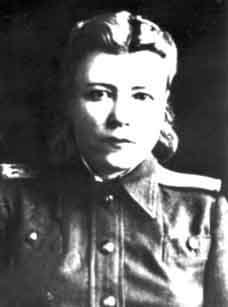
Miruts Maria Andreyevna
Miruts Maria Andreevna_x000D_
_x000D_
Rank: Captain of Medical Service _x000D_
_x000D_
Subdivision: 250th Infantry Bobruisk Red Banner Order of Suvorov Division 268 Separate Medical Battalion. _x000D_
_x000D_
Maria Andreevna Miruts was born on December 27, 1913 in Grodno. In 1938 she graduated from the Tomsk Medical Institute. She went to the war in June 1941 in 215th Medical Battalion of 166th Rifle Division as a surgeon-resident. Since May 1943 in 268th Medical Battalion of 250th Rifle Division of 3rd army as a surgeon, since September 1943 until the end of the war she was the commander of a hospital platoon. She graduated from the war with the rank of Captain of the Medical Service. She was awarded the Order of the Red Star, medals "For Military Merit", "For Capture of Berlin", "For Capture of Konigsberg", "For Victory over Germany" and others, seven thanks of the Supreme Commander-in-Chief. _x000D_
From the memoirs of M.A. Miruts 04/09/1986: "After completing 3-month advanced training courses for medical personnel (KUMS) in Ulyanovsk, I was sent through the Main Sanitary Directorate of Moscow with a group of doctors to the Lev Tolstoy station, where the medical department of 3rd army was located. From the sanitary department three feldshers and I were sent to 250th division, to 268th Medical Battalion, to the surgeon position. This was the Talitsa station. After a while the entire Medical Battalion moved to the village of Berezovka, where we settled in tents in the garden. It was May. It was very intensive preparation for a big offensive. It was the Orel-Kursk combat. We carried out work in the regiments and in the Medical Battalion, getting ready for military actions. _x000D_
And so it began. There was such a strong fire of artillery that everything was in motion. Our division went on the offensive. In this time we were ready to move forward behind the division. To be as close to the combat as possible in order to provide assistance as soon as possible from the moment of injury. _x000D_
We were shown camouflage security and driveways. We deployed a sorting room, where all the wounded were received. Then the urgent with tourniquets immediately went to the surgery room, people in shock went to the shock ward, lightly wounded went to the hospital through the evacuation department. The hospital platoon received the wounded in the abdomen, chest and with large amputations. Here everyone received the necessary care and treatment. They were simply nursed so that they could be evacuated further. Evacuation was agreed with the surgeon. _x000D_
In September, after the hospital platoon commander was put out, I was appointed to this position, where I worked until the end of the war. We went through Belarus, Poland, the Baltic states, attacked Berlin and ended the war on the river Elbe. _x000D_
Hospital platoon worked on two fronts. The Medical Battalion moves forward with the active army (division). The hospital platoon sends part of the forces to the forward group to receive post-surgery wounds. Some people are left behind with seriously wounded, not transportable people, then treats them, and prepares for evacuation to the hospital. _x000D_
Having sent everyone to the hospital, the group overtakes the Medical Battalion, and again part of the hospital platoon remains with the seriously wounded in the forest or in a village where there are no residents. _x000D_
War brings hardship for everyone in the war, but especially for women. Especially threatening were the moments when the front was uncontrollably moving forward. In the rear the groups of fascists escaping from the "cauldron" were wandering around. Our small medical groups, who remained with the wounded, were in danger. _x000D_
The invaluable nurses in caring for the wounded were my combat friends: Filippova Zhenya, Medvedeva-Okatova Shura, Vinogradova Lida and Sedyakina Tamara. I could completely rely on them in any setting, they were sincere, affectionate, responsive, real "sisters of mercy." They were not afraid of any difficulties, they were never lost in an any situation. I have never heard from them the words "I do not know", "I cannot". They knew how, in the harsh days of war and hardship, to create comfort in tents from the most primitive material at their disposal! _x000D_
I did not hear any complaints from the sisters and did not face non-fulfillment of appointments, though sometimes I had to give orders. _x000D_
After the war, I have always referred to their work as an example. And now, when we meet, we always remember the details of that difficult time. _x000D_
After the capture of Orel, the first artillery salute was held in Moscow. We were advancing behind our division. The advance units have just left. The Medical Battalion arrived at the Lokot station. They settled in the surviving houses. Houses were burning all around, some civilians were still moving and were rescued. More children came to our hospital platoon. They were as thin, small as old people. We put them two on the same bed (in the position of a "jack" in the cards). I will remember it for a lifetime. Children told how they were taken to the forest, where the command was given "Lie Down", and those lying were shot from machine guns. Boy Styopa lay with a shot in the shoulder and lower leg. They were brought to the forest and ordered to lie down, while his sister, 3 years old, did not lie down and was crying. This boy Styopa and a girl of 19 years old, completely gray were brought to us. _x000D_
In the Bryansk forests, many partisans joined us, a whole unit. There were many sick and wounded. When they were all examined, Doctor V.A.Lugina and I took them to hospitals in cars. While I was driving, I had seven or eight cars behind me, I heard screams, shooting in the bushes not far away. The drivers rushed there with their guns. _x000D_
We drove further along the Mogilev shosse, so the modern road hardly reminds one in September 1943. All roadsides were littered with wrecked vehicles and guns. We found a hospital, handed over the wounded, but patients with suspected infection were not admitted. Evening has come, what should I do? Fortunately, I met a representative of the medical and sanitary service of 3rd army, who ordered to take all the sick. Following the order, they immediately deployed a tent. I had a sense of accomplishment and returned to Zhenya, but my heart was restless. We drove in complete darkness and almost crashed into a column of German prisoners led by our escorts. A monotonous incomprehensible speech and the heavy shuffling steps of hundreds of Nazis were heard. _x000D_
I realized that the enemy was disarmed, but still it was terrifying to drive along a living enemy corridor. This circumstance further increased my concern for Zhenya and the wounded. And so all the way I was not at peace. But I was happy to see that everything was in place. _x000D_
The next day, the wounded were taken to the nearest hospital, and we returned to the Medical Battalion to start all over again. I often had to stay in a forest or in a village where no one was living. We were always bothered by the worst thoughts. _x000D_
There was such an accident in the Bryansk forests. There were left many wounded about 18 people in a divisional tent. We stayed with Lida Vinogradova, an orderly and a cook, since there were many wounded in the abdomen. The night passed quietly. During the day we made all the appointments, and on the second night we heard shooting not far from us, grenade explosions, the wounded became worried, we calmed them down as best we could. Although we did not understand what was happening. _x000D_
By morning, everything became quiet. We were picked up early in the morning. There were many cars to get everyone up at once. Later learned that not far from us, the Nazis destroyed the entire Medical Battalion. Many unfinished fascists were hiding in the Bryansk forest. _x000D_
When our Medical Battalion had to lag behind his division, since the fuel was not delivered, the mortar men also lagged behind came to us near the village of Zabolotye. We heard shooting in the village, the messenger reported that the Germans were in the village. We quickly loaded everything onto cars, drove off a short distance and, together with the mortar men, took up defensive positions. They held defense until our units had arrived. _x000D_
After Minsk, Ostrolenka, our direction was to East Prussia. After the combats for Melzak, our division took part in the liquidation of a group of enemy forces in the Pillau area. The entire coast was covered with the corpses of horses, people and cars. The Germans intended to leave this bank by water and air. But they almost failed. After that our direction was to Berlin. When Berlin was captured, we, a large group of doctors, were taken to see this citadel. We examined the Imperial Chancellery, bunkers, visited the Reichstag, like everyone else, tried to leave our signatures as high as possible. _x000D_
Our division ended the war on the river Elbe. For some time we lived in Gentin, and then moved to Borisov (Belarus). The Medical Battalion was disbanded, and we, then young doctors, were assigned to the regiments. I worked for another year in 918th Rifle Regiment until the end of June 1946, when the division was disbanded. _x000D_
Based on materials from the published literary collection "I am writing to you from the war ..." series "From the history of the land of Tomsk (1941-1945). State Archives of the Tomsk region, Tomsk, 2001. Council of Veterans of the 250 Bobruisk Red Banner Order of Suvorov II degree Rifle Division.
Miruts Maria Andreyevna
Miruts Maria Andreevna_x000D_
_x000D_
Rank: Captain of Medical Service _x000D_
_x000D_
Subdivision: 250th Infantry Bobruisk Red Banner Order of Suvorov Division 268 Separate Medical Battalion. _x000D_
_x000D_
Maria Andreevna Miruts was born on December 27, 1913 in Grodno. In 1938 she graduated from the Tomsk Medical Institute. She went to the war in June 1941 in 215th Medical Battalion of 166th Rifle Division as a surgeon-resident. Since May 1943 in 268th Medical Battalion of 250th Rifle Division of 3rd army as a surgeon, since September 1943 until the end of the war she was the commander of a hospital platoon. She graduated from the war with the rank of Captain of the Medical Service. She was awarded the Order of the Red Star, medals "For Military Merit", "For Capture of Berlin", "For Capture of Konigsberg", "For Victory over Germany" and others, seven thanks of the Supreme Commander-in-Chief. _x000D_
From the memoirs of M.A. Miruts 04/09/1986: "After completing 3-month advanced training courses for medical personnel (KUMS) in Ulyanovsk, I was sent through the Main Sanitary Directorate of Moscow with a group of doctors to the Lev Tolstoy station, where the medical department of 3rd army was located. From the sanitary department three feldshers and I were sent to 250th division, to 268th Medical Battalion, to the surgeon position. This was the Talitsa station. After a while the entire Medical Battalion moved to the village of Berezovka, where we settled in tents in the garden. It was May. It was very intensive preparation for a big offensive. It was the Orel-Kursk combat. We carried out work in the regiments and in the Medical Battalion, getting ready for military actions. _x000D_
And so it began. There was such a strong fire of artillery that everything was in motion. Our division went on the offensive. In this time we were ready to move forward behind the division. To be as close to the combat as possible in order to provide assistance as soon as possible from the moment of injury. _x000D_
We were shown camouflage security and driveways. We deployed a sorting room, where all the wounded were received. Then the urgent with tourniquets immediately went to the surgery room, people in shock went to the shock ward, lightly wounded went to the hospital through the evacuation department. The hospital platoon received the wounded in the abdomen, chest and with large amputations. Here everyone received the necessary care and treatment. They were simply nursed so that they could be evacuated further. Evacuation was agreed with the surgeon. _x000D_
In September, after the hospital platoon commander was put out, I was appointed to this position, where I worked until the end of the war. We went through Belarus, Poland, the Baltic states, attacked Berlin and ended the war on the river Elbe. _x000D_
Hospital platoon worked on two fronts. The Medical Battalion moves forward with the active army (division). The hospital platoon sends part of the forces to the forward group to receive post-surgery wounds. Some people are left behind with seriously wounded, not transportable people, then treats them, and prepares for evacuation to the hospital. _x000D_
Having sent everyone to the hospital, the group overtakes the Medical Battalion, and again part of the hospital platoon remains with the seriously wounded in the forest or in a village where there are no residents. _x000D_
War brings hardship for everyone in the war, but especially for women. Especially threatening were the moments when the front was uncontrollably moving forward. In the rear the groups of fascists escaping from the "cauldron" were wandering around. Our small medical groups, who remained with the wounded, were in danger. _x000D_
The invaluable nurses in caring for the wounded were my combat friends: Filippova Zhenya, Medvedeva-Okatova Shura, Vinogradova Lida and Sedyakina Tamara. I could completely rely on them in any setting, they were sincere, affectionate, responsive, real "sisters of mercy." They were not afraid of any difficulties, they were never lost in an any situation. I have never heard from them the words "I do not know", "I cannot". They knew how, in the harsh days of war and hardship, to create comfort in tents from the most primitive material at their disposal! _x000D_
I did not hear any complaints from the sisters and did not face non-fulfillment of appointments, though sometimes I had to give orders. _x000D_
After the war, I have always referred to their work as an example. And now, when we meet, we always remember the details of that difficult time. _x000D_
After the capture of Orel, the first artillery salute was held in Moscow. We were advancing behind our division. The advance units have just left. The Medical Battalion arrived at the Lokot station. They settled in the surviving houses. Houses were burning all around, some civilians were still moving and were rescued. More children came to our hospital platoon. They were as thin, small as old people. We put them two on the same bed (in the position of a "jack" in the cards). I will remember it for a lifetime. Children told how they were taken to the forest, where the command was given "Lie Down", and those lying were shot from machine guns. Boy Styopa lay with a shot in the shoulder and lower leg. They were brought to the forest and ordered to lie down, while his sister, 3 years old, did not lie down and was crying. This boy Styopa and a girl of 19 years old, completely gray were brought to us. _x000D_
In the Bryansk forests, many partisans joined us, a whole unit. There were many sick and wounded. When they were all examined, Doctor V.A.Lugina and I took them to hospitals in cars. While I was driving, I had seven or eight cars behind me, I heard screams, shooting in the bushes not far away. The drivers rushed there with their guns. _x000D_
We drove further along the Mogilev shosse, so the modern road hardly reminds one in September 1943. All roadsides were littered with wrecked vehicles and guns. We found a hospital, handed over the wounded, but patients with suspected infection were not admitted. Evening has come, what should I do? Fortunately, I met a representative of the medical and sanitary service of 3rd army, who ordered to take all the sick. Following the order, they immediately deployed a tent. I had a sense of accomplishment and returned to Zhenya, but my heart was restless. We drove in complete darkness and almost crashed into a column of German prisoners led by our escorts. A monotonous incomprehensible speech and the heavy shuffling steps of hundreds of Nazis were heard. _x000D_
I realized that the enemy was disarmed, but still it was terrifying to drive along a living enemy corridor. This circumstance further increased my concern for Zhenya and the wounded. And so all the way I was not at peace. But I was happy to see that everything was in place. _x000D_
The next day, the wounded were taken to the nearest hospital, and we returned to the Medical Battalion to start all over again. I often had to stay in a forest or in a village where no one was living. We were always bothered by the worst thoughts. _x000D_
There was such an accident in the Bryansk forests. There were left many wounded about 18 people in a divisional tent. We stayed with Lida Vinogradova, an orderly and a cook, since there were many wounded in the abdomen. The night passed quietly. During the day we made all the appointments, and on the second night we heard shooting not far from us, grenade explosions, the wounded became worried, we calmed them down as best we could. Although we did not understand what was happening. _x000D_
By morning, everything became quiet. We were picked up early in the morning. There were many cars to get everyone up at once. Later learned that not far from us, the Nazis destroyed the entire Medical Battalion. Many unfinished fascists were hiding in the Bryansk forest. _x000D_
When our Medical Battalion had to lag behind his division, since the fuel was not delivered, the mortar men also lagged behind came to us near the village of Zabolotye. We heard shooting in the village, the messenger reported that the Germans were in the village. We quickly loaded everything onto cars, drove off a short distance and, together with the mortar men, took up defensive positions. They held defense until our units had arrived. _x000D_
After Minsk, Ostrolenka, our direction was to East Prussia. After the combats for Melzak, our division took part in the liquidation of a group of enemy forces in the Pillau area. The entire coast was covered with the corpses of horses, people and cars. The Germans intended to leave this bank by water and air. But they almost failed. After that our direction was to Berlin. When Berlin was captured, we, a large group of doctors, were taken to see this citadel. We examined the Imperial Chancellery, bunkers, visited the Reichstag, like everyone else, tried to leave our signatures as high as possible. _x000D_
Our division ended the war on the river Elbe. For some time we lived in Gentin, and then moved to Borisov (Belarus). The Medical Battalion was disbanded, and we, then young doctors, were assigned to the regiments. I worked for another year in 918th Rifle Regiment until the end of June 1946, when the division was disbanded. _x000D_
Based on materials from the published literary collection "I am writing to you from the war ..." series "From the history of the land of Tomsk (1941-1945). State Archives of the Tomsk region, Tomsk, 2001. Council of Veterans of the 250 Bobruisk Red Banner Order of Suvorov II degree Rifle Division.
0 comment



2026 © Russian Military Historical Society Developed by Jetmix