


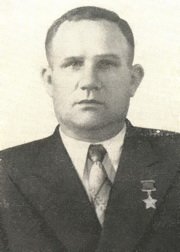


Grigory Borchenko
Rank: Major
Branch of Service: Land Forces, Air Force (except for Naval Aviation), Coast Guard, NKVD troops, Border Guard
Unit: 250th Bobruisk Red Banner Order of Suvorov Rifle Division
July 1943. The division's regiments were moving to the front line of the defense, which ran along the Neruch River. The personnel spent almost three months preparing hard for combat. The newly formed 308 Separate Anti-tank Artilleri Detachment, along with other units, was approaching the front. I as the commander of the detachment was haunted by the thought: how would it show itself in fighting?
The detachment after artillery preparation went on the offensive on July 12.
The battery had motor tractors. This allowed it to be the first of the artillery units that accompanied the infantry to approach the village. It immediately turned around and began firing direct fire at enemy positions. The gun commander, Sergeant Russkikh, found the machine gun and destroyed it with accurate fire. The observer of another gun reported that an enemy battery was seen in Berezovets, firing at the attackers. Gun crews of Sergeants Kapitonov and Kolodnikov from behind the left flank of the attackers came close to the village along with the infantry, broke into it and captured the 155-mm artillery battery of the Germans. The Nazis did not even have time to disable the guns.
The 922nd Rifle Regiment by the end of the day of July 27 captured the dominant height and the village of Novo-Dmitrievka, it approached the station of Stanovoy Kolodez, but could not take it on the move. At dawn on July 28, 922nd and 918th Rifle Regiments , supported by artillery, launched an attack. German aircraft tried to bomb the attackers. Our fighters started an air battle and forced Germans planes to drop bombs on their own positions. On the left flank of the 922nd Regiment, one of the companies layed down. Captain Miroshnikov's anti-tank battery came to the rescue. It destroyed the enemy's firing positions with a direct fire. Especially distinguished were the gun crews of Sergeant M. Sosnin and Specialist Ratushny, who destroyed four machine guns and one artillery piece.
Our soldiers liberated the Stanovoy Kolodez station on July 28. Captain Filatov was buried on its forecourt. Later, he was reburied in the mass grave of our soldiers.
Before reaching the front line by eighty kilometers, we stopped in the village of Gusevo. Summer. Heat. All undressed and had a rest after the march. I layed down under the gun in the shade. Doze off. Suddenly an explosion, I woke up, and logs were flying at me. A German plane, a single one, bombed our lines. The bastard made two passes. It was a total mess. I was at the front earlier, so it was more or less familiar to me but the recruits did not know where to run and what to do. The losses were decent.
Our troops launched an offensive, and we supported them with fire. I suppressed their firing points that with a fire of my battery and we occupied this village, where the Germans had previously been.
However, in this village we lost all the horses. They were shot at from the attics. We burned down the houses where this was done. I looked it up later. In each attic, one by one, two Germans were sitting with machine guns.
After a while, we were transferred to another section of the front. Here we had to retreat. Part of the army was surrounded, and some managed to escape. They were on the defensive and stood there until the fall. On the eve of the New Year, the task was set to take two localities South of Rzhev. If we take them, the division would become a Guards division, if not, then no.
We went on the offensive, took half the city, but the German knocked us out. We're on the defensive. The city burned. Including food warehouses. The people at night picked up food from burning warehouses so it would not burn.
We spent the winter near Rzhev, and in the spring we were transferred to the North-Western Front, near Staraya Russa. In the area of Lake Seliger, we got reinforcments and went on the offensive.
From there, the remnants of our division in three echelons (and in the normal configuration for the transfer of the division, 16 echelons were necessary) were transferred to Yelets. Further formation took place in the Krasninsky District. Here I was appointed Commander of the 308th Separate Fighter Anti-tank detachment of the 250th Rifle Division. We received men, new guns, anti-tank guns, vehicles and uniforms.
After staffing, we were transferred to Orel. It was the summer of 1943. Then the battle of Kursk began. However, the Germans woul not advance in our lane. This happened to the left.
Thus, our division did not take Orel, but cut the German communications, which contributed to the capture of the city.
I was awarded the Order of the Red Star for my participation in the battles on the Kursk bulge.
After the Kursk bulge, our unit was transferred to Belarus on the Sozh River. As I was one of the first to go to the sea, I was awarded the Order of the Red Banner. In April 45, we received an order "To Berlin!" We moved to Germany on our own, without stopping anywhere. However, we were not sent to Berlin, but were sent to the rear, so that we could begin to advance to the East. Here we were fighting a strong German group. We were told on May 9, that the war was over.
Grigory Borchenko
Rank: Major
Branch of Service: Land Forces, Air Force (except for Naval Aviation), Coast Guard, NKVD troops, Border Guard
Unit: 250th Bobruisk Red Banner Order of Suvorov Rifle Division
July 1943. The division's regiments were moving to the front line of the defense, which ran along the Neruch River. The personnel spent almost three months preparing hard for combat. The newly formed 308 Separate Anti-tank Artilleri Detachment, along with other units, was approaching the front. I as the commander of the detachment was haunted by the thought: how would it show itself in fighting?
The detachment after artillery preparation went on the offensive on July 12.
The battery had motor tractors. This allowed it to be the first of the artillery units that accompanied the infantry to approach the village. It immediately turned around and began firing direct fire at enemy positions. The gun commander, Sergeant Russkikh, found the machine gun and destroyed it with accurate fire. The observer of another gun reported that an enemy battery was seen in Berezovets, firing at the attackers. Gun crews of Sergeants Kapitonov and Kolodnikov from behind the left flank of the attackers came close to the village along with the infantry, broke into it and captured the 155-mm artillery battery of the Germans. The Nazis did not even have time to disable the guns.
The 922nd Rifle Regiment by the end of the day of July 27 captured the dominant height and the village of Novo-Dmitrievka, it approached the station of Stanovoy Kolodez, but could not take it on the move. At dawn on July 28, 922nd and 918th Rifle Regiments , supported by artillery, launched an attack. German aircraft tried to bomb the attackers. Our fighters started an air battle and forced Germans planes to drop bombs on their own positions. On the left flank of the 922nd Regiment, one of the companies layed down. Captain Miroshnikov's anti-tank battery came to the rescue. It destroyed the enemy's firing positions with a direct fire. Especially distinguished were the gun crews of Sergeant M. Sosnin and Specialist Ratushny, who destroyed four machine guns and one artillery piece.
Our soldiers liberated the Stanovoy Kolodez station on July 28. Captain Filatov was buried on its forecourt. Later, he was reburied in the mass grave of our soldiers.
Before reaching the front line by eighty kilometers, we stopped in the village of Gusevo. Summer. Heat. All undressed and had a rest after the march. I layed down under the gun in the shade. Doze off. Suddenly an explosion, I woke up, and logs were flying at me. A German plane, a single one, bombed our lines. The bastard made two passes. It was a total mess. I was at the front earlier, so it was more or less familiar to me but the recruits did not know where to run and what to do. The losses were decent.
Our troops launched an offensive, and we supported them with fire. I suppressed their firing points that with a fire of my battery and we occupied this village, where the Germans had previously been.
However, in this village we lost all the horses. They were shot at from the attics. We burned down the houses where this was done. I looked it up later. In each attic, one by one, two Germans were sitting with machine guns.
After a while, we were transferred to another section of the front. Here we had to retreat. Part of the army was surrounded, and some managed to escape. They were on the defensive and stood there until the fall. On the eve of the New Year, the task was set to take two localities South of Rzhev. If we take them, the division would become a Guards division, if not, then no.
We went on the offensive, took half the city, but the German knocked us out. We're on the defensive. The city burned. Including food warehouses. The people at night picked up food from burning warehouses so it would not burn.
We spent the winter near Rzhev, and in the spring we were transferred to the North-Western Front, near Staraya Russa. In the area of Lake Seliger, we got reinforcments and went on the offensive.
From there, the remnants of our division in three echelons (and in the normal configuration for the transfer of the division, 16 echelons were necessary) were transferred to Yelets. Further formation took place in the Krasninsky District. Here I was appointed Commander of the 308th Separate Fighter Anti-tank detachment of the 250th Rifle Division. We received men, new guns, anti-tank guns, vehicles and uniforms.
After staffing, we were transferred to Orel. It was the summer of 1943. Then the battle of Kursk began. However, the Germans woul not advance in our lane. This happened to the left.
Thus, our division did not take Orel, but cut the German communications, which contributed to the capture of the city.
I was awarded the Order of the Red Star for my participation in the battles on the Kursk bulge.
After the Kursk bulge, our unit was transferred to Belarus on the Sozh River. As I was one of the first to go to the sea, I was awarded the Order of the Red Banner. In April 45, we received an order "To Berlin!" We moved to Germany on our own, without stopping anywhere. However, we were not sent to Berlin, but were sent to the rear, so that we could begin to advance to the East. Here we were fighting a strong German group. We were told on May 9, that the war was over.
0 comment




2026 © Russian Military Historical Society Developed by Jetmix