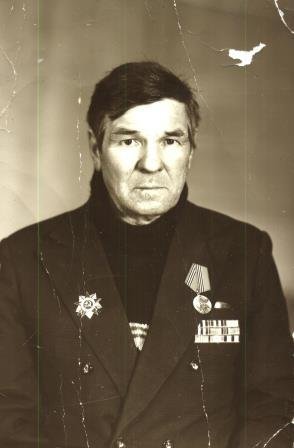


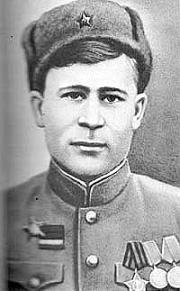


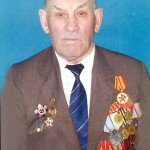
Sergey Babushkin
Rank: Petty Officer.
Branch of service: Artillery.
My grandfather, Sergey Babushkin was born in 1925 in Dengiz District of Guryev (now Atyrau) Region of the Kazakh SSR. When the war started, he was still too young to be drafted into the army, so, like other boys, he worked for a fishing collective farm. The collective farmers sent the fish they had caught to the front, providing food for our troops. In the summer of 1942, when there was a real danger that the enemy would occupy Astrakhan, the Guryevskiy Region bordering Astrakhan was also declared a war zone. However, the German troops did not enter the area. They just bombed the strategically important objects of Astrakhan and the region: their advance was stopped by the fierce defensive actions of the Red Army, which ended in the beginning of February 1943 with the victorious battle of Stalingrad.
It was in 1943 that my father, who was then 18 years old, was drafted by the Dengiz District Military Commissariate into the Red Army. He received a combat training at the school of gunners, after which he was sent to the artillery reconnaissance of the anti-aircraft artillery regiment of the 1st Ukrainian Front. And it was not by chance that he got into the intelligence service. While still studying at the artillery school, he showed his bold, determined and psychologically stable character. Although, as he said, at the beginning of the service, he had to survive a strong fright: crossing the front line and hiding from enemy fire, he jumped into a trench and fell directly on the corps of a German.
As ф part of the 1st Ukrainian front, my father liberated from the Nazis not only the territories of the Soviet Union, but also Europe: Poland, Austria, Czechoslovakia and Germany. One of the most remarkable episodes of his sparse military memories was the story of how, after the battle, he, along with his comrades, settled down in a haystack to rest properly before the next attack. Suddenly he was called to the commander of the unit, and when he got up and went, an enemy shell suddenly hit the stack, and everyone who was resting there was torn to pieces.
My father went through the war with front-line awards: Medals For Military Merit and For Bravery. In his submission to the medal For Bravery, in a brief description of the merits said: "The commander of the intelligence squad of the staff platoon of the regiment, corporal Sergei Babushkin, should be awarded the medal For Bravery for repelling the counterattack of enemy submachine gunners on the night of February 8 to 9, 1945 on the outskirts of the city Grottkau, despising the danger and risking his life, first rushed to meet the Germans and killed two enemy soldiers with his machine gun, which helped to repel the counterattack" (signed by the commander of the 1404th Guards Anti-aircraft Artillery Regiment, Lieutenant Colonel Vasilevsky and Chief of Staff Geriev).
But after the war, the army service for my father did not end. For another five years, he was the commander of a platoon of artillery reconnaissance units stationed in Hungary and Austria. He returned to his Homeland in 1951, and settled in Astrakhan, remaining on long-term service as a foreman of the radio engineering regiment, where he served until 1975. The fact that he was a respected man, whose authoritative opinion was listened to by his colleagues, is evidenced by the fact that even after retirement, he was invited to the unit for all festive events, presenting memorable gifts and sincerely thanking for military services in the Great Patriotic War and impeccable service in peacetime. And when in 2011, at the age of 85, my grandfather died, he was seen off with all military honors on his last journey. For me, my grandfather has always been and remains an example of fortitude, courage, discipline, decency, and selfless service to his homeland.
Sergey Babushkin
Rank: Petty Officer.
Branch of service: Artillery.
My grandfather, Sergey Babushkin was born in 1925 in Dengiz District of Guryev (now Atyrau) Region of the Kazakh SSR. When the war started, he was still too young to be drafted into the army, so, like other boys, he worked for a fishing collective farm. The collective farmers sent the fish they had caught to the front, providing food for our troops. In the summer of 1942, when there was a real danger that the enemy would occupy Astrakhan, the Guryevskiy Region bordering Astrakhan was also declared a war zone. However, the German troops did not enter the area. They just bombed the strategically important objects of Astrakhan and the region: their advance was stopped by the fierce defensive actions of the Red Army, which ended in the beginning of February 1943 with the victorious battle of Stalingrad.
It was in 1943 that my father, who was then 18 years old, was drafted by the Dengiz District Military Commissariate into the Red Army. He received a combat training at the school of gunners, after which he was sent to the artillery reconnaissance of the anti-aircraft artillery regiment of the 1st Ukrainian Front. And it was not by chance that he got into the intelligence service. While still studying at the artillery school, he showed his bold, determined and psychologically stable character. Although, as he said, at the beginning of the service, he had to survive a strong fright: crossing the front line and hiding from enemy fire, he jumped into a trench and fell directly on the corps of a German.
As ф part of the 1st Ukrainian front, my father liberated from the Nazis not only the territories of the Soviet Union, but also Europe: Poland, Austria, Czechoslovakia and Germany. One of the most remarkable episodes of his sparse military memories was the story of how, after the battle, he, along with his comrades, settled down in a haystack to rest properly before the next attack. Suddenly he was called to the commander of the unit, and when he got up and went, an enemy shell suddenly hit the stack, and everyone who was resting there was torn to pieces.
My father went through the war with front-line awards: Medals For Military Merit and For Bravery. In his submission to the medal For Bravery, in a brief description of the merits said: "The commander of the intelligence squad of the staff platoon of the regiment, corporal Sergei Babushkin, should be awarded the medal For Bravery for repelling the counterattack of enemy submachine gunners on the night of February 8 to 9, 1945 on the outskirts of the city Grottkau, despising the danger and risking his life, first rushed to meet the Germans and killed two enemy soldiers with his machine gun, which helped to repel the counterattack" (signed by the commander of the 1404th Guards Anti-aircraft Artillery Regiment, Lieutenant Colonel Vasilevsky and Chief of Staff Geriev).
But after the war, the army service for my father did not end. For another five years, he was the commander of a platoon of artillery reconnaissance units stationed in Hungary and Austria. He returned to his Homeland in 1951, and settled in Astrakhan, remaining on long-term service as a foreman of the radio engineering regiment, where he served until 1975. The fact that he was a respected man, whose authoritative opinion was listened to by his colleagues, is evidenced by the fact that even after retirement, he was invited to the unit for all festive events, presenting memorable gifts and sincerely thanking for military services in the Great Patriotic War and impeccable service in peacetime. And when in 2011, at the age of 85, my grandfather died, he was seen off with all military honors on his last journey. For me, my grandfather has always been and remains an example of fortitude, courage, discipline, decency, and selfless service to his homeland.
0 comment



2026 © Russian Military Historical Society Developed by Jetmix