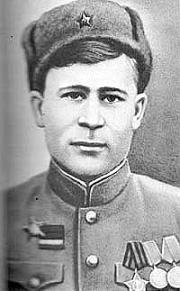


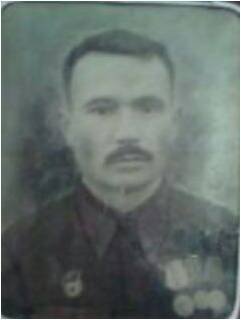


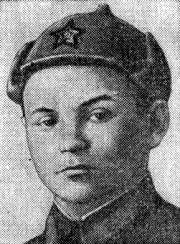
Ivan Boytsov
Rank: Red Army Soldier.
Branch of service: Army, Air Force (except for Naval Aviation), Coast Guard, NKVD troops, Border Guard.
Unit: 17th Gorkovskaya Red Banner Rifle Division.
Ivan oytsov (1918, Minkino, RSFSR — February 27, 1940, Vyborg province, Finland) was a Red Army soldier of the 7th Company of the 278th Motor Rifle Regiment of the 17th Motor Rifle Division of the 13th Army.
During the Winter war in February 1940, he participated in the assault on an enemy stronghold, was repeatedly wounded, but despite this, was the first to reach the pillbox and blown it out with grenades.
During this attack, he died, and in the same year was posthumously awarded the title of the Hero of the Soviet Union.
Ivan Boytsov was born in 1918 to a Russian peasant family in the village of Minkino, Novgorod province. After graduating from school, he worked for a collective farm.
With the beginning of the Soviet-Finnish war in November 1939, he was drafted into the Red Army. He served in the 7th Company of the 278th Motor Rifle Regiment of the 17th Motor Rifle Division of the 13th Army. The soldiers received their baptism of fire in the offensive near the Punnus-Joki river capturing a fortified enemy strip, when under heavy machine-gun and mortar fire, his company was forced to lie down. Boytsov encouraged their comrades and raised them to attack, which forced the enemy to retreat.
“We are strong in the righteousness of the cause and will crush the enemy. As for me, rest assured: for the sake of our victory, I will not spare myself, even if I want to live like the devil” – he wrote in one of the letters from the front.
In the battle to break through and capture the fortified area on the Salmen-Kaita river on February 27, 1940, the 7th Company, in which Ivan served, was ordered to destroy a pillbox that hindered the battalion's progress. Having selected twenty fighters for the assault group, senior political officer Chernobrovin led them to the attack. Boytsov went to the attack in the first rows with a red flag fixed on a bayonet, and was wounded in the arm: despite this, he was the first to reach the firing point, set a red banner on it, was wounded a second time, but still threw grenades at the pillbox. While completing the task, he was killed. The feat of Boytsov inspired the soldiers of the 7th Company, they surrounded the pillbox and captured it.
Ivan was buried in a mass grave near the village of Veshchevo in the Vyborg District of the Leningrad Region. The tombstone shows the wrong patronymic - Nikolaevich.
For his feat, Ivan Boytsov was posthumously awarded the title of the Hero of the Soviet Union with the Gold Star Medal and the Order of Lenin on April 7, 1940.
Joensuu village was renamed the village of the Boytsov. A street in Pestovo is named after I. Boytsov, and a bust of the hero is also installed in one of the city's squares. In the fall of 1942, residents of the Pestovsky District raised money for the creation of a tank column, called the "Leningrad Collective Farmer". One of the tanks was named after I. Boytsov.
EXCERPTS FROM BAIR IRINCHEEV'S BOOK: «DEFAMED STALIN'S VICTORY. ASSAULT ON THE MANNERHEIM LINE."
The 17th Motorized Rifle Division attacked the positions of the Finnish 5th and 6th regiments between lake Punnus-yarvi (Krasnoe) and Kirk-yarvi (Pravdinsky) from 11 to 15 February, and managed to advance 1-2 kilometers deep into the Finnish defense, but the Finnish front line still held. The advance was achieved at the cost of high losses in personnel, especially a lot of commanders were out of action.
FIGHTING ON THE SALMENKAITA RIVER
(DAMASK): BAPTISM OF GORKY CITY.
When attacking Finnish positions, the 17th Motorized Rifle Division had to pass the fields on the southern Bank, cross the river by the ice, and then begin a direct assault on the pillbox.
Soviet artillery began harassing the fortified area on the morning of February 20. Soviet artillery fire increased at 10.00, and the Finns prepared to repel the attack. By this time, the main forces of the 17th Motorized Rifle Division and the 50th Rifle Division had reached the areas South of the Salmenkaita river. The command of the 17th Division decided to strike the main blow in the center of the Finnish defense, in the fields of the village of Variksenkylya. Soviet units took up positions in the forest at heights one kilometer South of the river. On the left flank of the division was the 55th Motor Rifle Regiment, in the center-the 278th Motor Rifle Regiment, on the right flank the 271st Motor Rifle Regiment. To the right of the 271st Regiment, from pillboxes #3 and #4 to the Bank of the Vuoksa, the 359th and 2nd Regiments of the 50th Rifle Division were advancing.
The regimental artillery of the 271st Motorized Rifle Regiment was firing at the fortified points and wire entanglements of the Finns.
By evening, Soviet artillery fire marked the direction of the main attack of the 17th Motorized Rifle Division - shells fell mainly on the third battalion near the Hein-joki-Rautu highway in the center of the Finnish defense. The Finns noted that heavy guns appeared in the Soviet artillery group. Two old casemates on the shore were damaged by fire.
Soviet artillery opened a hurricane of fire on the entire line of defense of the regiment on February 21, at 8.30 am. However, most of the Finnish Pillboxes had not yet been scouted, and the fire was mainly directed at squares. It should also be noted that the 17th Motorized Rifle Division had rather weak artillery and could not help its motorized infantry much. Soviet rifle units stormed the fortified area on the 3rd battalion's site at 12: 30. Motorized infantry of the 1st and 2nd battalions of the 278th regiment managed to cross the narrow Salmenkaita river, gained a foothold in front of the 9th company's positions, took cover behind armored shields and engaged in a fire battle with the Finnish infantry. Soviet infantry captured Cavicchioni (Birch Cape) to the North-West of the highway at 13.30 and forced single Finnish platoon to retreat. Additional forces managed to cross to the North Bank of the river at 16.15, and the fire battle in the area of the 9th Company's defense continued.
The first battalion of the 278th Regiment continued the offensive, deploying in a chain in the field in front of pillboxes #15 and #36. Finnish machine gunners in the Pillbox let the battalion to the targeted wire fence and opened a hurricane of flanking fire. Caponier #15's machine guns were firing incessantly all day. The motorized infantry could not advance further than the wire fence.
They managed, however, at 17.00 to take also the grove Lehtosaari North - East of the road bridge over Salmenkaita. On the Soviet right flank, the first battalion of the 271st Motorized Rifle regiment was stopped by fire at the wire and could not advance further.
A Blizzard broke out in the afternoon, and the Soviet command decided to take advantage of this by going on the offensive along the entire front of the division. The 3rd Company and part of the 1st Company of the 278th Regiment under the command of political Commissar Senechkin again attacked the field at Pillboxes #15 and #36 and saddled pillbox #15 at dusk. However, this success could not be developed — due to heavy fire, other companies were unable to break through to the Pillbox. After suffering heavy losses in killed and wounded during the night, the 3rd Company was forced to retreat to the river. In total, on February 21, the first battalion of the 278th Regiment lost about 200 men killed and wounded.
The 1st battalion of the neighboring 271st Regiment also tried to attack in the evening, but when trying to cut the wire, it lost the battalion Commissar — senior political officer Zotov was killed. A few hours later, battalion commander First Lieutenant Kazansky was also wounded. On the Soviet left flank, the 55th Regiment managed to cross the river and occupy the old casemate #9, but was driven to the southern Bank of the river by a Finnish counterattack.
After artillery preparation, Major Krylov, commander of the 278th Motorized Rifle Regiment, threw the second battalion of the regiment into battle. The battalion sat down on tanks and managed to get to the river in this way, but the tankers did not go further, and the motorized infantry went further into battle on foot. They managed to occupy the Finnish lines of communication 150 meters from pillbox #15 and recapture Beryozovy Cape from the Finns. As a result, the commander of the 8th Finnish company fenrik of the Eloranta reserve decided to withdraw his company to pillbox #36, leaving fenrik Honkkil's machine gunners in Pillbox #15 alone. The soldiers of the 17th Division went on the offensive from the grove Lehtosaari to 14.15 saddled pilbox #16. It was not possible to destroy and hold the pillbox.
The commander of the 6th Regiment ordered the Khakalakhti company to immediately move to the CP of the third battalion and go to the command of Kombat-3. He also requested the commander of the 5th separate battalion to urgently send one company to the area of the regiment's CP. In the afternoon, the 278th regiment continued its attacks on pillbox #15, and the Finns were forced to transfer all reserves to the third battalion's defense sector. In the evening, the commander of the Finnish 6th regiment had at its disposal one infantry battalion in reserve (captain Lepplax).
On the Soviet left flank, the 55th Regiment launched an offensive against one company, which came under heavy Finnish machine-gun fire and was forced to retreat, suffering losses.
On the afternoon of February 22, a thaw with sleet began, and all the soldiers were soaked through. On the morning of February 23, frosts hit up to -10 degrees with a sharp wind, and all the uniforms — overcoats, valenki, mittens-froze.
Despite severe weather conditions, on February 23, the Soviet offensive continued along the entire front of the 17th division. On the Soviet left and right flanks, the Finns repulsed the attacks of the 55th and 271st regiments, and in the center a heavy battle broke out again for pillbox #15. At first, three tanks were thrown into the battle, but the Finns managed to knock out two of them. By evening, the Soviet assault group managed to ride the pillbox and blow it up with a powerful charge.
On February 24, in the morning, Soviet artillery began artillery preparation, knocking down an armored dome from pillbox #13, and at 12:30 the 278th Regiment again went on the offensive with the support of six tanks, two of which were stuck in the holes. By 18:50, despite the stubborn Finnish resistance, the motorized infantry managed to recapture the destroyed pillbox #15 and the ruins of the Rantala farm. The Finns had to replace the 8th company and reinforce the 9th company with one platoon and launch another night counterattack. By 21.00, the Finns knocked out the Soviet motorized infantry from the remains of the farm Rantala, and by 04.00 on February 25-and the grove South-East of it.
Both sides were severely exhausted after four days of continuous fighting. The 278th Regiment suffered heavy losses, while the Finns had fewer losses. On February 25, the 278th Rifle Regiment was withdrawn from the front line. Losses in the regiment amounted to more than 50 % of the personnel.
Ivan Boytsov
Rank: Red Army Soldier.
Branch of service: Army, Air Force (except for Naval Aviation), Coast Guard, NKVD troops, Border Guard.
Unit: 17th Gorkovskaya Red Banner Rifle Division.
Ivan oytsov (1918, Minkino, RSFSR — February 27, 1940, Vyborg province, Finland) was a Red Army soldier of the 7th Company of the 278th Motor Rifle Regiment of the 17th Motor Rifle Division of the 13th Army.
During the Winter war in February 1940, he participated in the assault on an enemy stronghold, was repeatedly wounded, but despite this, was the first to reach the pillbox and blown it out with grenades.
During this attack, he died, and in the same year was posthumously awarded the title of the Hero of the Soviet Union.
Ivan Boytsov was born in 1918 to a Russian peasant family in the village of Minkino, Novgorod province. After graduating from school, he worked for a collective farm.
With the beginning of the Soviet-Finnish war in November 1939, he was drafted into the Red Army. He served in the 7th Company of the 278th Motor Rifle Regiment of the 17th Motor Rifle Division of the 13th Army. The soldiers received their baptism of fire in the offensive near the Punnus-Joki river capturing a fortified enemy strip, when under heavy machine-gun and mortar fire, his company was forced to lie down. Boytsov encouraged their comrades and raised them to attack, which forced the enemy to retreat.
“We are strong in the righteousness of the cause and will crush the enemy. As for me, rest assured: for the sake of our victory, I will not spare myself, even if I want to live like the devil” – he wrote in one of the letters from the front.
In the battle to break through and capture the fortified area on the Salmen-Kaita river on February 27, 1940, the 7th Company, in which Ivan served, was ordered to destroy a pillbox that hindered the battalion's progress. Having selected twenty fighters for the assault group, senior political officer Chernobrovin led them to the attack. Boytsov went to the attack in the first rows with a red flag fixed on a bayonet, and was wounded in the arm: despite this, he was the first to reach the firing point, set a red banner on it, was wounded a second time, but still threw grenades at the pillbox. While completing the task, he was killed. The feat of Boytsov inspired the soldiers of the 7th Company, they surrounded the pillbox and captured it.
Ivan was buried in a mass grave near the village of Veshchevo in the Vyborg District of the Leningrad Region. The tombstone shows the wrong patronymic - Nikolaevich.
For his feat, Ivan Boytsov was posthumously awarded the title of the Hero of the Soviet Union with the Gold Star Medal and the Order of Lenin on April 7, 1940.
Joensuu village was renamed the village of the Boytsov. A street in Pestovo is named after I. Boytsov, and a bust of the hero is also installed in one of the city's squares. In the fall of 1942, residents of the Pestovsky District raised money for the creation of a tank column, called the "Leningrad Collective Farmer". One of the tanks was named after I. Boytsov.
EXCERPTS FROM BAIR IRINCHEEV'S BOOK: «DEFAMED STALIN'S VICTORY. ASSAULT ON THE MANNERHEIM LINE."
The 17th Motorized Rifle Division attacked the positions of the Finnish 5th and 6th regiments between lake Punnus-yarvi (Krasnoe) and Kirk-yarvi (Pravdinsky) from 11 to 15 February, and managed to advance 1-2 kilometers deep into the Finnish defense, but the Finnish front line still held. The advance was achieved at the cost of high losses in personnel, especially a lot of commanders were out of action.
FIGHTING ON THE SALMENKAITA RIVER
(DAMASK): BAPTISM OF GORKY CITY.
When attacking Finnish positions, the 17th Motorized Rifle Division had to pass the fields on the southern Bank, cross the river by the ice, and then begin a direct assault on the pillbox.
Soviet artillery began harassing the fortified area on the morning of February 20. Soviet artillery fire increased at 10.00, and the Finns prepared to repel the attack. By this time, the main forces of the 17th Motorized Rifle Division and the 50th Rifle Division had reached the areas South of the Salmenkaita river. The command of the 17th Division decided to strike the main blow in the center of the Finnish defense, in the fields of the village of Variksenkylya. Soviet units took up positions in the forest at heights one kilometer South of the river. On the left flank of the division was the 55th Motor Rifle Regiment, in the center-the 278th Motor Rifle Regiment, on the right flank the 271st Motor Rifle Regiment. To the right of the 271st Regiment, from pillboxes #3 and #4 to the Bank of the Vuoksa, the 359th and 2nd Regiments of the 50th Rifle Division were advancing.
The regimental artillery of the 271st Motorized Rifle Regiment was firing at the fortified points and wire entanglements of the Finns.
By evening, Soviet artillery fire marked the direction of the main attack of the 17th Motorized Rifle Division - shells fell mainly on the third battalion near the Hein-joki-Rautu highway in the center of the Finnish defense. The Finns noted that heavy guns appeared in the Soviet artillery group. Two old casemates on the shore were damaged by fire.
Soviet artillery opened a hurricane of fire on the entire line of defense of the regiment on February 21, at 8.30 am. However, most of the Finnish Pillboxes had not yet been scouted, and the fire was mainly directed at squares. It should also be noted that the 17th Motorized Rifle Division had rather weak artillery and could not help its motorized infantry much. Soviet rifle units stormed the fortified area on the 3rd battalion's site at 12: 30. Motorized infantry of the 1st and 2nd battalions of the 278th regiment managed to cross the narrow Salmenkaita river, gained a foothold in front of the 9th company's positions, took cover behind armored shields and engaged in a fire battle with the Finnish infantry. Soviet infantry captured Cavicchioni (Birch Cape) to the North-West of the highway at 13.30 and forced single Finnish platoon to retreat. Additional forces managed to cross to the North Bank of the river at 16.15, and the fire battle in the area of the 9th Company's defense continued.
The first battalion of the 278th Regiment continued the offensive, deploying in a chain in the field in front of pillboxes #15 and #36. Finnish machine gunners in the Pillbox let the battalion to the targeted wire fence and opened a hurricane of flanking fire. Caponier #15's machine guns were firing incessantly all day. The motorized infantry could not advance further than the wire fence.
They managed, however, at 17.00 to take also the grove Lehtosaari North - East of the road bridge over Salmenkaita. On the Soviet right flank, the first battalion of the 271st Motorized Rifle regiment was stopped by fire at the wire and could not advance further.
A Blizzard broke out in the afternoon, and the Soviet command decided to take advantage of this by going on the offensive along the entire front of the division. The 3rd Company and part of the 1st Company of the 278th Regiment under the command of political Commissar Senechkin again attacked the field at Pillboxes #15 and #36 and saddled pillbox #15 at dusk. However, this success could not be developed — due to heavy fire, other companies were unable to break through to the Pillbox. After suffering heavy losses in killed and wounded during the night, the 3rd Company was forced to retreat to the river. In total, on February 21, the first battalion of the 278th Regiment lost about 200 men killed and wounded.
The 1st battalion of the neighboring 271st Regiment also tried to attack in the evening, but when trying to cut the wire, it lost the battalion Commissar — senior political officer Zotov was killed. A few hours later, battalion commander First Lieutenant Kazansky was also wounded. On the Soviet left flank, the 55th Regiment managed to cross the river and occupy the old casemate #9, but was driven to the southern Bank of the river by a Finnish counterattack.
After artillery preparation, Major Krylov, commander of the 278th Motorized Rifle Regiment, threw the second battalion of the regiment into battle. The battalion sat down on tanks and managed to get to the river in this way, but the tankers did not go further, and the motorized infantry went further into battle on foot. They managed to occupy the Finnish lines of communication 150 meters from pillbox #15 and recapture Beryozovy Cape from the Finns. As a result, the commander of the 8th Finnish company fenrik of the Eloranta reserve decided to withdraw his company to pillbox #36, leaving fenrik Honkkil's machine gunners in Pillbox #15 alone. The soldiers of the 17th Division went on the offensive from the grove Lehtosaari to 14.15 saddled pilbox #16. It was not possible to destroy and hold the pillbox.
The commander of the 6th Regiment ordered the Khakalakhti company to immediately move to the CP of the third battalion and go to the command of Kombat-3. He also requested the commander of the 5th separate battalion to urgently send one company to the area of the regiment's CP. In the afternoon, the 278th regiment continued its attacks on pillbox #15, and the Finns were forced to transfer all reserves to the third battalion's defense sector. In the evening, the commander of the Finnish 6th regiment had at its disposal one infantry battalion in reserve (captain Lepplax).
On the Soviet left flank, the 55th Regiment launched an offensive against one company, which came under heavy Finnish machine-gun fire and was forced to retreat, suffering losses.
On the afternoon of February 22, a thaw with sleet began, and all the soldiers were soaked through. On the morning of February 23, frosts hit up to -10 degrees with a sharp wind, and all the uniforms — overcoats, valenki, mittens-froze.
Despite severe weather conditions, on February 23, the Soviet offensive continued along the entire front of the 17th division. On the Soviet left and right flanks, the Finns repulsed the attacks of the 55th and 271st regiments, and in the center a heavy battle broke out again for pillbox #15. At first, three tanks were thrown into the battle, but the Finns managed to knock out two of them. By evening, the Soviet assault group managed to ride the pillbox and blow it up with a powerful charge.
On February 24, in the morning, Soviet artillery began artillery preparation, knocking down an armored dome from pillbox #13, and at 12:30 the 278th Regiment again went on the offensive with the support of six tanks, two of which were stuck in the holes. By 18:50, despite the stubborn Finnish resistance, the motorized infantry managed to recapture the destroyed pillbox #15 and the ruins of the Rantala farm. The Finns had to replace the 8th company and reinforce the 9th company with one platoon and launch another night counterattack. By 21.00, the Finns knocked out the Soviet motorized infantry from the remains of the farm Rantala, and by 04.00 on February 25-and the grove South-East of it.
Both sides were severely exhausted after four days of continuous fighting. The 278th Regiment suffered heavy losses, while the Finns had fewer losses. On February 25, the 278th Rifle Regiment was withdrawn from the front line. Losses in the regiment amounted to more than 50 % of the personnel.
0 comment



2026 © Russian Military Historical Society Developed by Jetmix