


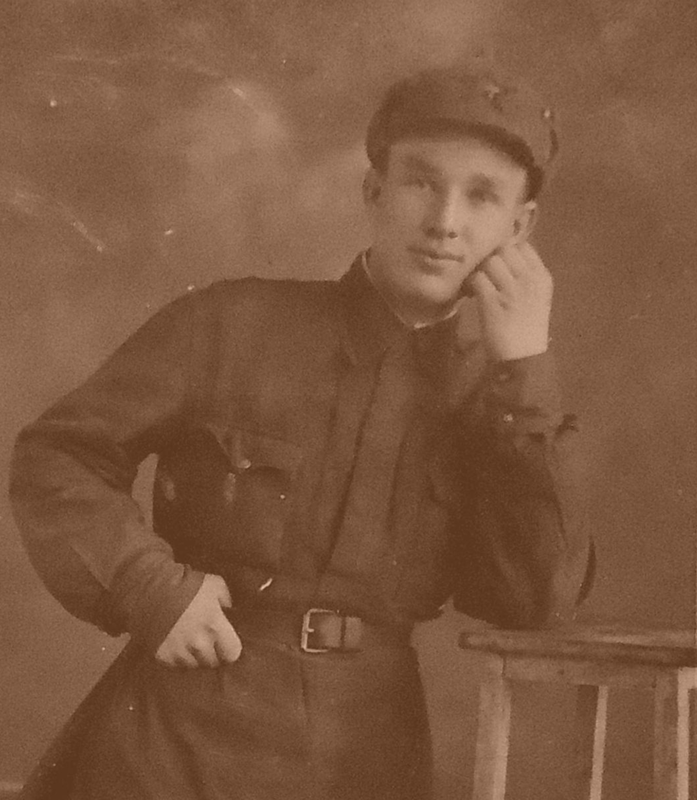

Konanov Vladimir Gavrilovich
Military rank is Sergant-Major. Branch of troops is Ground forces, Air Forces (except Naval aviation), shore service, NKVD troops and frontier troops. Vladimir Gavrilovich Konanov was born in 1918 in village Varakino Chebsar district of the Vologda region. He has finished 4 forms of a secondary school and received a specialty as a Head of handicraft production. He began fighting in the Soviet-Finnish war in 1939-1940, where he won a trophy in battle, a Finnish knife "Finka", which he later shaved with. He had risen to the rank of Sergant-Majorand and later served in the Airborne brigade. At the end of the war, he lived in city Pushkin, Leningrad region, from where in 1941 he was drafted by the Pushkin RVC of the Leningrad region into Red Army. He served in the 62nd Guards Rifle regiment with the rank of Sergeant. Sergeant Konanov participated in the defense of Leningrad, namely, at the Nevsky Pyatachok bridgehead, where on December 9, 1941, he was seriously wounded by a mine fragment in the back and leg, and a burst from a machine gun in the chest, piercing the lungs. "Nevsky Pyatachok" became one of the symbols of courage, heroism and self-sacrifice of Soviet soldiers. After the war, the Nevsky Pyatachok memorial was erected on the fighting site. After being wounded at the end of 1942, he was taken along lake Ladoga, the so-called "Road of life", and until 1944 he was treated in various hospitals. The Commission of No.1215 evacuation hospital of city Irkutsk was declared him unfit for military service. After discharge, he was sent to the Vologda region for rehabilitation, where he remained. He was assigned the 2nd disability group. That did not prevent him from working hard in the post-war period, knowing his strong-willed character, the management directed him to difficult areas to restore production at the creameries of the Vologda region. For long-term and impeccable work, he was awarded the title of "Veteran of labor of the Vologda dairy plant". In 1977, he was awarded the Veteran of Labor medal. During his military service, he received many awards, including Order of the Patriotic War First Class, Order of Glory Third Class, medal "For the Defense of Leningrad", etc. He died in July 1990.
Konanov Vladimir Gavrilovich
Military rank is Sergant-Major. Branch of troops is Ground forces, Air Forces (except Naval aviation), shore service, NKVD troops and frontier troops. Vladimir Gavrilovich Konanov was born in 1918 in village Varakino Chebsar district of the Vologda region. He has finished 4 forms of a secondary school and received a specialty as a Head of handicraft production. He began fighting in the Soviet-Finnish war in 1939-1940, where he won a trophy in battle, a Finnish knife "Finka", which he later shaved with. He had risen to the rank of Sergant-Majorand and later served in the Airborne brigade. At the end of the war, he lived in city Pushkin, Leningrad region, from where in 1941 he was drafted by the Pushkin RVC of the Leningrad region into Red Army. He served in the 62nd Guards Rifle regiment with the rank of Sergeant. Sergeant Konanov participated in the defense of Leningrad, namely, at the Nevsky Pyatachok bridgehead, where on December 9, 1941, he was seriously wounded by a mine fragment in the back and leg, and a burst from a machine gun in the chest, piercing the lungs. "Nevsky Pyatachok" became one of the symbols of courage, heroism and self-sacrifice of Soviet soldiers. After the war, the Nevsky Pyatachok memorial was erected on the fighting site. After being wounded at the end of 1942, he was taken along lake Ladoga, the so-called "Road of life", and until 1944 he was treated in various hospitals. The Commission of No.1215 evacuation hospital of city Irkutsk was declared him unfit for military service. After discharge, he was sent to the Vologda region for rehabilitation, where he remained. He was assigned the 2nd disability group. That did not prevent him from working hard in the post-war period, knowing his strong-willed character, the management directed him to difficult areas to restore production at the creameries of the Vologda region. For long-term and impeccable work, he was awarded the title of "Veteran of labor of the Vologda dairy plant". In 1977, he was awarded the Veteran of Labor medal. During his military service, he received many awards, including Order of the Patriotic War First Class, Order of Glory Third Class, medal "For the Defense of Leningrad", etc. He died in July 1990.
0 comment




2026 © Russian Military Historical Society Developed by Jetmix