


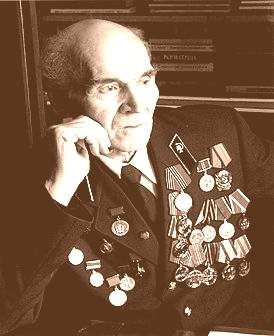
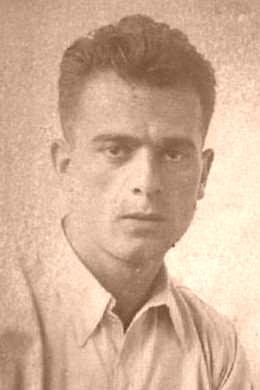

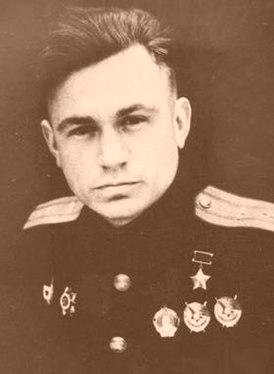

Vladimir Kozulin
He was born in a peasant family. My father, Nikolai Kozulin, came from a poor family. His father, my grandfather Fadey, was drafted into the army during the World War I and died at the front.
“I was conscripted in September 1944. The call took place on the Komsomol set in the air force. We were called to Bagdarin for a Commission before that in the summer. We walked from Tsipikan to Bagdarin and back.
After saying goodbye to family and friends, we, ten people, went on foot to Verh-Tsipikan, to the airport. The next day we boarded a large four-engine TB-3 aircraft (a heavy bomber converted to a transport plane) and flew to Chita.
All of us were on the plane for the first time. We clung to the cracks of the fuselage, looking at the ground passing under us, completely covered with forest. From Chita Airport (Kadali) we were taken by rail to Ulan-Ude. For almost all of us, the railway was a novelty. In Ulan-Ude, we passed the Commission. I was assigned to the 53rd School of Junior Aviation Specialists, which was located in the village of Domna in the Chita Region. Together with me, Vasily Kurdyukov (the village of Baunt), Vladimir Vikulov and Viktor Kislitsyn (Uakit) came from our district. We arrived at the aviation school at the end of September. We were dressed in military uniforms and assigned to the 4th Company, the commander of which, as I remember now, was Captain Vorontsov. At first, I was assigned to the group of masters in aviation radio equipment, and soon, I don't know why, I was transferred to the group of masters in aviation armament. I studied machine guns, cannons, rockets, bombs, and aircraft equipment for nine months. The end of the war with Germany coincided with the end of school. We had just sat down in the classroom for classes on May 9, when an officer ran into the school building and shouted at the top of his voice: "the War is over! Victory!” Everyone jumped up, what kind of classes are there? Soon, the school personnel was lined up on the garrison parade ground, the head of the school congratulated everyone on the victory and declared the day free from classes.
After a while, all those who completed their studies were assigned to units. I was assigned to the 921st Assault Aviation Regiment, which was based at the 77th Division in the Chita Region. My new duty station was 3rd squadron, 2nd wing. There were three planes. I had two subordinates, two privates, Fomin and Seredkin at my disposal. Both were about forty or slightly older. For me, when I was eighteen, they were old people. As I now imagine, and it becomes funny to me, as these two guys both solid with pity looked at me. I was skinny, only 50 kilograms and no more. But they looked at me as their direct superior. It is impossible to remember without laughter how I "learned" master tried to teach them how to handle weapons, but, in the end, they taught me the correct operation with weapons in the field and in combat. At first, they did not allow me to do the hard work: remove weapons from the plane, hang bombs, and clean the material parts. I always remember them with gratitude! For the first time in the regiment, I saw girls who were motorists, instrument makers, parachutists. Before the war with Japan, they were demobilized.
At the end of July, the order came to load into trucks and relocate to one of the "squares" of Mongolia bordering Manchuria. We rode through the Mongolian steppe, admired its vastness, and marveled at the equanimity of its native tarbagans.
When we on Studebaker arrived in our "square", there already was an aircraft of our regiment. We stood in this "Square" for several days, lived in tents, like on a camping trip. At night of from August 8 to 9, 1945, everyone was woken up by a strong growing hum. We jumped out of the tents. The entire steppe was flooded with light from end to end. It was as if a large tank column was rushing straight to our parking lot. The column skipped past, almost hitting the last plane and our tents. The tanks were moving towards the border of Manchuria. There was no sleep. In the morning, the regiment was lined up, and the regiment commander, Major Simagin, reported that the Soviet Government had declared war on Japan.
The planes were refueled and the weapons were loaded. A convoy of vehicles came up and we crossed the border in the area of Khalun-Arshan and Solun. In Solun, where the Japanese had established a Spa on a mineral spring, we enjoyed bathing in a pit lined with marble slabs, and for so long that we had to be helped out of this wonderful bath.
Then there was a pass over the Khingan Ridge, all littered with broken tanks, guns, planes, vehicles and other military equipment. At one of the railway stations, I don't remember the name, our aircraft bombed a train with Japanese cadets. We, who had not yet smelled gunpowder, were afraid to look at the burning cars and corpses. Bodies were strewn everywhere and machines were moving over them. A cadaverous smell and the smell of burnt meat. At nights our convoys and military units were attacked by the Japanese remaining in the rear of the group. There were cases when everyone was slaughtered. Wells with drinking water were filled up with corpses, river water was also unusable for drinking, it floated the corpses of Japanese soldiers.
Our regiment stopped near the town of Vanimo. Our planes flew to bomb and attack from the field airfield.
I remember a curious incident. I was on duty, guarding the aircraft parking lot. Before the start of the shift, the head of the guard and the duty officer warned that the Japanese tried to blow up planes in the neighboring regiment at night. I walk around the row of planes and suddenly saw someone standing at the last plane. My heart sank. I carefully unslung my rifle and crept around the plane, looking around for anyone behind me. Quietly, almost to myself, I said: "Hands up, I will shoot!". He was silent. And then the moon came out from behind the clouds, illuminated the "enemy". The enemy turned out to be a balloon with compressed air. I think it took a long time to hiccup from my words to the one who did not remove the balloon from the plane.
Late one evening the whole steppe was lit up by fire. Rockets flew into the air, tracks from cannon and machine-gun fire, rifle and pistol shots. Everyone fired what they could. This was the end of the war with Japan. We did not stend for long under Wangmao. The gratitude of the Supreme Commander-in-Chief I. V. Stalin was announced to everyone, and our 316th Assault Air Division was named Mukden. The order to return home, to the Homeland we received somewhere in the middle of September”.
0 comment



2026 © Russian Military Historical Society Developed by Jetmix