


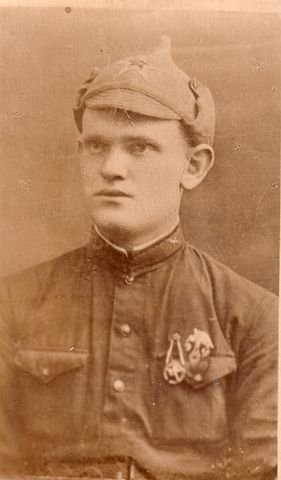
Gavrilov Ivan Samsonovich
Rank: Junior Sergeant. Type of service: Ground Forces, Air Force (except naval aviation), the Coast Guard, the NKVD troops, the border guards. Division: 163d Rifle Romnensk-Kiev order of Lenin Red Banner order of Suvorov and Kutuzov division. My uncle Ivan Samsonovich Gavrilov, was born in 1912 in the family of a worker in Khanzhenkovo village, Taganrog district of the Don Army Region of the Russian Empire (now in the city of Makeyevka, Donetsk region of Ukraine). He graduated from seven classes of secondary school in Khanzhenkovo village and the school of apprenticies at the mine No. 21. He worked in the mines of Makeyevka as a foreman and assistant .In July 1941, Ivan Samsonovich was sent to Karaganda, where he worked at mine No. 12 as the head transport department. In June 1942, among the volunteers, he was sent to develop the Pechora coal basin. He lived in the Kozhvinsky district of the Pechora district of the Komi ASSR in the town of chekists. He worked as an assistant at the mine No. 1/2, then as the head of the section of mine No.4. On March 8, 1943 I.Gavrilov was drafted into the Red Army by the Kozhvinsky district military Commissariat. After a short training course, Junior Sergeant Gavrilov was sent to the 1318th Rifle Regiment of the 163d Rifle Division of the 27th Army of the Voronezh front. Ivan Samsonovich served in active Army from April 14, 1943 as a squad leader of the 3rd Rifle Batallion. Until August 1943, the 27th Army was in the front reserve and went on the offensive in August 1943 during the Belgorod-Kharkiv operation of the battle of Kursk. The battle for the Dnieper began very soon. He reached the Dnieper river opposite Kiev at the end of September 1943 as part of the 6th Guards Army, then the 38th Army, the 163d Rifle Division, he liberated the cities of Romny and Priluki during the Sumy-Priluki offensive operation of the Voronezh front. The first attempt to cross the river was unsuccessful. The second attempt was made by the division's regiments South of Kiev near the village of Bortnichi. The 1318th Rifle Regiment had to cross the Dnieper river at the southern edge of Kiev in the area of Zhukov island. On the night of October 2, 1943, the Rifle Department headed by Junior Sergeant I. S. Gavrilov forced the water barrier, attacked the German positions and captured the trenches. The enemy launched five counterattacks to destroy the landing party, but all attacks were repulsed by the squad with great damage to the enemy. Thanks to the actions of Gavrilov's squad, the rest of the regiment successfully crossed the Dnieper and soon liberated the village of Chapayevka on the outskirts of Kiev. On October 29, 1943, Sergeant Ivan Samsonovich Gavrilov was awarded the title Hero of the Soviet Union by decree of the Presidium of the Supreme Soviet of the USSR for successful crossing the Dnieper river, for firm securing of a bridgehead on the Western Bank of the Dnieper river, and for his bravery and heroism. In early November 1943, the 163rd Rifle Division was transferred to the Lutezhsky bridgehead. Ivan Samsonovich took part in the Kiev offensive and defensive operations (from the end of November 1943 as part of the 40th army of the 1st Ukrainian front). At the end of December 1943 I. S. Gavrilov was seriously wounded in the battle of Fastov. Ivan Samsonovich was evacuated to a hospital in the village of Stavishche, but could not be saved. He died of his wounds on January 2, 1944. I. S. Gavrilov was buried in the village of Stavishche, Kiev region of Ukraine."
0 comment



2026 © Russian Military Historical Society Developed by Jetmix