


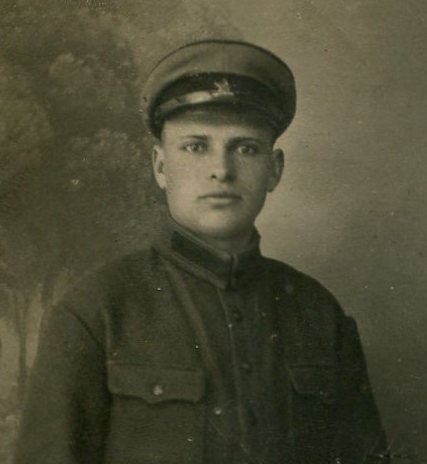

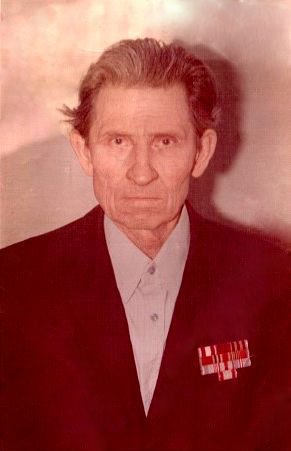


Ivan Bezrukov
Rank: Corporal
Branch of Service: Army Corps of Engineers
Unit: 313th Svir-Petrozavodsk Double Red Banner Order of Suvorov and Kutuzov Rifle Division
I am Lydia Golova, granddaughter of Ivan Bezrukov.
I want to tell you about my grandfather.
Ivan Bezrukov was born in Simbirsk Province (now Ulyanovsk Region) in 1906 in a large family. He lived in the village of Mullovka, in the Melekessky District of the Ulyanovsk Region, and worked as a carpenter for a distillery. At the time when the Great Patriotic war broke out, the grandfather was married and had five children, the eldest daughter was only twelve years old, and the youngest son was not even a year old.
On the second day of the war, he was conscripted into the Red Army. The carpenter's profession was useful to him in the war. Ivan was appointed Squad Leader of the 139th Separate Bridge-building Battalion. He fought on the Karelian Front and ended the war in Poland, on the 2nd Belorussian Front. He liberated the Polish cities of Gdansk, Gdynia. He fought on the Karelian Front in 1942. It was necessary to build a bridge over the White Sea-Baltic Canal within four days. In a bad roads conditions the Squad Commander I. Bezrukov together with his unit completed the task in two days.
For this, and for his courage in the battles with the Finnish and German invaders, corporal Bezrukov was awarded the medal For Military Merit. The medal For Bravery he received for showing himself in the construction of the crossing under heavy enemy artillery fire, thanks to which the units of the Petrozavodsk Rifle Division quickly crossed to the enemy-occupied shorebank and developed a rapid offensive. My grandfather received the order of Glory, 3rd class in May 1945.
This happend on the Belorussian front in the 313th Petrozavodsk Rifle Division. He under heavy enemy fire transported soldiers by boat across the Strait of Divenow. When he moved all the fighters, he transported ammunition, and from there the wounded. In total, he made four flights and personally transported eighteen wounded soldiers and officers. Fortunately, during the entire war, he did not have any contusions or injuries. He was discharged from the Soviet Army in October 1945. He returned to his family and his company, where he worked until his retirement. He died in 1981 due to lung disease. Perhaps it was the hardships of the war that shook his health and did not allow him to live to a ripe old age. He brought up five children, ten grandchildren and even two great-grandchildren with dignity. We, the grandchildren, passed on the memories of our grandfather to our children and grandchildren, and we are all very proud to be part of his family. Every year, on May 9, we, his grandchildren and great-grandchildren, stand in line with him, marching with the Immortal Regiment.
On the photo, the grandfather with his family, May 9, 1950 and in the mid-1970th with the youngest grandson and our grandmother. The third photo shows the march of the Immortal Regiment in Dimitrovgrad, Ulyanovsk Region, 2016.
Ivan Bezrukov
Rank: Corporal
Branch of Service: Army Corps of Engineers
Unit: 313th Svir-Petrozavodsk Double Red Banner Order of Suvorov and Kutuzov Rifle Division
I am Lydia Golova, granddaughter of Ivan Bezrukov.
I want to tell you about my grandfather.
Ivan Bezrukov was born in Simbirsk Province (now Ulyanovsk Region) in 1906 in a large family. He lived in the village of Mullovka, in the Melekessky District of the Ulyanovsk Region, and worked as a carpenter for a distillery. At the time when the Great Patriotic war broke out, the grandfather was married and had five children, the eldest daughter was only twelve years old, and the youngest son was not even a year old.
On the second day of the war, he was conscripted into the Red Army. The carpenter's profession was useful to him in the war. Ivan was appointed Squad Leader of the 139th Separate Bridge-building Battalion. He fought on the Karelian Front and ended the war in Poland, on the 2nd Belorussian Front. He liberated the Polish cities of Gdansk, Gdynia. He fought on the Karelian Front in 1942. It was necessary to build a bridge over the White Sea-Baltic Canal within four days. In a bad roads conditions the Squad Commander I. Bezrukov together with his unit completed the task in two days.
For this, and for his courage in the battles with the Finnish and German invaders, corporal Bezrukov was awarded the medal For Military Merit. The medal For Bravery he received for showing himself in the construction of the crossing under heavy enemy artillery fire, thanks to which the units of the Petrozavodsk Rifle Division quickly crossed to the enemy-occupied shorebank and developed a rapid offensive. My grandfather received the order of Glory, 3rd class in May 1945.
This happend on the Belorussian front in the 313th Petrozavodsk Rifle Division. He under heavy enemy fire transported soldiers by boat across the Strait of Divenow. When he moved all the fighters, he transported ammunition, and from there the wounded. In total, he made four flights and personally transported eighteen wounded soldiers and officers. Fortunately, during the entire war, he did not have any contusions or injuries. He was discharged from the Soviet Army in October 1945. He returned to his family and his company, where he worked until his retirement. He died in 1981 due to lung disease. Perhaps it was the hardships of the war that shook his health and did not allow him to live to a ripe old age. He brought up five children, ten grandchildren and even two great-grandchildren with dignity. We, the grandchildren, passed on the memories of our grandfather to our children and grandchildren, and we are all very proud to be part of his family. Every year, on May 9, we, his grandchildren and great-grandchildren, stand in line with him, marching with the Immortal Regiment.
On the photo, the grandfather with his family, May 9, 1950 and in the mid-1970th with the youngest grandson and our grandmother. The third photo shows the march of the Immortal Regiment in Dimitrovgrad, Ulyanovsk Region, 2016.
0 comment



2026 © Russian Military Historical Society Developed by Jetmix