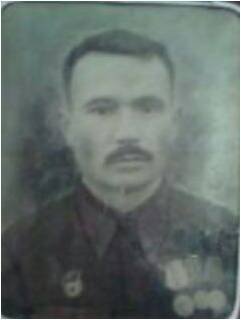


Aristakes Bardakchiyan
Branch of service: Artillery.
Rank: Red Army Soldier.
Born on January 14, 1917 in the village of Chaltyr, Myasnikovsky District, Rostov Region. In 1931, he graduated from Chaltyr High School and entered the Armenian Pedagogical College in Nakhichevan. Since 1933, in the ranks of the Komsomol, he was a member of the Komsomol Committee. After graduating from the pedagogical technical school, he worked as a geography teacher in grades 5-7 and head of the educational part of the school #13 named after KIM of Leninavansky Village Council Myasnikovsky District, Rostov-on-Don Region. He was elected to the Chaltyrsky Council of workers', peasants' and red army deputies of the Myasnikovsky District, North Caucasus Region. In 1937, he entered the Rostov-on-Don State University named after V. Molotov to study geography (correspondence Department).
He was called up for active military service in the Red Army and enlisted as a cadet in an artillery regiment in the Leningrad region in 1939. He was transferred to the border regiment that took part in the Soviet-Finnish war in 1939-1940 in 1940. In a letter dated March 18, 1940, he wrote: "on March 9, more than 1,000 people went on a campaign in full military uniforms. They took guns with them. Some moved on foot, others on skis, others on horseback. I was skiing. Every day we walked 20-25 km. We spent the night in the villages we passed through. As a result, we reached a mountainous area and a dense forest with large trees. In the forest, the snow was higher than my head. Guns were fired from this spot. The shells flew far away and exploded there. In total, they covered about 220 km there and the same distance back. It's amazing that I've never skied before, but I've covered such a distance calmly. When we were on the campaign, many were sent to Finland and all of our Armenians including Termolyan Asvatur. Another unit of our regiment is now in Finland. Bahagiyan Ruben is there too. I received two letters from him. They say that another unit will be sent there on the 29th. Maybe I'll get there, too. While I'm here, only the Russian guys, my good friends, have already left. After the hike, I read your letters, previously written and Galusta, too. He writes that he is in a very difficult situation. Now the war is over, but I don't know where he is. I sent a telegram to the old address, but there is no response. I don't know how he is now, but he was in the most difficult conditions. Maybe he'll write to me, or if you get a letter from him, let me know."
After the end of the Soviet-Finnish war, he served on the border with Finland. In a letter dated 13.06.1940 wrote: "I am now on the land where my brother fought for more than a month in a terrible fire. On the land where our brothers and thousands of soldiers fought, shed blood and acquired these lands so that our great city of Leningrad could be located beyond the border. Now we have come to protect these lands, our new Union borders, to protect our homeland. Our border regiment is located 12 km from the border and 20 km from the city of Vyborg."
In 1941, after the beginning of the Great Patriotic War, he fought against the Germans on the Finnish front. In a letter dated 26.07.1941, he wrote: "...there are often difficult moments. Suddenly, the shelling begins and all around, shells fall on all four sides, bullets whistle... starting from the 14th, we are in the thick of the war. What will you do in the line of duty. Don't worry too much about us, live your life, and what will happen to us will happen. If there is at least a piece of luck, we will remain alive, if not, then ... " in a letter dated 28.07.1941 (the last letter) wrote: "I don't have any Armenians with me, and the Russian guys are not the ones I served with before. When the war started, I was sent further North. Shells often fall here, they bomb and machine-gun us from planes. In between, there is no fear. Shells fall, we lie down, after the explosion we rise, of course, we must be careful. We don't think too much about it. For example, we go by truck, I play the mandolin (found here), and shells explode from four sides… Now I'm sitting in the trench, writing this letter and looking ahead. In front of us at a distance of about 1 km two villages and a little further other villages are burning covered with extensive flames. Write a lot of letters to let me know about you. As long as I live, I will try to write as much as possible."
Aristakes Bardakchiyan
Branch of service: Artillery.
Rank: Red Army Soldier.
Born on January 14, 1917 in the village of Chaltyr, Myasnikovsky District, Rostov Region. In 1931, he graduated from Chaltyr High School and entered the Armenian Pedagogical College in Nakhichevan. Since 1933, in the ranks of the Komsomol, he was a member of the Komsomol Committee. After graduating from the pedagogical technical school, he worked as a geography teacher in grades 5-7 and head of the educational part of the school #13 named after KIM of Leninavansky Village Council Myasnikovsky District, Rostov-on-Don Region. He was elected to the Chaltyrsky Council of workers', peasants' and red army deputies of the Myasnikovsky District, North Caucasus Region. In 1937, he entered the Rostov-on-Don State University named after V. Molotov to study geography (correspondence Department).
He was called up for active military service in the Red Army and enlisted as a cadet in an artillery regiment in the Leningrad region in 1939. He was transferred to the border regiment that took part in the Soviet-Finnish war in 1939-1940 in 1940. In a letter dated March 18, 1940, he wrote: "on March 9, more than 1,000 people went on a campaign in full military uniforms. They took guns with them. Some moved on foot, others on skis, others on horseback. I was skiing. Every day we walked 20-25 km. We spent the night in the villages we passed through. As a result, we reached a mountainous area and a dense forest with large trees. In the forest, the snow was higher than my head. Guns were fired from this spot. The shells flew far away and exploded there. In total, they covered about 220 km there and the same distance back. It's amazing that I've never skied before, but I've covered such a distance calmly. When we were on the campaign, many were sent to Finland and all of our Armenians including Termolyan Asvatur. Another unit of our regiment is now in Finland. Bahagiyan Ruben is there too. I received two letters from him. They say that another unit will be sent there on the 29th. Maybe I'll get there, too. While I'm here, only the Russian guys, my good friends, have already left. After the hike, I read your letters, previously written and Galusta, too. He writes that he is in a very difficult situation. Now the war is over, but I don't know where he is. I sent a telegram to the old address, but there is no response. I don't know how he is now, but he was in the most difficult conditions. Maybe he'll write to me, or if you get a letter from him, let me know."
After the end of the Soviet-Finnish war, he served on the border with Finland. In a letter dated 13.06.1940 wrote: "I am now on the land where my brother fought for more than a month in a terrible fire. On the land where our brothers and thousands of soldiers fought, shed blood and acquired these lands so that our great city of Leningrad could be located beyond the border. Now we have come to protect these lands, our new Union borders, to protect our homeland. Our border regiment is located 12 km from the border and 20 km from the city of Vyborg."
In 1941, after the beginning of the Great Patriotic War, he fought against the Germans on the Finnish front. In a letter dated 26.07.1941, he wrote: "...there are often difficult moments. Suddenly, the shelling begins and all around, shells fall on all four sides, bullets whistle... starting from the 14th, we are in the thick of the war. What will you do in the line of duty. Don't worry too much about us, live your life, and what will happen to us will happen. If there is at least a piece of luck, we will remain alive, if not, then ... " in a letter dated 28.07.1941 (the last letter) wrote: "I don't have any Armenians with me, and the Russian guys are not the ones I served with before. When the war started, I was sent further North. Shells often fall here, they bomb and machine-gun us from planes. In between, there is no fear. Shells fall, we lie down, after the explosion we rise, of course, we must be careful. We don't think too much about it. For example, we go by truck, I play the mandolin (found here), and shells explode from four sides… Now I'm sitting in the trench, writing this letter and looking ahead. In front of us at a distance of about 1 km two villages and a little further other villages are burning covered with extensive flames. Write a lot of letters to let me know about you. As long as I live, I will try to write as much as possible."
0 comment




2026 © Russian Military Historical Society Developed by Jetmix