Images of War
Images of War
Images of War
Images of War
RU
EN
Send a photo
Topics
CAMD
Russia-Serbia Belgorod-Belgrade
Donbass 2014-2025, SWO
We accuse - only facts
Heroes and feats
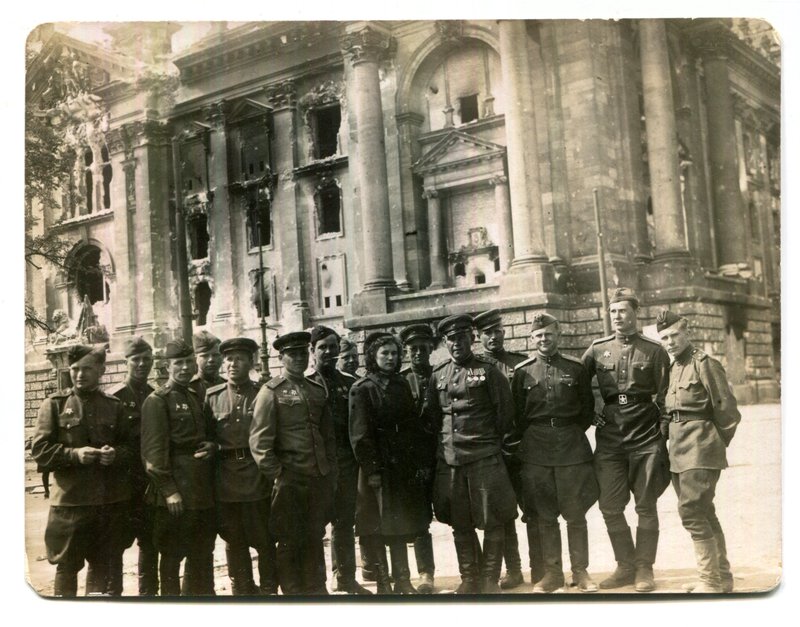
N.P. Khazov with his military comrades.
N.P. Khazov (on the left) with his comrades. March 1945
To favorites
After the crossing of the Basia River
Andrey Zherebtsov was born in the village of Krotovo in the Dovolensky District of the Novosibirsk Region on September 11, 1911. Rank: Specialist. In the Red Army from 08.09.1942, called up by the Topkinsky District Military Commissariat of the Topkinsky District of the Novosibirsk Region (until 01.01.1943 Topkinsky District was part of the Novosibirsk Region). Unit of service: 1111 Rifle Regiment, 330 Rifle Division, 2nd Belarusian Front. Date of the feat: 25.06.1944. Medal For Bravery, order of 13.07.1944 Presidium of the Supreme Soviet of the USSR. Squad Leader of the 3rd Rifle Battalion, Specialist A. Zherebtsov in the battle of 25.06.1944 for the town of Chausy of Mogilev Region crossed the Basya River and was the first to break into the city with his squad.
To favorites
Afanasy Markovich Bedov, serviceman
Afanasy Markovich Bedov, serviceman Afanasy Markovich Bedov. The photo was taken in 1941 during the conscription at the military registration and enlistment office in the village of Aginskoye, Sayansky area, Krasnoyarsk Region. This is the last photo of Afanasy Markovich, because he was wounded in the battle for the Socialist Motherland, died on February 19, 1942 and was awarded posthumously. He is buried in the village of Arefino, Chudovsky District, Leningrad Region.
To favorites
Nikolay Kokorev
Nikolai Kokorev before he was sent to the front in August 1943. Nikolay participated in the fighting on the 1st Baltic Front in the 89th Tank Brigade as a mechanic-driver of the T-34 tank. He was awarded the medal For Bravery on July 26, 1944.
To favorites
Alexey Andreevich Snytko
Alexey Andreevich Snytko Alexey Andreevich Snytko. The photo dated to the post-war years, when he had already returned from the front and lived with his family. Alexey Andreevich went through the whole war from August 1941 to September 1945. Much has happened to him during the war. He received the Order of War of 2nd class, was wounded.
To favorites
Komsomol seminar
Komsomol seminar The picture was taken in the Hungarian city of Miskolc. Now it is kept in the personal file of the participant of the Great Patriotic -War Mirchenko (Kobernik) Lyubov Ivanovna. The ranks and surnames are written in neat handwriting on the back of the photo: Major Baytsev, Senior Lieutenant Molchanov, Maksimova, Kobernik, Fedorova, Lane, Sukhanov, Galushkina, Drobkov, Gaidukov, Mironova, Vorobiev, Maslova, Romanova. The author of the photo captured the seminar of the Komsomol agents of the 82nd Separate Anti-aircraft Artillery Division of the Air Defense, where Corporal Lyubov Mirchenko served as an instrument operator from April 1942 to August 1945
To favorites
Kroshchenko Ivan Ilyich
Kroshchenko Ivan Ilyich was born in July 1930 in the Ukrainian city of Akhtyrka, Sumy region, in a large family. The father worked at the factory, the mother was a housewife. Ivan was 11 years old when the war began. Already on August 23, 1941, that part of Ukraine where the Kroshchenko family lived was occupied by the Germans. After the liberation in August 1943, life in the city improved. The school continued classes interrupted during the occupation; it was possible to walk around the city and go to the forest without a fear. After graduating from the mechanization technical school in Akhtyrka in 1949, the new specialist with a mechanic diploma left for distribution to Moldova, but returned home a year later. He worked at the Kharkov plant. Labour roads brought him to the Tambov region in 1953,the Pichaevsky district. He worked as a senior mechanic for labour-intensive processes at MTS, later as a chief engineer. After graduating from the Michurinsk Fruit and Vegetable Institute, he worked at engineering position in the state farm "Rudkovsky" for some time. In the early 1970s, I. Kroshchenko was transferred to the collective farm "Collectivist" in the Nikiforovsky district, where he worked for almost ten years. The last time before his retirement, Ivan Ilyich worked as deputy manager for trade in the Nikiforovskaya agricultural machinery association. For conscientious work Ivan Ilyich was awarded medals: "For Labour Distinction", "For Valiant Labour", numerous certificates of honour.
To favorites
Zemskikh Nina Vasilievna
Zemskikh Nina Vasilievna was born on November 29, 1928 in the Staroyuryevsky district in a large family. When the war began, Nina Vasilievna studied at school. Father and elder sister went to the front from the first days of the war. Younger children up to the age of seven helped the collective farm to collect spikelets in the field, and some older ones weeded rye. They sowed makhorka on the collective farm. Nina Vasilievna and five other girls organized a brigade and worked in the makhorka fields all summer. The norm for each teenager was 0.5 hectares, they worked from early morning until late night, and in the evening they still managed to help their mother around the house, cultivated their own garden. The collective farm provided bread for the workdays earned, but the portions were very small. After graduating from school, she wanted to continue her studies at college, but for family reasons, she did not enter the college immediately. She lived in a hostel, slept on mattresses filled with grass or straw. In the post-war period she worked and studied. She graduated from the Pedagogical Institute and worked at school. She was awarded with jubilee medals and certificates of honour.
To favorites
Borisova Anna Efimovna
Born on October 1, 1922 in the city of Uvarovo, she began her career in September 1939 and was appointed as a teacher of German language at the Lebyazhievsk school of the Uvarovsky district, where she worked until March 1944. From March 1944 to February 1960, she worked as the second and then as the first secretary of the Komsomol Labour Committee, held the positions of assistant secretary of the Labour Committee, propagandist, instructor of the Communist Party. In April 1960 she was elected a chairman of the workers' committee of the "Uvarovsky" state farm, where she worked until November 1970. Then she worked as the head of the reading room of the Uvarov city library, the inspector of the personnel department of the Autocolumn No. 1804. After retiring to a well-deserved rest in October 1977, Anna Efimovna continued to be socially active as a member of the “Union of Pensioners of Russia LLC”, conducting a great patriotic educational work among the youngsters of the city. Anna Efimovna was instructed to take part in the creation of Uvarovo Book of Memory. During the war years, she acquired 2 lottery tickets, won 10 thousand roubles and gave this money to the creation of the column "Tambov collective farmer". She dreamt of bringing Victory closer! In 2010 A.E.Borisova supported the initiative to raise funds for the reconstruction of the memorial to the fallen soldiers in the city of Uvarovo. She was not indifferent to what was happening in our city: in which conditions veterans lived, how the issues of improving medical services were being resolved, the state of patriotic education of young people and much more. Considering the long-term and fruitful socially significant activity for the benefit of the city Borisova Anna Efimovna was awarded the title of "Honorary Citizen of the city of Uvarovo" by the decision of the City Council of People's Deputies on October 12, 2000 (the title was awarded by the decision of the Uvarovsky City Council of 10/12/2000 # 381)
To favorites
Krasnova Tatyana Efimovna
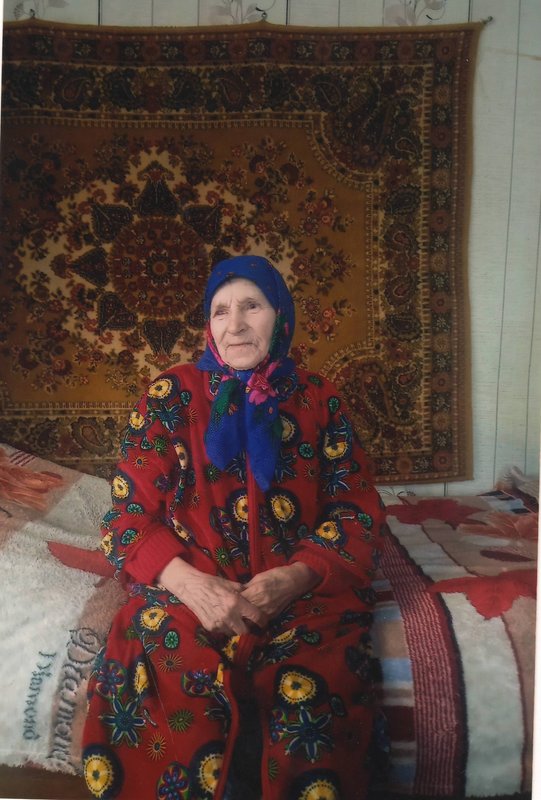
Krasnova Tatyana Efimovna Krasnova Tatyana Efimovna was born on November 6, 1923 in the village 1-Peresypkino. She turned 17 when the Great Patriotic War began. As soon as the war began, together with friends she was sent to dig trenches near Morshansk, later was sent to Moscow, from there was sent to the Urals, where she worked at a logging factory. Arriving home, she worked on a collective farm in sowing, harvesting from early morning till late night. All of them worked very hard, because they wanted the war to end sooner and all relatives, friends and acquaintances to return home. When the war ended, she married a participant in the Great Patriotic War Nikolai Alekseevich Krasnov, who went through the entire war and returned to his homeland. They lived together for 58 years. In the post-war years, she worked as a milk collector on a collective farm, also in seasonal work. Lives lonely.
To favorites
Shamova Maria Alexandrovna
Shamova Maria Alexandrovna. Was born on November 25, 1929 in the village of Olshanka. In 1937, she went to the Olshansk eight-year school. In 1944, she finished 7 classes. “From the radio message we learned that the war had started, the screams of women spread throughout the village. People were crying and screaming. My father was taken to the military registration and enlistment office right from the field on the first day of the war. He died in 1942 near Smolensk. Mom had three daughters left, she worked all the time on the collective farm in various jobs. We also took part in the work both in the field and in the warehouses. I had to work not only on holiday, I was released from school to help during sowing and harvesting. What kind of work did the schoolchildren take part in? We created guard posts for bread protection, carried out raids on readiness checks on collective farms for field work, collected ears, fertilizers, cut the tops of potato tubers for planting, looked after young growth on livestock farms, made shields for snow retention. The main rear occupation for children and adults during the war years was labour, hard and painstaking, which made it possible to provide those living in the rear with some kind of food and provide all possible assistance to the front. In the beginning, women and children had to learn to do everything without men, with their own hands. All those women and children managed to survive ”- says Maria Alexandrovna.
To favorites
Safronova (Alekseeva) Raisa Andreevna.
Safronova (Alekseeva) Raisa Andreevna. Safronova (Alekseeva) Raisa Andreevna was born on April 7, 1928 in the village of Sinyavka. Her family also had a sister and 4 brothers. She studied at the Sinyavskaya school. Before the war, she managed to finish 4 classes. The Great Patriotic War began. Father and three brothers went to the front. Two older brothers: Peter and Ivan died. Father and brother Alexei returned home. Sister Masha was sent to the Urals to work at a factory. In wartime, Raisa Andreevna, like all children, worked on a collective farm. Teenagers worked 12 hours a day or more. Despite hunger and cold and such a hard life in general, people tried to celebrate the holidays. Raisa Andreevna recalls: “A holiday was held when all the bread was harvested and the threshing was over. We sang songs, danced, played different games. Both children and old people had fun. There were no drunks, everyone was sober. Most often, we were invited to different houses as no one had a lot of food. " After the war, Raisa Andreevna married. They had four children in their family. She worked as a handy woman on the collective farm until her retirement. Now lives with her husband Mikhail Stepanovich Safronov in the village of Polyakovo.
To favorites
Safronov Mikhail Stepanovich
Safronov Mikhail Stepanovich was born on December 28, 1930 in the village of Polyakovo. The family had two more daughters. He studied at the Polyakovskaya school, but finished only 2 classes when the war began. His father went to the front and Misha had to go to the collective farm to work. He took on any job, so there was no time to get bored. The boy shepherded horses, carried hay and firewood. Summer was usually the hardest time to harrow and plough the field, he almost had to live in the field. From morning to late evening they had much of work, and did it together with friends. Then, in general, people were more friendly, helped in everything. There was something to do for teenagers. There was no other way. After all, it was impossible to put everything on the shoulders of women, so they worked, saving their mothers. There was no need to beg anyone, they just knew they had to. But even so, he talks about his childhood like a happy time. Although it was “barefoot”, complete mutual understanding reigned between kids, they even managed to have fun. Two more uncles from the family fought at the front: Uncle Petya and Uncle Ivan. At the end of the war, both father and uncles returned home. After the war, Mikhail Stepanovich worked in his native collective farm as a groom, a shepherd, a watchman. He is a very hard-working and respectable person. He lives with his wife Raisa Andreevna, who is also worker in the rear. They have a son and two daughters.
To favorites
Agapova Anastasia Filippovna.
Agapova Anastasia Filippovna. Agapova Anastasia Filippovna was born in the village Gavrilovka the 1st in 1924. She grew up without a father. Their uncles helped them with their mother. All three went to the front when the war began: Zaikov Arseny Yegorovich, Zaikov Nikita Yegorovich, Zaikov Alexey Yegorovich. All three were missing. During the war, Anastasia Filippovna worked at the "Glavtabak" plant. Together with her fellows she went to dig trenches in Morshansk. It was very difficult because there were not enough shovels, it was very cold in winter and autumn. Mutual help and support saved them all in difficult times. They endured all the difficulties, they were young and believed that all this would come to an end. They understood, it was not easy at the front, they did not lose faith in victory. " Four years of war dragged on for a long time, but May 1945 finally came. When people learned about the Victory, everyone was very happy, poured out into the street, hugged each other, kissed and cried at the same time. The widows of the dead cried especially. Everyone began to wait for those who stayed alive " Since 1955, Anastasia Filippovna worked as a school technician until she was 70 years old. All children called her "beloved aunty Nastya".
To favorites
Krapivina Anastasia Andreevna.
Krapivina Anastasia Andreevna. Krapivina Anastasia Andreevna was born on December 18,1927 in the village Sofyino. There were four kids in the family. The most difficult memory of the war is when they received funerals for their dead relatives. She lost her father. During the war Anastasia Andreevna worked on a tractor, also from time to time she was a handywoman and was sent to dig trenches in the Tula region together with her friends. Latee she returned to the collective farm. She remembers that on Victory Day, on May 9, 1945, a brigadier came to the field and said that the war was over. Victory! They were given one day off, the first one in a very long period. After the war, she again worked as a tractor driver, manualed the seeders, worked at a mill, was a handywoman. She never got married, now she lives alone.
To favorites
1
. . .
266
267
268
. . .
640
Show more
2026 © Russian Military Historical Society
Developed by Jetmix