


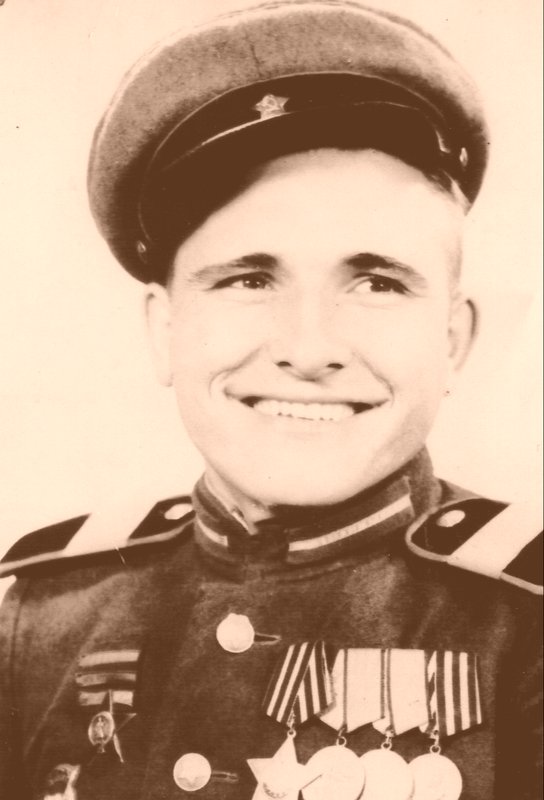


Osikov Nikolai Stepanovich
Nikolay Osikov was born in 1910 in the Donbass Region, in the mining village of Titovo (now Lisichansky District of the Luhansk Region). Before the war, he worked for Metrostroy, where he was one of the best managers of shield drilling. He was relieved from military service - but when a particularly difficult situation developed near the capital in the autumn of 1941, Nikolai went to the front._x000D_
With a group of fighters, he crossed the front line and became the commander of a partisan unit in the forests of Mozhaisk Region. The partisans carried out raids on German headquarters, set them on fire and derailed the enemy’s trains. He was in the same unit as Zoya Kosmodemyanskaya. There were many girls in Nikolai Osikov's squad who, like Zoya, risked their lives and fearlessly performed important tasks._x000D_
In one of the battles, Osikov was seriously wounded, but managed to take out his comrade — in-arms, also a metrostroevets, Ilya Reznikov, from the battlefield. In this battle, Nikolai Stepanovich lost an arm, was treated in a hospital for a long time — but at the end of 1942, he again came to the construction site and led the advanced section on the construction of the Baumanskaya station._x000D_
For many years, Nikolai Stepanovich Osikov worked first in the production Department of the Metrostroy Department, then in the control room. He was a very responsible and very humble person. He did not like to talk about the war — and his colleagues learned about his feat, of course, not from him. But about Zoe and the other girls in his squad, he always spoke willingly, with pride and great respect. Zoe's last assignment, he said, was very difficult. At that time there was a German unit in Petrishchev — and it was almost impossible to set fire to the commandant's office building unnoticed._x000D_
Nikolai Stepanovich was awarded the order of the red Star and the order of the Patriotic war I degree._x000D_
"The heroism of the partisans and underground workers could not but be reflected in the architecture of the Moscow metro stations, which continued to be built during the great Patriotic war. Then seven new stations were built — three ("Novokuznetsk", "Paveletskaya" and "Avtozavodskaya") on the Zamoskvoretskaya line and four ("Baumanskaya", "Elektrozavodskaya", "Semenovskaya" and "Partizanskaya") on Arbatsko-Pokrovskaya. On each of them you will see a glittering gold inscription on marble slabs — "Built in the days of the great Patriotic war"._x000D_
At the station "Partizanskaya", on the platform at the first two columns, there are large sculptural figures of partisan heroes by the famous sculptor Matvey Genrikhovich Manizer-Muscovite Zoya Kosmodemyanskaya and a peasant from the Pskov region Matvey Kuzmin, who repeated the feat of Ivan Susanin in 1942._x000D_
According to the memoirs of his family, Nikolai Stepanovich rarely spoke about the war. Thank you to all those who have collected bits and pieces of information about the heroes of the war-so that their great-grandchildren do not forget their feat!
Osikov Nikolai Stepanovich
Nikolay Osikov was born in 1910 in the Donbass Region, in the mining village of Titovo (now Lisichansky District of the Luhansk Region). Before the war, he worked for Metrostroy, where he was one of the best managers of shield drilling. He was relieved from military service - but when a particularly difficult situation developed near the capital in the autumn of 1941, Nikolai went to the front._x000D_
With a group of fighters, he crossed the front line and became the commander of a partisan unit in the forests of Mozhaisk Region. The partisans carried out raids on German headquarters, set them on fire and derailed the enemy’s trains. He was in the same unit as Zoya Kosmodemyanskaya. There were many girls in Nikolai Osikov's squad who, like Zoya, risked their lives and fearlessly performed important tasks._x000D_
In one of the battles, Osikov was seriously wounded, but managed to take out his comrade — in-arms, also a metrostroevets, Ilya Reznikov, from the battlefield. In this battle, Nikolai Stepanovich lost an arm, was treated in a hospital for a long time — but at the end of 1942, he again came to the construction site and led the advanced section on the construction of the Baumanskaya station._x000D_
For many years, Nikolai Stepanovich Osikov worked first in the production Department of the Metrostroy Department, then in the control room. He was a very responsible and very humble person. He did not like to talk about the war — and his colleagues learned about his feat, of course, not from him. But about Zoe and the other girls in his squad, he always spoke willingly, with pride and great respect. Zoe's last assignment, he said, was very difficult. At that time there was a German unit in Petrishchev — and it was almost impossible to set fire to the commandant's office building unnoticed._x000D_
Nikolai Stepanovich was awarded the order of the red Star and the order of the Patriotic war I degree._x000D_
"The heroism of the partisans and underground workers could not but be reflected in the architecture of the Moscow metro stations, which continued to be built during the great Patriotic war. Then seven new stations were built — three ("Novokuznetsk", "Paveletskaya" and "Avtozavodskaya") on the Zamoskvoretskaya line and four ("Baumanskaya", "Elektrozavodskaya", "Semenovskaya" and "Partizanskaya") on Arbatsko-Pokrovskaya. On each of them you will see a glittering gold inscription on marble slabs — "Built in the days of the great Patriotic war"._x000D_
At the station "Partizanskaya", on the platform at the first two columns, there are large sculptural figures of partisan heroes by the famous sculptor Matvey Genrikhovich Manizer-Muscovite Zoya Kosmodemyanskaya and a peasant from the Pskov region Matvey Kuzmin, who repeated the feat of Ivan Susanin in 1942._x000D_
According to the memoirs of his family, Nikolai Stepanovich rarely spoke about the war. Thank you to all those who have collected bits and pieces of information about the heroes of the war-so that their great-grandchildren do not forget their feat!
0 comment




2026 © Russian Military Historical Society Developed by Jetmix